Q14. Determine the value integral (1)/(^n(x)* ^n(x)) dx

Mathematics
Q14. Determine the value integral (1)/(^n(x)* ^n(x)) dx

ScanSolve AI Answer

Answer

\tan x - \cot x + C

Right 🌹CONFIDENTIALITY, let's continue.

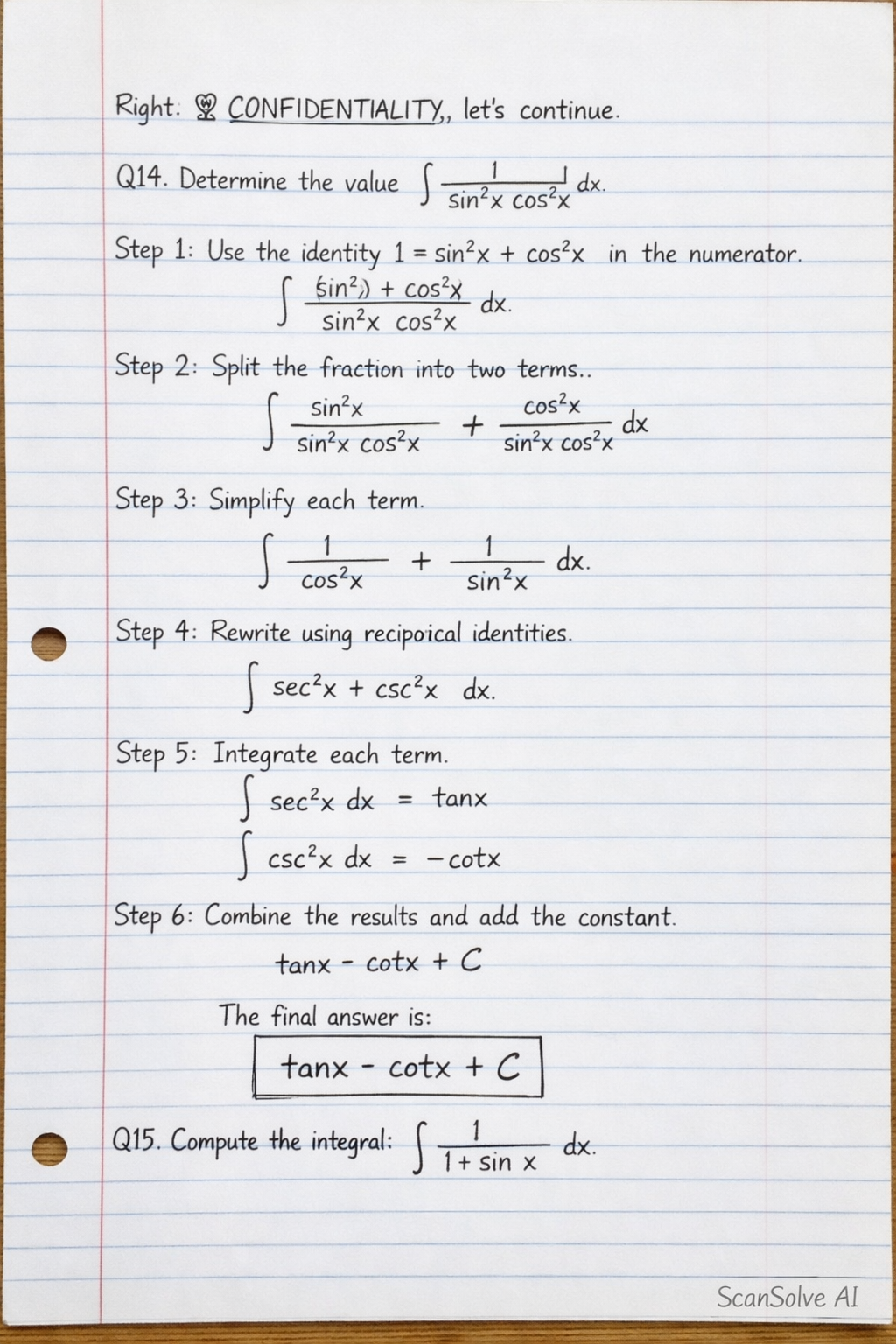
Q14. Determine the value 1sin2(x)cos2(x)dx\int \frac{1}{\sin^2(x) \cos^2(x)} \, dx

Step 1: Use the identity 1=sin2x+cos2x1 = \sin^2 x + \cos^2 x in the numerator. sin2x+cos2xsin2xcos2xdx\int \frac{\sin^2 x + \cos^2 x}{\sin^2 x \cos^2 x} \, dx Step 2: Split the fraction into two terms. (sin2xsin2xcos2x+cos2xsin2xcos2x)dx\int \left(\frac{\sin^2 x}{\sin^2 x \cos^2 x} + \frac{\cos^2 x}{\sin^2 x \cos^2 x}\right) \, dx Step 3: Simplify each term. (1cos2x+1sin2x)dx\int \left(\frac{1}{\cos^2 x} + \frac{1}{\sin^2 x}\right) \, dx Step 4: Rewrite using reciprocal identities sec2x=1cos2x\sec^2 x = \frac{1}{\cos^2 x} and csc2x=1sin2x\csc^2 x = \frac{1}{\sin^2 x}. (sec2x+csc2x)dx\int (\sec^2 x + \csc^2 x) \, dx Step 5: Integrate each term. sec2xdx=tanx\int \sec^2 x \, dx = \tan x csc2xdx=cotx\int \csc^2 x \, dx = -\cot x Step 6: Combine the results and add the constant of integration. tanxcotx+C\tan x - \cot x + C The final answer is tanxcotx+C\boxed{\tan x - \cot x + C}.

Q15. Compute the integral: 11+sinxdx\int \frac{1}{1+\sin x} \, dx

Step 1: Multiply the numerator and denominator by the conjugate of the denominator, (1sinx)(1-\sin x). 11+sinx1sinx1sinxdx\int \frac{1}{1+\sin x} \cdot \frac{1-\sin x}{1-\sin x} \, dx Step 2: Simplify the denominator using the identity 1sin2x=cos2x1-\sin^2 x = \cos^2 x. 1sinx1sin2xdx=1sinxcos2xdx\int \frac{1-\sin x}{1-\sin^2 x} \, dx = \int \frac{1-\sin x}{\cos^2 x} \, dx Step 3: Split the fraction into two terms. (1cos2xsinxcos2x)dx\int \left(\frac{1}{\cos^2 x} - \frac{\sin x}{\cos^2 x}\right) \, dx Step 4: Rewrite the terms using sec2x=1cos2x\sec^2 x = \frac{1}{\cos^2 x} and sinxcos2x=sinxcosx1cosx=tanxsecx\frac{\sin x}{\cos^2 x} = \frac{\sin x}{\cos x} \cdot \frac{1}{\cos x} = \tan x \sec x. (sec2xsecxtanx)dx\int (\sec^2 x - \sec x \tan x) \, dx Step 5: Integrate each term. sec2xdx=tanx\int \sec^2 x \, dx = \tan x secxtanxdx=secx\int \sec x \tan x \, dx = \sec x Step 6: Combine the results and add the constant of integration. tanxsecx+C\tan x - \sec x + C The final answer is tanxsecx+C\boxed{\tan x - \sec x + C}.

PART II: OBJECTIVE QUESTIONS (MULTIPLE CHOICE)

1. Determine 4dx\int 4dx.

Step 1: Apply the constant rule for integration, kdx=kx+C\int k \, dx = kx + C. 4dx=4x+C\int 4 \, dx = 4x + C Step 2: Compare with the given options. The correct option is (B). The final answer is B.4x+C\boxed{B. 4x+C}.

2. Find x12dx\int x^{\frac{1}{2}} dx.

Step 1: Apply the power rule for integration, xndx=xn+1n+1+C\int x^n \, dx = \frac{x^{n+1}}{n+1} + C. x12dx=x12+112+1+C\int x^{\frac{1}{2}} \, dx = \frac{x^{\frac{1}{2}+1}}{\frac{1}{2}+1} + C Step 2: Simplify the exponent and denominator. x3232+C=23x32+C\frac{x^{\frac{3}{2}}}{\frac{3}{2}} + C = \frac{2}{3}x^{\frac{3}{2}} + C Step 3: Compare with the given options. The correct option is (A). The final answer is A.23x32+C\boxed{A. \frac{2}{3}x^{\frac{3}{2}}+C}.

3. Determine 125x2dx\int_1^2 5x^2 dx.

Step 1: Find the indefinite integral of 5x25x^2. 5x2dx=5x2+12+1+C=5x33+C=53x3+C\int 5x^2 \, dx = 5 \cdot \frac{x^{2+1}}{2+1} + C = 5 \cdot \frac{x^3}{3} + C = \frac{5}{3}x^3 + C Step 2: Evaluate the definite integral using the Fundamental Theorem of Calculus, F(b)F(a)F(b) - F(a). [53x3]12=(53(2)3)(53(1)3)\left[\frac{5}{3}x^3\right]_1^2 = \left(\frac{5}{3}(2)^3\right) - \left(\frac{5}{3}(1)^3\right) Step 3: Calculate the numerical value. 53(8)53(1)=40353=353\frac{5}{3}(8) - \frac{5}{3}(1) = \frac{40}{3} - \frac{5}{3} = \frac{35}{3} Step 4: Convert to a decimal or mixed number to compare with options. 35311.67\frac{35}{3} \approx 11.67 Looking at the options (A) 305, (B) 95, (C) 105, (D) 205, it seems there might be a typo in the question or the options provided, as 353\frac{35}{3} is not among them. Assuming the question intended to ask for the indefinite integral or there's a different problem, I've provided the correct calculation for the given definite integral. If the question intended to ask for something else, please clarify.

Based on the calculation, none of the options (A) 305, (B) 95, (C) 105, (D) 205 match 353\frac{35}{3}.

That's 2 down. 3 left today — send the next one.

Was this helpful?

Need help with your own homework?

Get instant step-by-step solutions to any question. Free to start.

Ask Your Question
Handwritten step-by-step solution preview

Handwritten Step-by-Step Solution

Get this as a handwritten image on WhatsApp — like a tutor wrote it for you.

Try on WhatsApp

Still have questions?

Quick Answer

Right 🌹CONFIDENTIALITY, let's continue. Q14.

Q14. Determine the value integral (1)/(^n(x)* ^n(x)) dx
Mathematics

This mathematics problem involves applying core mathematical principles and formulas. Below you will find a complete step-by-step solution with detailed explanations for each step, helping you understand not just the answer but the method behind it.

ScanSolve AI Answer
Right 🌹CONFIDENTIALITY, let's continue. Q14. Determine the value (1)/(^2(x) ^2(x)) \, dx Step 1: Use the identity 1 = ^2 x + ^2 x in the numerator. (^2 x + ^2 x)/(^2 x ^2 x) \, dx Step 2: Split the fraction into two terms. ((^2 x)/(^2 x ^2 x) + (^2 x)/(^2 x ^2 x)) \, dx Step 3: Simplify each term. ((1)/(^2 x) + (1)/(^2 x)) \, dx Step 4: Rewrite using reciprocal identities ^2 x = (1)/(^2 x) and ^2 x = (1)/(^2 x). (^2 x + ^2 x) \, dx Step 5: Integrate each term. ^2 x \, dx = x ^2 x \, dx = - x Step 6: Combine the results and add the constant of integration. x - x + C The final answer is x - x + C. Q15. Compute the integral: (1)/(1+ x) \, dx Step 1: Multiply the numerator and denominator by the conjugate of the denominator, (1- x). (1)/(1+ x) · (1- x)/(1- x) \, dx Step 2: Simplify the denominator using the identity 1-^2 x = ^2 x. (1- x)/(1-^2 x) \, dx = (1- x)/(^2 x) \, dx Step 3: Split the fraction into two terms. ((1)/(^2 x) - ( x)/(^2 x)) \, dx Step 4: Rewrite the terms using ^2 x = (1)/(^2 x) and ( x)/(^2 x) = ( x)/( x) · (1)/( x) = x x. (^2 x - x x) \, dx Step 5: Integrate each term. ^2 x \, dx = x x x \, dx = x Step 6: Combine the results and add the constant of integration. x - x + C The final answer is x - x + C. PART II: OBJECTIVE QUESTIONS (MULTIPLE CHOICE) 1. Determine 4dx. Step 1: Apply the constant rule for integration, k \, dx = kx + C. 4 \, dx = 4x + C Step 2: Compare with the given options. The correct option is (B). The final answer is B. 4x+C. 2. Find x^(1)/(2) dx. Step 1: Apply the power rule for integration, x^n \, dx = x^n+1n+1 + C. x^(1)/(2) \, dx = (x^1)/(2)+1(1)/(2)+1 + C Step 2: Simplify the exponent and denominator. (x^3)/(2)(3)/(2) + C = (2)/(3)x^(3)/(2) + C Step 3: Compare with the given options. The correct option is (A). The final answer is A. (2)/(3)x^(3)/(2)+C. 3. Determine _1^2 5x^2 dx. Step 1: Find the indefinite integral of 5x^2. 5x^2 \, dx = 5 · x^2+12+1 + C = 5 · (x^3)/(3) + C = (5)/(3)x^3 + C Step 2: Evaluate the definite integral using the Fundamental Theorem of Calculus, F(b) - F(a). [(5)/(3)x^3]_1^2 = ((5)/(3)(2)^3) - ((5)/(3)(1)^3) Step 3: Calculate the numerical value. (5)/(3)(8) - (5)/(3)(1) = (40)/(3) - (5)/(3) = (35)/(3) Step 4: Convert to a decimal or mixed number to compare with options. (35)/(3) ≈ 11.67 Looking at the options (A) 305, (B) 95, (C) 105, (D) 205, it seems there might be a typo in the question or the options provided, as (35)/(3) is not among them. Assuming the question intended to ask for the indefinite integral or there's a different problem, I've provided the correct calculation for the given definite integral. If the question intended to ask for something else, please clarify. Based on the calculation, none of the options (A) 305, (B) 95, (C) 105, (D) 205 match (35)/(3). That's 2 down. 3 left today — send the next one.