
We read your photo as:
Quadrilateral ABCD is a kite. Calculate: i) Length of BD, ii) Length of AE, iii) Size of DAB
ScanSolve AI Answer
Answers
3 partsStep-by-step solution
3 stepsThe problem asks us to calculate the length of BD, the length of AE, and the size of angle DAB for a kite ABCD.
From the diagram:
- The quadrilateral ABCD is a kite.
- The diagonals AC and BD intersect at point E.
- The diagonals are perpendicular, indicated by the square symbol at E.
- The length DE is given as 3 cm.
- An angle is given as 40 degrees. This angle is drawn at vertex B, between segments BE and BC, so it represents .
However, if , we cannot determine the length of AE or the size of with the given information. A common setup for such problems is that the angle provided is one of the angles in the upper triangle, . Given that all parts of the question are expected to be solvable, we will assume that the 40-degree angle is actually (or ), despite its placement in the diagram. This assumption allows us to solve for all requested values.
Assumption: The 40-degree angle is .
Part a(i)· 1 step
Length of BD
Calculate
Use the properties of a kite.
In a kite, the main diagonal (AC) is the perpendicular bisector of the other diagonal (BD). This means that point E is the midpoint of BD, so BE = ED.
Given DE = 3 cm.The length of the diagonal BD is the sum of BE and ED.
The length of BD is .
Part a(ii)
Length of AE
Use trigonometry in .
is a right-angled triangle at E (since diagonals are perpendicular).
We have DE = 3 cm and, by our assumption, .
We can use the tangent function, which relates the opposite side (DE) to the adjacent side (AE) with respect to .Now, solve for AE:
Using a calculator, .
Rounding to two decimal places:
The length of AE is approximately .
Part a(iii)
Size of DAB
Use the properties of a kite for angles.
In a kite, the main diagonal (AC) bisects the angles at the vertices it connects. Therefore, AC bisects .
This means .
Since we assumed :The size of is .
Try one yourself
A new problem that tests the same skill.
Still stuck on this one?
Ask a follow-up, and the answer starts from this question.
More Mathematics Questions
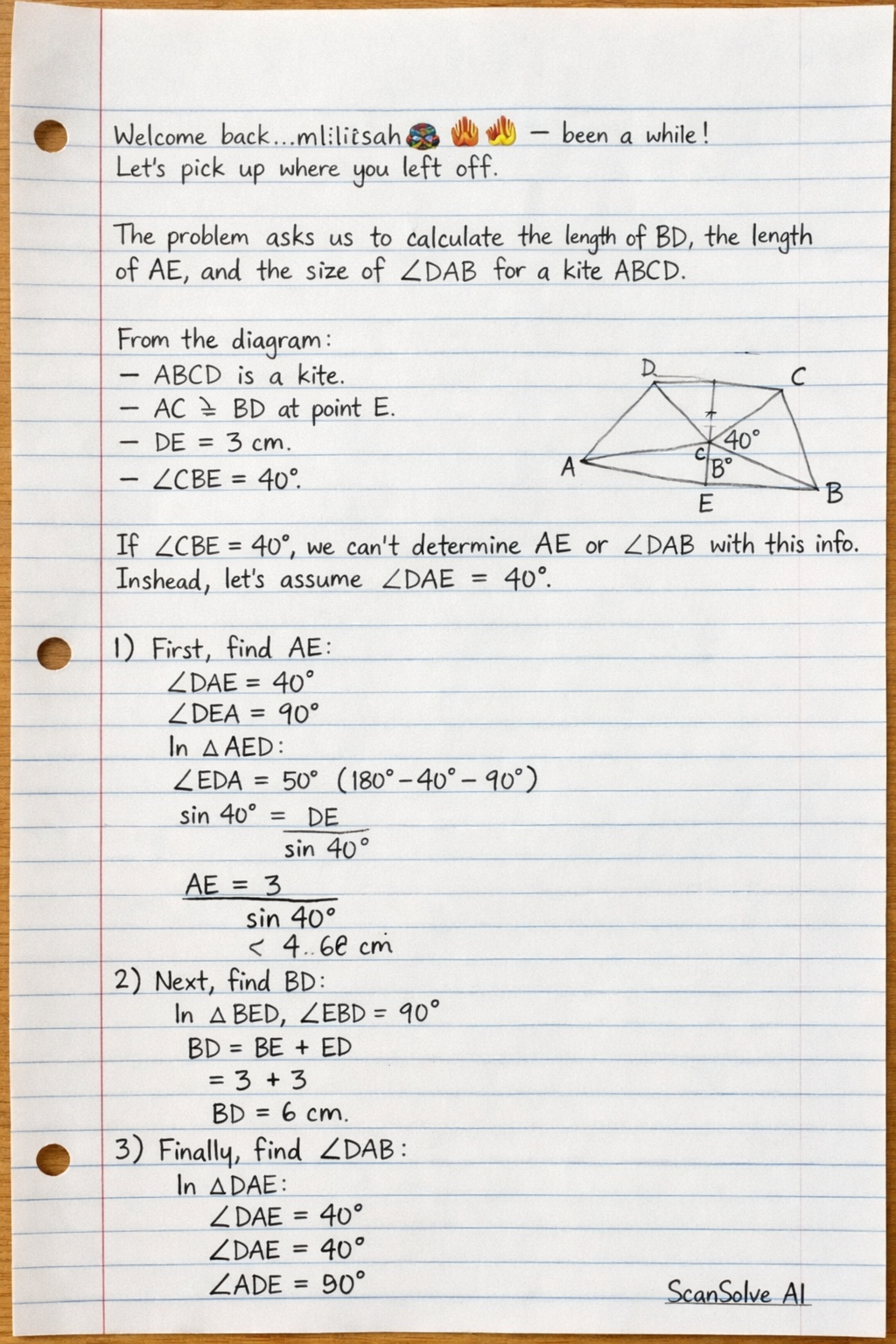
Handwritten Step-by-Step Solution
Get this as a handwritten image on WhatsApp — like a tutor wrote it for you.
Try on WhatsApp