

This mathematics problem involves applying core mathematical principles and formulas. Below you will find a complete step-by-step solution with detailed explanations for each step, helping you understand not just the answer but the method behind it.
ScanSolve AI Answer
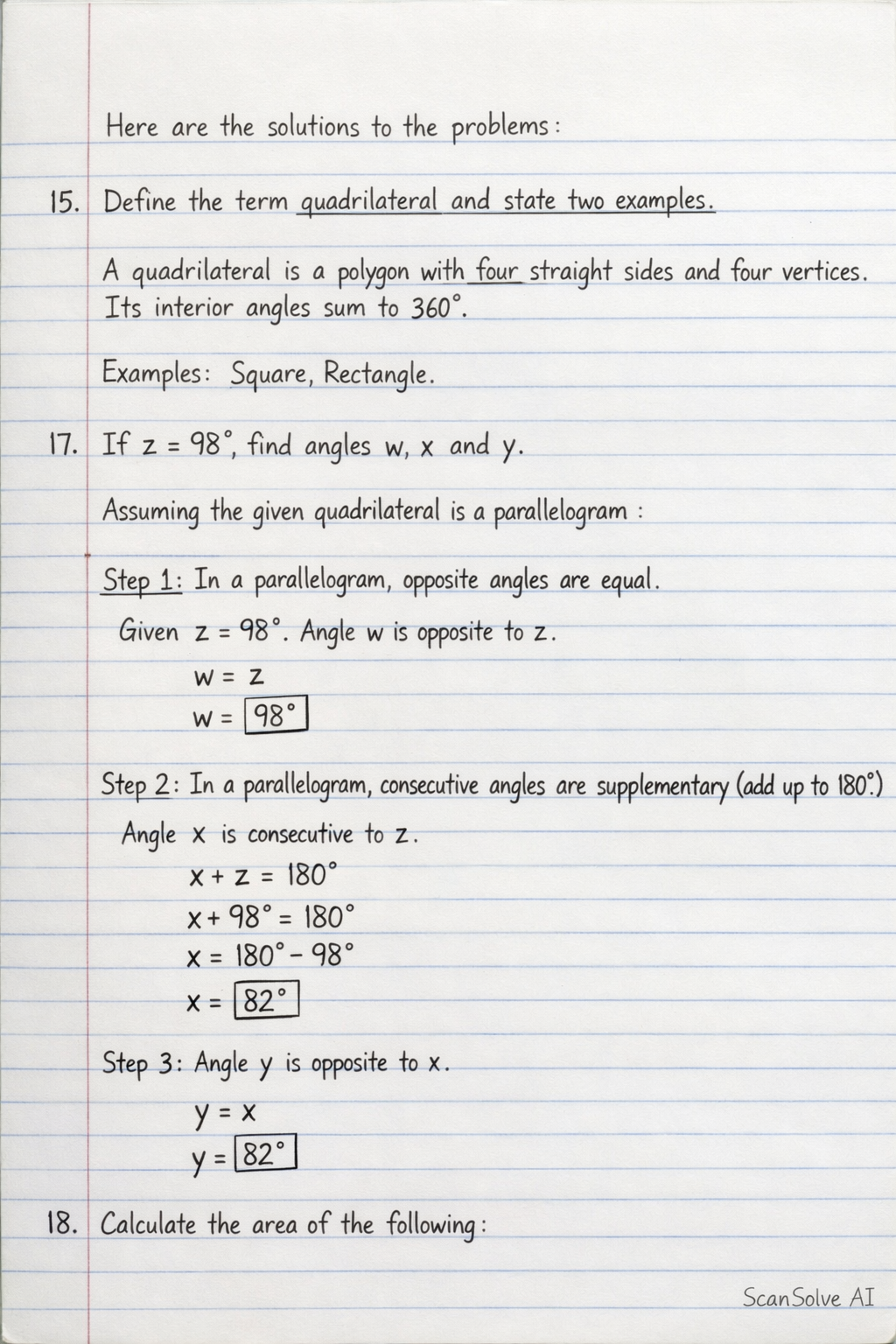
Here are the solutions to the problems: 15. Define the term quadrilateral and state two examples. A quadrilateral is a polygon with four straight sides and four vertices. Its interior angles sum to 360^. Examples: Square, Rectangle. 17. If z=98^ find angles w, x and y. Assuming the given quadrilateral is a parallelogram based on the diagram: Step 1: In a parallelogram, opposite angles are equal. Given z = 98^. Angle w is opposite to z. w = z w = 98^ Step 2: In a parallelogram, consecutive angles are supplementary (add up to 180^). Angle x is consecutive to z. x + z = 180^ x + 98^ = 180^ x = 180^ - 98^ x = 82^ Step 3: Angle y is opposite to x. y = x y = 82^ 18. Calculate the area of the following: a) Trapezium Step 1: Identify the lengths of the parallel sides (a and b) and the height (h). a = 6 cm b = 10 cm h = 4 cm Step 2: Use the formula for the area of a trapezium. Area = (1)/(2)(a+b)h Area = (1)/(2)(6 cm + 10 cm)(4 cm) Area = (1)/(2)(16 cm)(4 cm) Area = (1)/(2)(64 cm^2) Area = 32 cm^2 b) Square Step 1: Identify the side length (s). s = 8 cm Step 2: Use the formula for the area of a square. Area = s^2 Area = (8 cm)^2 Area = 64 cm^2 c) Parallelogram Step 1: Identify the base (b) and the given angle and side. Base = 10 cm Side = 6 cm Angle = 60^ Step 2: Calculate the height (h) using trigonometry. h = Side × (Angle) h = 6 cm × (60^) h = 6 cm × sqrt(3)2 h = 3sqrt(3) cm Step 3: Use the formula for the area of a parallelogram. Area = Base × h Area = 10 cm × 3sqrt(3) cm Area = 30sqrt(3) cm^2 (Approximately 51.96 cm^2) 19. A quadrilateral has angles x^, (x+20)^, 2x^, 3x^. Find the value of x. Step 1: The sum of the interior angles of a quadrilateral is 360^. Set up the equation with the given angles. x + (x+20) + 2x + 3x = 360 Step 2: Combine like terms. (x+x+2x+3x) + 20 = 360 7x + 20 = 360 Step 3: Solve for x. 7x = 360 - 20 7x = 340 x = (340)/(7) x = (340)/(7) or approximately 48.57