
We read your photo as:
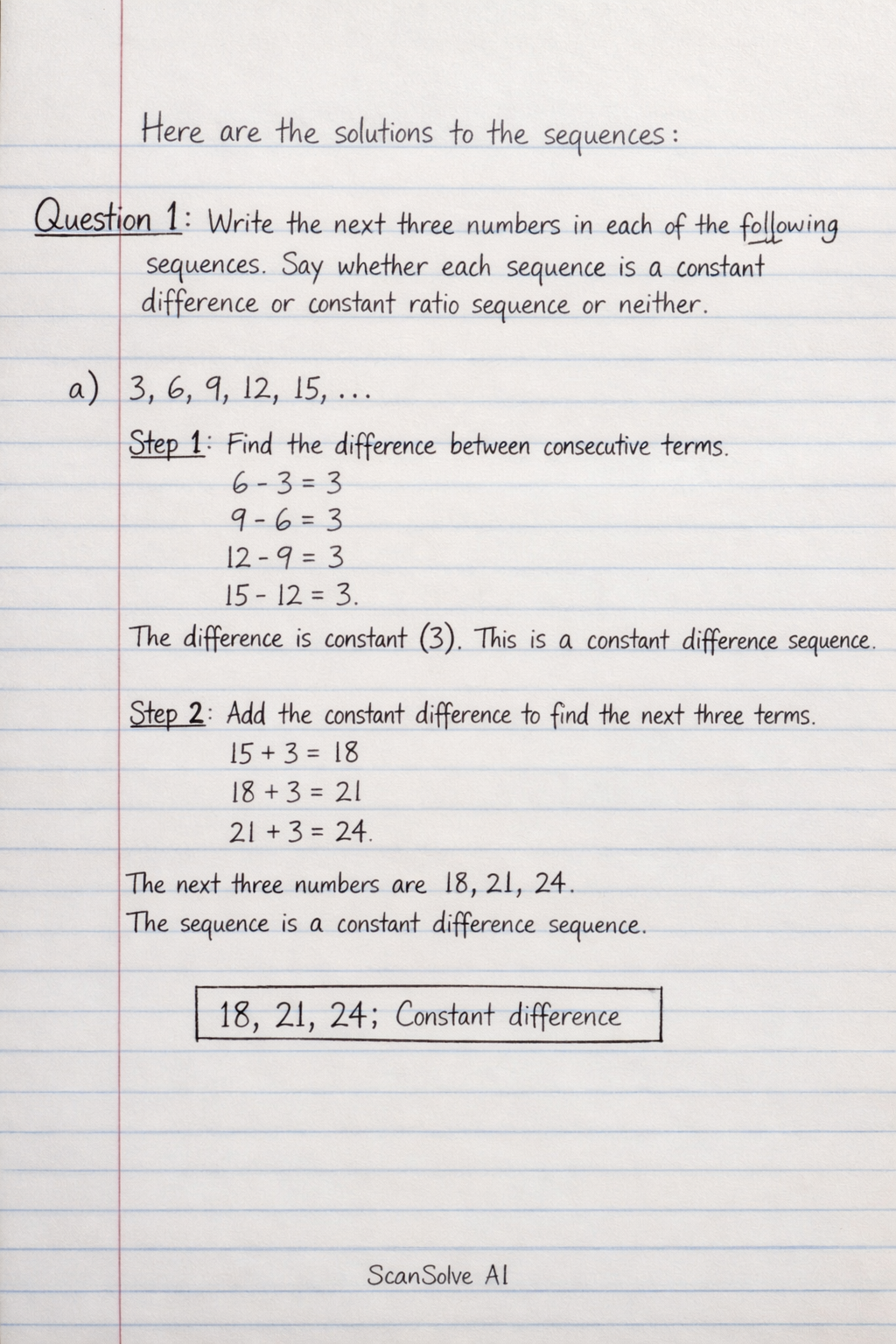
Question 1: Write the next three numbers in each of the following sequences. Say whether each sequence is a constant difference or constant ratio sequence or neither.
Mathematics
ScanSolve AI Answer
Step-by-step solution
14 stepsHere are the solutions to the sequences:
Part 1· 10 steps
Write the next three numbers in each of the following sequences. Say whether each sequence is a constant difference or constant ratio sequence or neither.
- a) 3, 6, 9, 12, 15, ...
Find the difference between consecutive terms.
$6-3=3$ $9-6=3$ $12-9=3$ $15-12=3$ The difference is constant (3). This is a constant difference sequence.Add the constant difference to find the next three terms.
$15+3=18$ $18+3=21$ $21+3=24$ The next three numbers are 18, 21, 24. The sequence is a constant difference sequence. $$ \boxed{\text{18, 21, 24; Constant difference}} $$- b) 2, 4, 8, 16, ...
Find the ratio between consecutive terms.
$\frac{4}{2}=2$ $\frac{8}{4}=2$ $\frac{16}{8}=2$ The ratio is constant (2). This is a constant ratio sequence.Multiply by the constant ratio to find the next three terms.
$16 \times 2=32$ $32 \times 2=64$ $64 \times 2=128$ The next three numbers are 32, 64, 128. The sequence is a constant ratio sequence. $$ \boxed{\text{32, 64, 128; Constant ratio}} $$- c) 7, 11, 15, 19, 23, ...
Find the difference between consecutive terms.
$11-7=4$ $15-11=4$ $19-15=4$ $23-19=4$ The difference is constant (4). This is a constant difference sequence.Add the constant difference to find the next three terms.
$23+4=27$ $27+4=31$ $31+4=35$ The next three numbers are 27, 31, 35. The sequence is a constant difference sequence. $$ \boxed{\text{27, 31, 35; Constant difference}} $$- d) 1, 4, 9, 16, ...
Check for constant difference.
$4-1=3$ $9-4=5$ $16-9=7$ The differences are not constant.Check for constant ratio.
$\frac{4}{1}=4$ $\frac{9}{4}=2.25$ The ratios are not constant.Observe the pattern.
The terms are squares of consecutive integers: .
Find the next three terms.
$5^2=25$
$6^2=36$
$7^2=49$
The next three numbers are 25, 36, 49.
The sequence is neither a constant difference nor a constant ratio sequence.
$$
\boxed{\text{25, 36, 49; Neither}}
$$
Part 2· 4 steps
Describe the pattern in each of the following sequences. State whether it is a constant difference or constant ratio sequence or neither. Then fill in the missing numbers.
- a) 18, 36, 54, 72, [ ], [ ], [ ]
Find the difference between consecutive terms.
$36-18=18$ $54-36=18$ $72-54=18$ The difference is constant (18). This is a constant difference sequence.Add the constant difference to find the missing terms.
$72+18=90$ $90+18=108$ $108+18=126$ The pattern is adding 18 to the previous term. The sequence is a constant difference sequence. The missing numbers are 90, 108, 126. $$ \boxed{\text{Constant difference; 90, 108, 126}} $$- b) 3, 9, 27, [ ], [ ], [ ]
Find the ratio between consecutive terms.
$\frac{9}{3}=3$ $\frac{27}{9}=3$ The ratio is constant (3). This is a constant ratio sequence.Multiply by the constant ratio to find the missing terms.
$27 \times 3=81$ $81 \times 3=243$ $243 \times 3=729$ The pattern is multiplying the previous term by 3. The sequence is a constant ratio sequence. The missing numbers are 81, 243, 729. $$ \boxed{\text{Constant ratio; 81, 243, 729}} $$- **c) 1.25, 2.5, 3.75, 5.0, [ ], [ ], [
Was this helpful?
Still stuck on this one?
Ask a follow-up, and the answer starts from this question.
Got a different question?Ask your own question
More Mathematics Questions
QDetermine the constant difference or the constant ratio of the following sequences and state whether…QFor the given number sequences, find the common difference or ratio and calculate the next two terms…QIn each of the following APs the 1st, 2nd and last terms are given. Find the common difference the…QContinue the following sequences based on their difference patterns.QWhat type of sequence is 1, 3, 5, 7,... and what is its common difference?
Handwritten Step-by-Step Solution
Get this as a handwritten image on WhatsApp — like a tutor wrote it for you.
Try on WhatsApp