
We read your photo as:
QUESTION 3.1 Simplify the following: 3.1.1 (2a-3)(2a+3) 3.1.2 (p2-1)-2p(p-1) 3.1.3 4x2y-8xy3/xy
ScanSolve AI Answer
Step-by-step solution
32 stepsHere are the solutions to Question 3:
3.1 Simplify the following:
3.1.1
Use the difference of squares formula, .
Simplify the terms.
The simplified expression is .
3.1.2
Distribute the into the second parenthesis.
Remove the parenthesis and combine like terms.
The simplified expression is .
3.1.3
Factor out the common term from the numerator.
The common term is .
Cancel out the common term from the numerator and denominator.
The simplified expression is .
3.2 Factorise the following:
3.2.1
Factor out the greatest common factor, which is 5.
Recognize the difference of squares pattern, , where and .
The factorised expression is .
3.2.2
Find two numbers that multiply to and add to .
These numbers are and 1.
Rewrite the middle term using these numbers and factor by grouping.
Factor out the common binomial factor .
The factorised expression is .
3.2.3
Group the terms and factor out common factors from each group.
Notice that is the negative of .
Rewrite as .
Factor out the common binomial factor .
The factorised expression is .
3.3 Solve for in each of the following equations:
3.3.1
Add 21 to both sides of the equation.
Divide both sides by 3.
Express 25 as a power of 5.
Equate the exponents.
The solution is .
3.3.2
Move all terms to one side to form a standard quadratic equation.
Divide the entire equation by 2 to simplify.
Factor the quadratic equation.
Find two numbers that multiply to and add to . These numbers are and 1.
Set each factor equal to zero and solve for .
The solutions are .
3.4 Solve the following inequality and give your solution in interval notation:
Add 3 to both sides of the inequality.
Divide both sides by 2.
Express the solution in interval notation.
The solution in interval notation is .
3.5 Solve algebraically for and in the following equations:
Rewrite equation (1) in standard form .
Use the elimination method.
Multiply Eq 1' by 5 and Eq 2 by 3 to make the coefficients of opposites.
Subtract Eq 4 from Eq 3 to eliminate .
Solve for .
Substitute the value of into Eq 1' () to solve for .
Subtract from both sides.
Divide by -3 to find .
The solutions are .
Still stuck on this one?
Ask a follow-up, and the answer starts from this question.
More Mathematics Questions
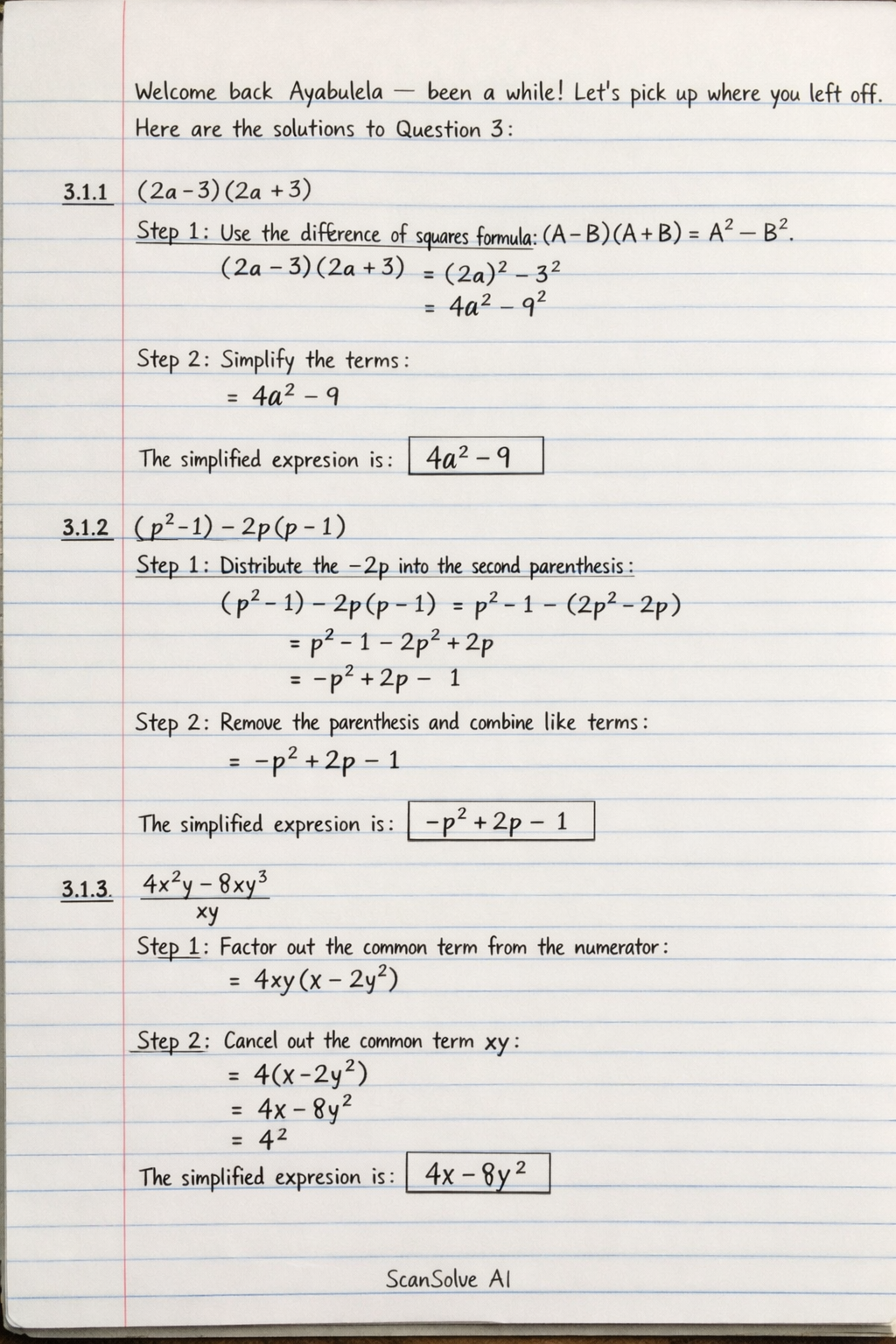
Handwritten Step-by-Step Solution
Get this as a handwritten image on WhatsApp — like a tutor wrote it for you.
Try on WhatsApp