

This mathematics problem involves applying core mathematical principles and formulas. Below you will find a complete step-by-step solution with detailed explanations for each step, helping you understand not just the answer but the method behind it.
ScanSolve AI Answer
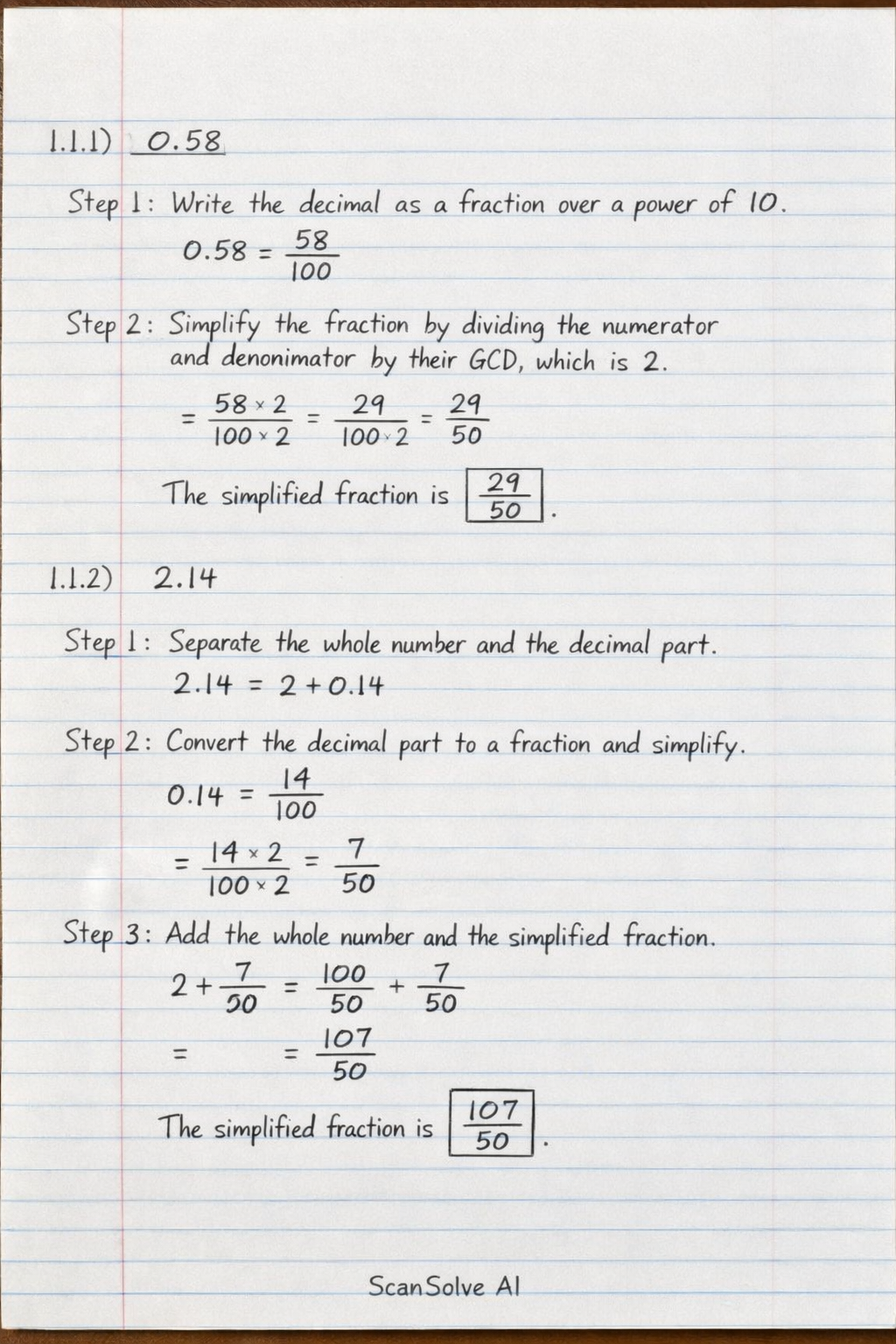
here are the solutions to Question 1: 1.1 Convert the following decimal fractions to the form (a)/(b) where a, b Z and b ≠ 0. Leave the answer in their simplest form. 1.1.1 0.58 Step 1: Write the decimal as a fraction over a power of 10. 0.58 = (58)/(100) Step 2: Simplify the fraction by dividing the numerator and denominator by their greatest common divisor, which is 2. = (58 ÷ 2)/(100 ÷ 2) = (29)/(50) The simplified fraction is (29)/(50). 1.1.2 2.14 Step 1: Separate the whole number and the decimal part. 2.14 = 2 + 0.14 Step 2: Convert the decimal part to a fraction and simplify. 0.14 = (14)/(100) = (14 ÷ 2)/(100 ÷ 2) = (7)/(50) Step 3: Add the whole number and the simplified fraction. 2 + (7)/(50) = (100)/(50) + (7)/(50) = (107)/(50) The simplified fraction is (107)/(50). 1.1.3 0.375 Step 1: Write the decimal as a fraction over a power of 10. 0.375 = (375)/(1000) Step 2: Simplify the fraction by dividing the numerator and denominator by their greatest common divisor. (375 ÷ 125)/(1000 ÷ 125) = (3)/(8) The simplified fraction is (3)/(8). 1.2 Simplify the following by using the laws of exponents and leave answers with positive exponents and in surd form where applicable: 1.2.1 ((81a^3)/(16a^-1))^-(3)/(2) Step 1: Simplify the expression inside the parenthesis using exponent rules (a^m/a^n = a^m-n). ((81)/(16) a^3-(-1))^-(3)/(2) = ((81)/(16) a^4)^-(3)/(2) Step 2: Apply the negative exponent by inverting the base. = ((16)/(81a^4))^(3)/(2) Step 3: Apply the fractional exponent, which means taking the square root first, then cubing the result. = (sqrt((16)/(81a^4)))^3 = (sqrt(16)sqrt(81a^4))^3 Step 4: Calculate the square roots. = ((4)/(9a^2))^3 Step 5: Cube the expression. = (4^3)/((9a^2)^3) = (64)/(9^3 (a^2)^3) = (64)/(729a^6) The simplified expression is (64)/(729a^6). 1.2.2 (x^2y^3 × x^3y^4)/((2x^-3)y)^2 + sqrt(4x^2y^3) Step 1: Simplify the first term (the fraction) using exponent rules. (x^2y^3 × x^3y^4)/((2x^-3)y)^2 = x^2+3y^3+42^2(x^-3)^2y^2 = (x^5y^7)/(4x^-6)y^2 Step 2: Continue simplifying the fraction. = (1)/(4) x^5-(-6) y^7-2 = (1)/(4) x^11 y^5 Step 3: Simplify the second term (the surd). Assume x 0 for sqrt(x^2)=x. sqrt(4x^2y^3) = sqrt(4) · sqrt(x^2) · sqrt(y^2 · y) = 2xysqrt(y) Step 4: Combine the simplified terms. (1)/(4) x^11 y^5 + 2xysqrt(y) The simplified expression is (1)/(4) x^11 y^5 + 2xysqrt(y). 1.3 Simplify the following by using surd laws. Leave answer in a surd form. sqrt(75)+sqrt(12)+sqrt(108)sqrt(147) Step 1: Simplify each surd in the numerator by finding perfect square factors. sqrt(75) = sqrt(25 × 3) = 5sqrt(3) sqrt(12) = sqrt(4 × 3) = 2sqrt(3) sqrt(108) = sqrt(36 × 3) = 6sqrt(3) Step 2: Simplify the surd in the denominator. sqrt(147) = sqrt(49 × 3) = 7sqrt(3) Step 3: Substitute the simplified surds back into the expression. 5sqrt(3)+2sqrt(3)+6sqrt(3)7sqrt(3) Step 4: Combine the like terms in the numerator. = (5+2+6)sqrt(3)7sqrt(3) = 13sqrt(3)7sqrt(3) Step 5: Cancel out the common factor sqrt(3). = (13)/(7) The simplified expression is (13)/(7). 1.4 Simplify the following expression by rationalising the denominator. 2-sqrt(3)3-sqrt(2) Step 1: Multiply the numerator and the denominator by the conjugate of the denominator, which is 3+sqrt(2). 2-sqrt(3)3-sqrt(2) × 3+sqrt(2)3+sqrt(2) Step 2: Expand the numerator using the distributive property (FOIL). (2-sqrt(3))(3+sqrt(2)) = 2(3) + 2(sqrt(2)) - sqrt(3)(3) - sqrt(3)(sqrt(2)) = 6 + 2sqrt(2) - 3sqrt(3) - sqrt(6) Step 3: Expand the denominator using the difference of squares formula (a-b)(a+b)=a^2-b^2. (3-sqrt(2))(3+sqrt(2)) = 3^2 - (sqrt(2))^2 = 9 - 2 = 7 Step 4: Combine the simplified numerator and denominator. = 6 + 2sqrt(2) - 3sqrt(3) - sqrt(6)7 The simplified expression is 6 + 2sqrt(2) - 3sqrt(3) - sqrt(6)7. 1.5 Given: A_t = A_0 (1 + (r)/(100))^n 1.5.1 Make "r" the subject of the formula. Step 1: Divide both sides by A_0. (A_t)/(A_0) = (1 + (r)/(100))^n Step 2: Take the n-th root of both sides. n/(A_0) = 1 + (r)/(100) Step 3: Subtract 1 from both sides. n/(A_0) - 1 = (r)/(100) Step 4: Multiply both sides by 100. r = 100 (n/(A_0) - 1) The formula with r as the subject is r = 100 (n/(A_0) - 1). 1.5.2 Determine the value of r if n=4, A_0=3000 and A_t=4200. Step 1: Use the formula derived in 1.5.1. r = 100 (n/(A_0) - 1) Step 2: Substitute the given values n=4, A_0=3000, and A_t=4200. r = 100 (4/(3000) - 1) Step 3: Simplify the fraction inside the root. r = 100 (4/(30) - 1) = 100 (4/(5) - 1) r = 100 ([4]1.4 - 1) Step 4: Calculate the fourth root and then the value of r. r ≈ 100 (1.08775 - 1) r ≈ 100 (0.08775) r ≈ 8.775 The value of r is approximately 8.775. (Question 1.6 was addressed in a previous message.) What's next?