

This mathematics problem involves applying core mathematical principles and formulas. Below you will find a complete step-by-step solution with detailed explanations for each step, helping you understand not just the answer but the method behind it.
ScanSolve AI Answer
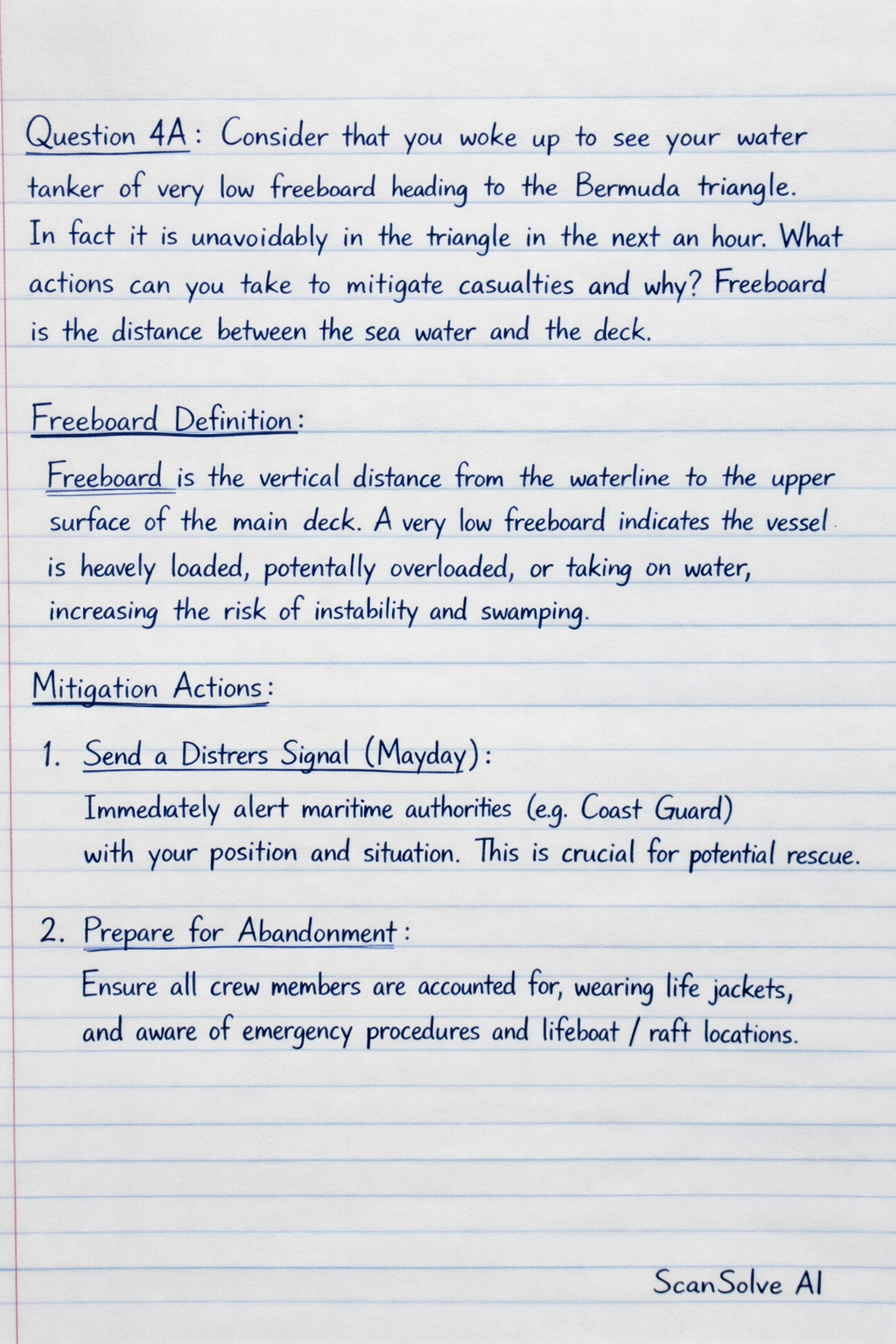
Question 4A: Consider that you woke up to see your water tanker of very low freeboard heading to the Bermuda triangle. In-fact it is unavoidably in the triangle in the next an hour. What actions can you take to mitigate casualties and why? Freeboard is the distance between the sea water and the deck. Freeboard Definition: Freeboard* is the vertical distance from the waterline to the upper surface of the main deck. A very low freeboard indicates the vessel is heavily loaded, potentially overloaded, or taking on water, increasing the risk of instability and swamping. Mitigation Actions: 1. Send a Distress Signal (Mayday): Immediately alert maritime authorities (e.g., Coast Guard) with your position and situation. This is crucial for potential rescue. 2. Prepare for Abandonment: Ensure all crew members are accounted for, wearing life jackets, and aware of emergency procedures and lifeboat/raft locations. 3. Secure Cargo: If possible and safe, ensure all cargo is properly secured to prevent shifting, which could further destabilize the vessel. 4. Reduce Speed and Change Course (if possible): Slowing down minimizes the impact of waves. If there's any possibility to alter course to present the bow or stern to the largest waves, it might reduce rolling and pitching, but with very low freeboard, this could also be risky. 5. Activate Bilge Pumps: If water is entering the hull, operate all available bilge pumps to remove it and maintain buoyancy. Why mitigate: These actions are taken to preserve human life* (casualties), prevent the vessel from sinking, and minimize potential environmental damage from cargo spills. Question 4B: In a single sentence state what caused the titanic vessel to sink? The Titanic sank after colliding with an iceberg, which caused significant damage to its hull and led to catastrophic flooding. Question 4C: The strongest underwater current that operates between Madagascar and southern Africa is called? While the one that dominates west Africa is? The strongest underwater current between Madagascar and southern Africa is the Agulhas Current. The current that dominates West Africa is the Guinea Current. Question 4D: Why is the river Niger not blue? The River Niger is not blue because it carries a significant amount of suspended sediments (silt, clay), dissolved organic matter, and sometimes algae, which give its water a brownish or muddy appearance rather than the clear, deep blue associated with very pure water bodies. Question 5A: Name three causes gyres? 1. Coriolis effect 2. Global wind patterns (e.g., trade winds, westerlies) 3. Continental boundaries (landmasses deflecting ocean currents) Question 5B: Why is ocean salty and rivers fresh water? Oceans are salty because rivers continuously carry dissolved minerals and salts from eroded land into the sea, and these salts accumulate over geological time as water evaporates. Rivers remain fresh because they are constantly replenished by precipitation (rain and snow), which is essentially distilled water, preventing significant salt buildup despite picking up some minerals. Question 5C: Differentiate between hurricane, tornadoes and rogue waves? A hurricane* is a large, rotating tropical storm system that forms over warm ocean waters, characterized by strong winds, heavy rainfall, and storm surge. A tornado* is a violently rotating column of air extending from a thunderstorm to the ground, known for extremely high wind speeds over a localized area. A rogue wave* is an unusually large, unexpected, and often steep ocean wave that appears suddenly and is much larger than the surrounding waves, not necessarily associated with a storm. Question 5D: What is the condition for slamming waves in terms of wave height and wave period? Slamming waves typically occur when waves are steep, meaning they have a large wave height relative to a short wave period (and thus a short wavelength). This condition often leads to waves breaking or impacting a structure with high, sudden forces. Question 5E: With aid of diagram, show how wave and slamming forces differ. Wave Force: This is the oscillating pressure exerted by a passing wave on a structure. It's generally a more gradual, cyclical force. Slamming Force: This is a sudden, high-magnitude impact force caused by the rapid impact of a breaking wave crest or a large volume of water on a structure, often involving air entrapment. It's characterized by a very short duration and a high peak pressure. c Force \\ \\ [scale=0.7] % Wave Force [blue, thick] (0,0) sin (0.5,1) cos (1,0) sin (1.5,-1) cos (2,0) sin (2.5,1) cos (3,0); at (1.5, 1.5) Wave Force; % Slamming Force [red, thick] (4,0) -- (4.1,2) -- (4.2,0); at (4.1, 2.5) Slamming Force; % Axes [->] (-0.5,0) -- (5,0) node[below] Time; [->] (0,-1.5) -- (0,2.5); The diagram above illustrates the difference: Wave force shows a smooth, oscillating pattern over time, while slamming force is represented by a sharp, high-magnitude spike over a very short duration. Question 6A: With the aid of a diagram, describe the concept of Easterlies, Westerlies and trade winds in the global wind pattern. 12mks Diagram: [scale=0.8] % Earth representation [thick] (0,0) circle (3cm); % Equator [dashed] (-3,0) -- (3,0) node[right] Equator (0^); % Latitudes [dashed] (-2.8,1.5) -- (2.8,1.5) node[right] 30^ N; [dashed] (-2.8,-1.5) -- (2.8,-1.5) node[right] 30^ S; [dashed] (-2.5,2.5) -- (2.5,2.5) node[right] 60^ N; [dashed] (-2.5,-2.5) -- (2.5,-2.5) node[right] 60^ S; at (0,2.9) 90^ N (Pole); at (0,-2.9) 90^ S (Pole); % Wind Arrows - Northern Hemisphere % Polar Easterlies [->, thick, blue] (1.5,2.7) -- (0.5,2.7); [->, thick, blue] (-0.5,2.7) -- (-1.5,2.7); at (0,2.2) Polar Easterlies; % Westerlies [->, thick, green] (-2.2,2) -- (-1.2,2); [->, thick, green] (0.2,2) -- (1.2,2); at (0,1.7) Westerlies; % Northeast Trade Winds [->, thick, red] (2.5,0.7) -- (1.5,0.7); [->, thick, red] (0.5,0.7) -- (-0.5,0.7); at (0,1.2) Northeast Trade Winds; % Wind Arrows - Southern Hemisphere % Polar Easterlies [->, thick, blue] (1.5,-2.7) -- (0.5,-2.7); [->, thick, blue] (-0.5,-2.7) -- (-1.5,-2.7); at (0,-2.2) Polar Easterlies; % Westerlies [->, thick, green] (-2.2,-2) -- (-1.2,-2); [->, thick, green] (0.2,-2) -- (1.2,-2); at (0,-1.7) Westerlies; % Southeast Trade Winds [->, thick, red] (2.5,-0.7) -- (1.5,-0.7); [->, thick, red] (0.5,-0.7) -- (-0.5,-0.7); at (0,-1.2