

This mathematics problem involves applying core mathematical principles and formulas. Below you will find a complete step-by-step solution with detailed explanations for each step, helping you understand not just the answer but the method behind it.
ScanSolve AI Answer
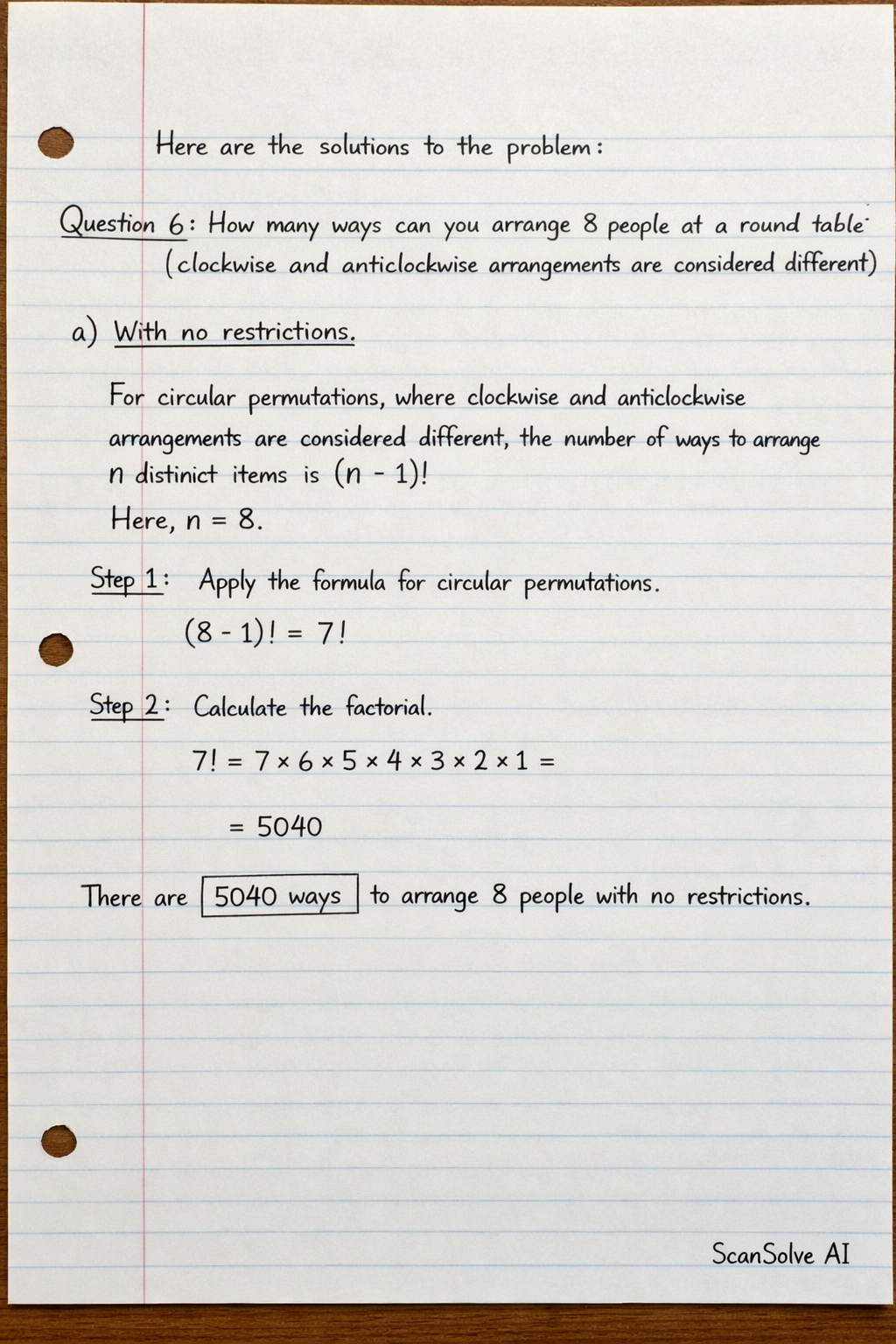
Here are the solutions to the problem: Question 6: How many ways can you arrange 8 people at a round table (clockwise and anticlockwise arrangements are considered different) a) With no restrictions For circular permutations where clockwise and anticlockwise arrangements are considered different, the number of ways to arrange n distinct items is (n-1)!. Here, n=8. Step 1: Apply the formula for circular permutations. (8-1)! = 7! Step 2: Calculate the factorial. 7! = 7 × 6 × 5 × 4 × 3 × 2 × 1 = 5040 There are 5040 ways to arrange 8 people with no restrictions. b) If George and Harry must sit next to each other Step 1: Treat George and Harry as a single unit. Now we are arranging 8-1=7 units (6 individuals + the GH pair). Step 2: Arrange these 7 units around the table. The number of ways is (7-1)! = 6!. Step 3: Consider the internal arrangement of George and Harry within their unit. They can sit as (George, Harry) or (Harry, George), which is 2! ways. Step 4: Multiply the arrangements of the units by the internal arrangements of the pair. 6! × 2! = (720) × (2) = 1440 There are 1440 ways if George and Harry must sit next to each other. c) If Mary refuses to sit next to George Step 1: Calculate the total number of arrangements with no restrictions (from part a), which is 7! = 5040. Step 2: Calculate the number of arrangements where Mary does sit next to George. This is similar to part b. Treat Mary and George as a single unit. We are arranging 8-1=7 units. This gives (7-1)! = 6! ways. Within the unit, Mary and George can be arranged in 2! ways (MG or GM). So, arrangements where Mary does sit next to George = 6! × 2! = 720 × 2 = 1440. Step 3: Subtract the arrangements where Mary sits next to George from the total arrangements. 5040 - 1440 = 3600 There are 3600 ways if Mary refuses to sit next to George. d) If clockwise and anticlockwise arrangements are considered equivalent. For circular permutations where clockwise and anticlockwise arrangements are considered equivalent (symmetrical arrangements), the number of ways to arrange n distinct items is ((n-1)!)/(2). Here, n=8. Step 1: Apply the formula for symmetrical circular permutations. ((8-1)!)/(2) = (7!)/(2) Step 2: Calculate the factorial and divide by 2. (5040)/(2) = 2520 There are 2520 ways if clockwise and anticlockwise arrangements are considered equivalent.