

This mathematics problem involves applying core mathematical principles and formulas. Below you will find a complete step-by-step solution with detailed explanations for each step, helping you understand not just the answer but the method behind it.
ScanSolve AI Answer
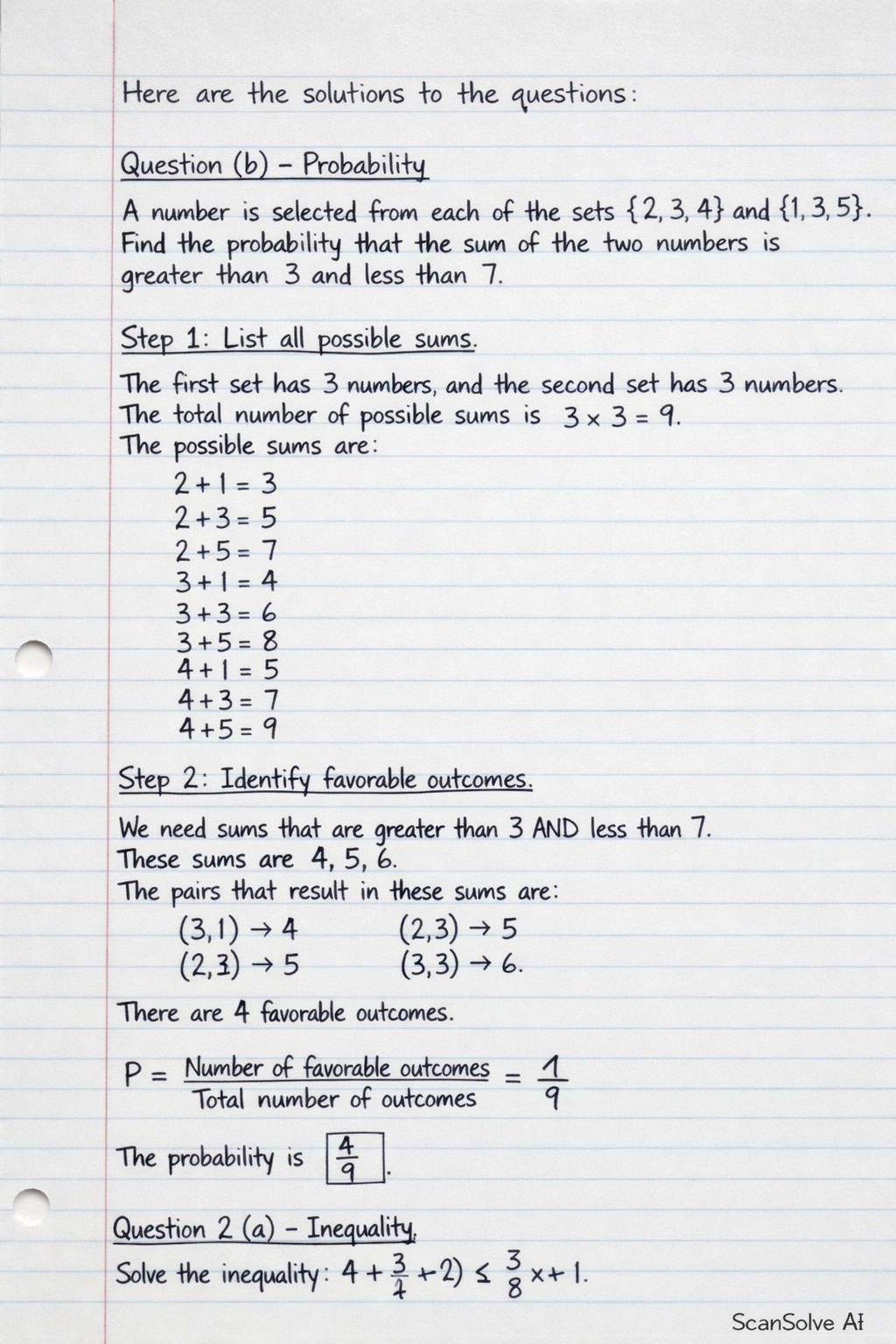
Here are the solutions to the questions: Question (b) - Probability A number is selected from each of the sets \2, 3, 4\ and \1, 3, 5\. Find the probability that the sum of the two numbers is greater than 3 and less than 7. Step 1: List all possible sums. The first set has 3 numbers, and the second set has 3 numbers. The total number of possible sums is 3 × 3 = 9. The possible sums are: 2+1=3 2+3=5 2+5=7 3+1=4 3+3=6 3+5=8 4+1=5 4+3=7 4+5=9 Step 2: Identify favorable outcomes. We need sums that are greater than 3 AND less than 7. These sums are 4, 5, 6. The pairs that result in these sums are: (3,1) 4 (2,3) 5 (4,1) 5 (3,3) 6 There are 4 favorable outcomes. Step 3: Calculate the probability. P = Number of favorable outcomesTotal number of outcomes = (4)/(9) The probability is (4)/(9). Question 2 (a) - Inequality Solve the inequality: 4 + (3)/(4)(x + 2) ≤ (3)/(8)x + 1. Step 1: Multiply by the least common multiple (LCM) of the denominators (4 and 8), which is 8, to clear fractions. 8 (4 + (3)/(4)(x + 2)) ≤ 8 ((3)/(8)x + 1) 32 + 6(x + 2) ≤ 3x + 8 Step 2: Distribute and simplify both sides of the inequality. 32 + 6x + 12 ≤ 3x + 8 44 + 6x ≤ 3x + 8 Step 3: Gather x terms on one side and constant terms on the other. 6x - 3x ≤ 8 - 44 3x ≤ -36 Step 4: Solve for x. x ≤ (-36)/(3) x ≤ -12 The solution to the inequality is x ≤ -12. Question 2 (b) - Geometry The diagram shows a rectangle PQRS from which a square of side x cm has been cut. The area of the shaded portion is 484 cm^2. Find the values of x. Step 1: Determine the dimensions of the large rectangle and the cut-out square. The total length of the rectangle PQRS is 10 cm + x cm + 10 cm = (20+x) cm. The width of the rectangle PQRS is 20 cm. The cut-out square has a side length of x cm. Step 2: Set up the equation for the shaded area. The area of the shaded portion is the area of the large rectangle minus the area of the cut-out square. Area of shaded portion