
We read your photo as:
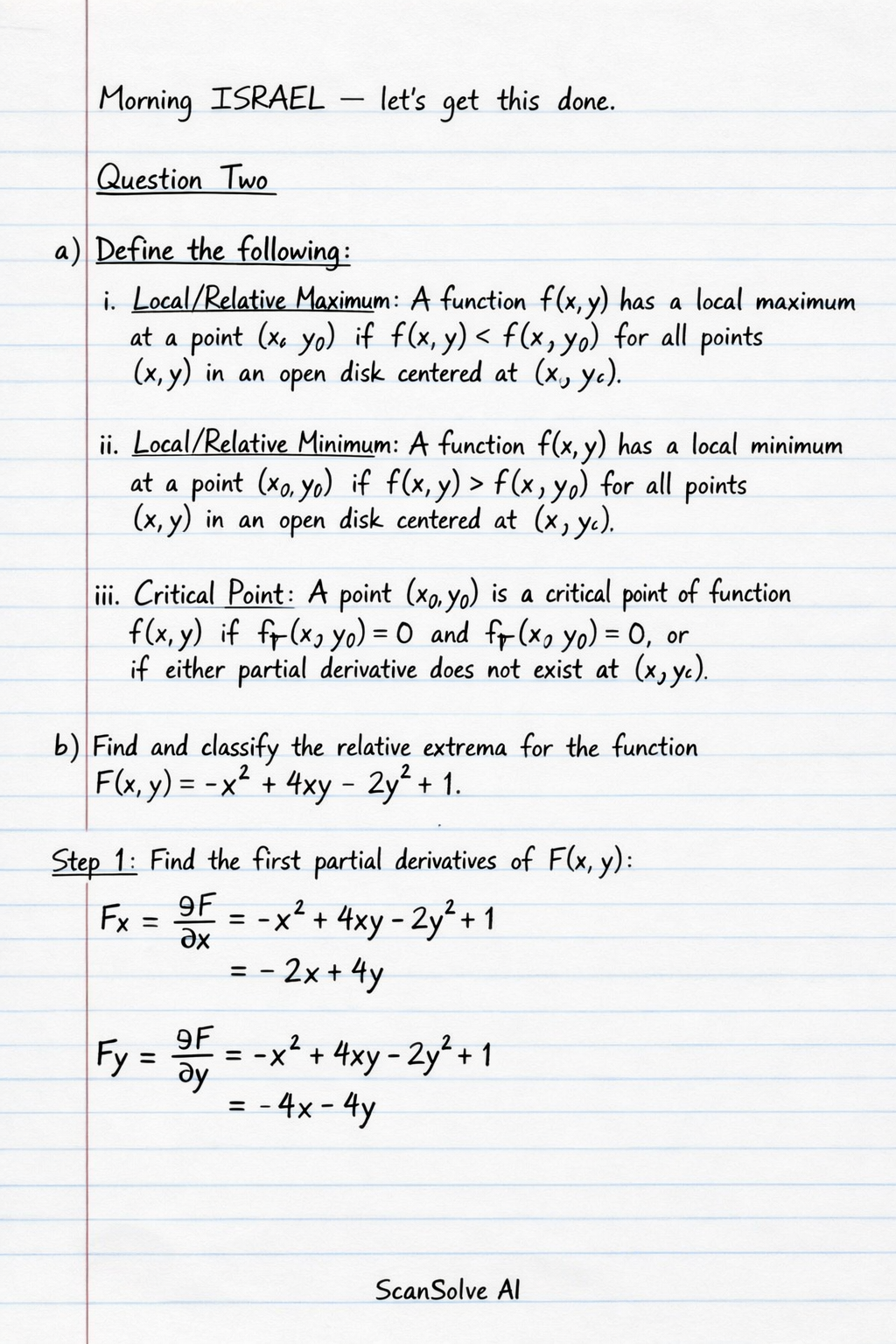
Question Two: a. Define the following: i. Local/Relative Maximum ii. Local/Relative Minimum iii. Critical Point. b. Find and classify the relative extrema for the function F(x,y)=-x2+4y-2y3+1. c. Find the absolute maximum/minimum of f(x,y)=4x+6y−x2−y2 on the boundary B = [(x,y)|0<=x<=4,0<=y<=5].
ScanSolve AI Answer
Answers
2 partsStep-by-step solution
7 stepsQuestion Two
Part a
Define the following
- i. Local/Relative Maximum: A function has a local maximum at a point if for all points in an open disk centered at .
- ii. Local/Relative Minimum: A function has a local minimum at a point if for all points in an open disk centered at .
- iii. Critical Point: A point is a critical point of a function if its first partial derivatives and are both equal to zero, or if one or both of the partial derivatives do not exist at .
Part b
Find and classify the relative extrema for the function .
Find the first partial derivatives of .
Set the partial derivatives to zero to find critical points.
Substitute (2) into (1):
Then .
The only critical point is .Use the Second Derivative Test to classify the critical point.
First, find the second partial derivatives:
Calculate the discriminant :
Since , the critical point is a saddle point.
Therefore, there are no relative maxima or minima for the function .The relative extrema are:
Part c13
Find the absolute maximum/minimum of on the boundary .
Find critical points inside the region.
Set .
Set .
The critical point is . This point lies within the given region .Evaluate at the critical point.
Evaluate along the boundaries of the region.
The region is a rectangle with corners .
-
Boundary 1: , . Let . . Points to check: , and the endpoints . . . .
-
Boundary 2: , . This is the same as Boundary 1. Critical point at . Points to check: , and the endpoints . . . .
-
Boundary 3: , . Let . . Points to check: , and the endpoints . . (already found). (already found).
-
Boundary 4: , . Let . . Points to check: , and the endpoints . . (already found). (already found).
-
Compare all candidate values.
The values of at the critical point and boundary points are:
The maximum value is 13.
The minimum value is 0.The absolute maximum is and the absolute minimum is .
Try one yourself
A new problem that tests the same skill.
Still stuck on this one?
Ask a follow-up, and the answer starts from this question.
More Mathematics Questions
Handwritten Step-by-Step Solution
Get this as a handwritten image on WhatsApp — like a tutor wrote it for you.
Try on WhatsApp