This mathematics problem involves applying core mathematical principles and formulas. Below you will find a complete step-by-step solution with detailed explanations for each step, helping you understand not just the answer but the method behind it.
ScanSolve AI Answer
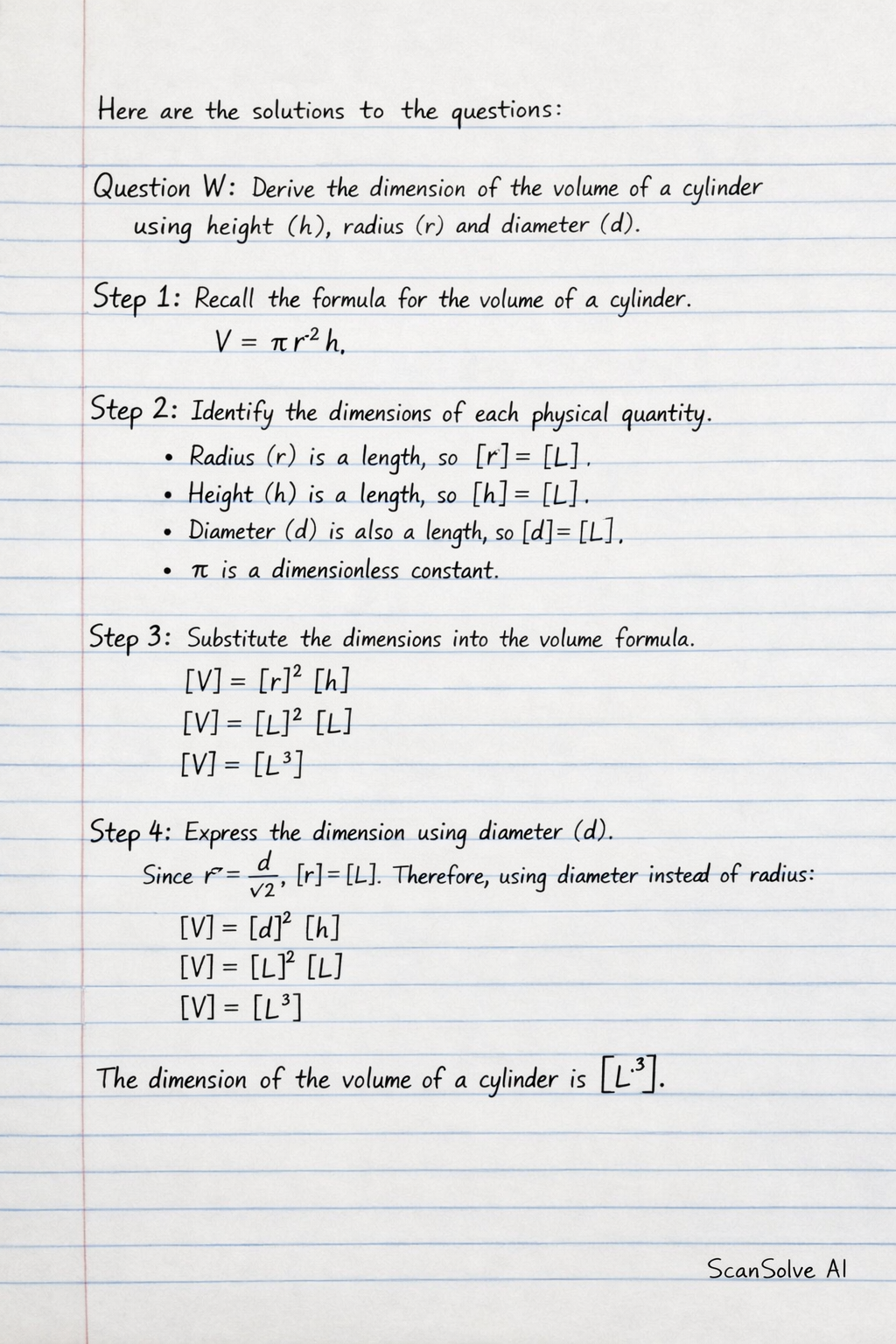
Here are the solutions to the questions:
---
Question W: Derive the dimension of the volume of a cylinder using height (h), radius (r), and diameter (d).
Step 1: Recall the formula for the volume of a cylinder.
The volume of a cylinder ($V$) is given by:
$$V = \pi r^2 h$$
Step 2: Identify the dimensions of each physical quantity.
Radius ($r$) is a length, so its dimension is $[L]$.
Height ($h$) is a length, so its dimension is $[L]$.
Diameter ($d$) is also a length, so its dimension is $[L]$.
$\pi$ is a dimensionless constant.
Step 3: Substitute the dimensions into the volume formula.
The dimension of $V$ is:
$$[V] = [r]^2 [h]$$
$$[V] = [L]^2 [L]$$
$$[V] = [L^3]$$
Step 4: Express the dimension using diameter (d).
Since the radius $r$ is half the diameter $d$ ($r = \frac{d}{2}$), its dimension is still $[L]$. Therefore, using diameter instead of radius does not change the overall dimension of volume.
$$[V] = [d]^2 [h]$$
$$[V] = [L]^2 [L]$$
$$[V] = [L^3]$$
The dimension of the volume of a cylinder is $\boxed{[L^3]}$.
---
Question 4: If a bob is attached to a string of length 80 cm and lifted at an angle of 45 degrees to cause a displacement.
i) Find the speed of the moving bob.
Assumption: We assume the question asks for the speed of the bob at the lowest point of its swing after being released from rest at an angle of $45^\circ$. We will use the principle of conservation of mechanical energy.
Step 1: Convert the string length to meters.
Length of the string, $L = 80 \, \text{cm} = 0.80 \, \text{m}$.
Step 2: Calculate the vertical height ($h$) the bob falls.
When the bob is lifted to an angle $\theta$, its vertical height from the pivot is $L \cos\theta$. When it is at the lowest point, its vertical height from the pivot is $L$.
The change in vertical height (the height it falls) is:
$$h = L - L \cos\theta = L(1 - \cos\theta)$$
Given $\theta = 45^\circ$:
$$h = 0.80 \, \text{m} (1 - \cos 45^\circ)$$
$$h = 0.80 \, \text{m} \left(1 - \frac{\sqrt{2}}{2}\right)$$
$$h = 0.80 \, \text{m} (1 - 0.7071)$$
$$h = 0.80 \, \text{m} (0.2929)$$
$$h = 0.23432 \, \text{m}$$
Step 3: Apply the conservation of mechanical energy.
At the initial position (lifted at $45^\circ$), the bob has potential energy ($PE_i$) and zero kinetic energy ($KE_i = 0$).
At the lowest point, the bob has zero potential energy ($PE_f = 0$) and maximum kinetic energy ($KE_f$).
$$PE_i + KE_i = PE_f + KE_f$$
$$mgh + 0 = 0 + \frac{1}{2}mv^2$$
Where $m$ is the mass of the bob, $g$ is the acceleration due to gravity ($9.8 \, \text{m/s}^2$), and $v$ is the speed at the lowest point.
Step 4: Solve for the speed ($v$).
$$mgh = \frac{1}{2}mv^2$$
Divide both sides by $m$:
$$gh = \frac{1}{2}v^2$$
$$v^2 = 2gh$$
$$v = \sqrt{2gh}$$
Substitute the values for $g$ and $h$:
$$v = \sqrt{2 \times 9.8 \, \text{m/s}^2 \times 0.23432 \, \text{m}}$$
$$v = \sqrt{4.592672 \, \text{m}^2/\text{s}^2}$$
$$v \approx 2.143 \, \text{m/s}$$
The speed of the moving bob at the lowest point is $\boxed{2.14 \, \text{m/s}}$.
ii) Calculate X from the diagram shown.
The diagram mentioned in this part of the question is not provided. Therefore, it is not possible to calculate X.
Question W: Derive the dimension of the volume of a cylinder using height (h), radius (r), and diameter (d).
|Mathematics
Question W: Derive the dimension of the volume of a cylinder using height (h), radius (r), and diameter (d).
ScanSolve AI Answer
Here are the solutions to the questions:
Question W: Derive the dimension of the volume of a cylinder using height (h), radius (r), and diameter (d).
Step 1: Recall the formula for the volume of a cylinder.
The volume of a cylinder (V) is given by:
V=πr2h
Step 2: Identify the dimensions of each physical quantity.
Radius (r) is a length, so its dimension is [L].
Height (h) is a length, so its dimension is [L].
Diameter (d) is also a length, so its dimension is [L].
π is a dimensionless constant.
Step 3: Substitute the dimensions into the volume formula.
The dimension of V is:
[V]=[r]2[h][V]=[L]2[L][V]=[L3]
Step 4: Express the dimension using diameter (d).
Since the radius r is half the diameter d (r=2d), its dimension is still [L]. Therefore, using diameter instead of radius does not change the overall dimension of volume.
[V]=[d]2[h][V]=[L]2[L][V]=[L3]
The dimension of the volume of a cylinder is [L3].
Question 4: If a bob is attached to a string of length 80 cm and lifted at an angle of 45 degrees to cause a displacement.
i) Find the speed of the moving bob.
Assumption: We assume the question asks for the speed of the bob at the lowest point of its swing after being released from rest at an angle of 45∘. We will use the principle of conservation of mechanical energy.
Step 1: Convert the string length to meters.
Length of the string, L=80cm=0.80m.
Step 2: Calculate the vertical height (h) the bob falls.
When the bob is lifted to an angle θ, its vertical height from the pivot is Lcosθ. When it is at the lowest point, its vertical height from the pivot is L.
The change in vertical height (the height it falls) is:
h=L−Lcosθ=L(1−cosθ)
Given θ=45∘:
h=0.80m(1−cos45∘)h=0.80m(1−22)h=0.80m(1−0.7071)h=0.80m(0.2929)h=0.23432m
Step 3: Apply the conservation of mechanical energy.
At the initial position (lifted at 45∘), the bob has potential energy (PEi) and zero kinetic energy (KEi=0).
At the lowest point, the bob has zero potential energy (PEf=0) and maximum kinetic energy (KEf).
PEi+KEi=PEf+KEfmgh+0=0+21mv2
Where m is the mass of the bob, g is the acceleration due to gravity (9.8m/s2), and v is the speed at the lowest point.
Step 4: Solve for the speed (v).
mgh=21mv2
Divide both sides by m:
gh=21v2v2=2ghv=2gh
Substitute the values for g and h:
v=2×9.8m/s2×0.23432mv=4.592672m2/s2v≈2.143m/s
The speed of the moving bob at the lowest point is 2.14m/s.
ii) Calculate X from the diagram shown.
The diagram mentioned in this part of the question is not provided. Therefore, it is not possible to calculate X.
Need help with your own homework?
Get instant step-by-step solutions to any question. Free to start.