This mathematics problem involves applying core mathematical principles and formulas. Below you will find a complete step-by-step solution with detailed explanations for each step, helping you understand not just the answer but the method behind it.
ScanSolve AI Answer
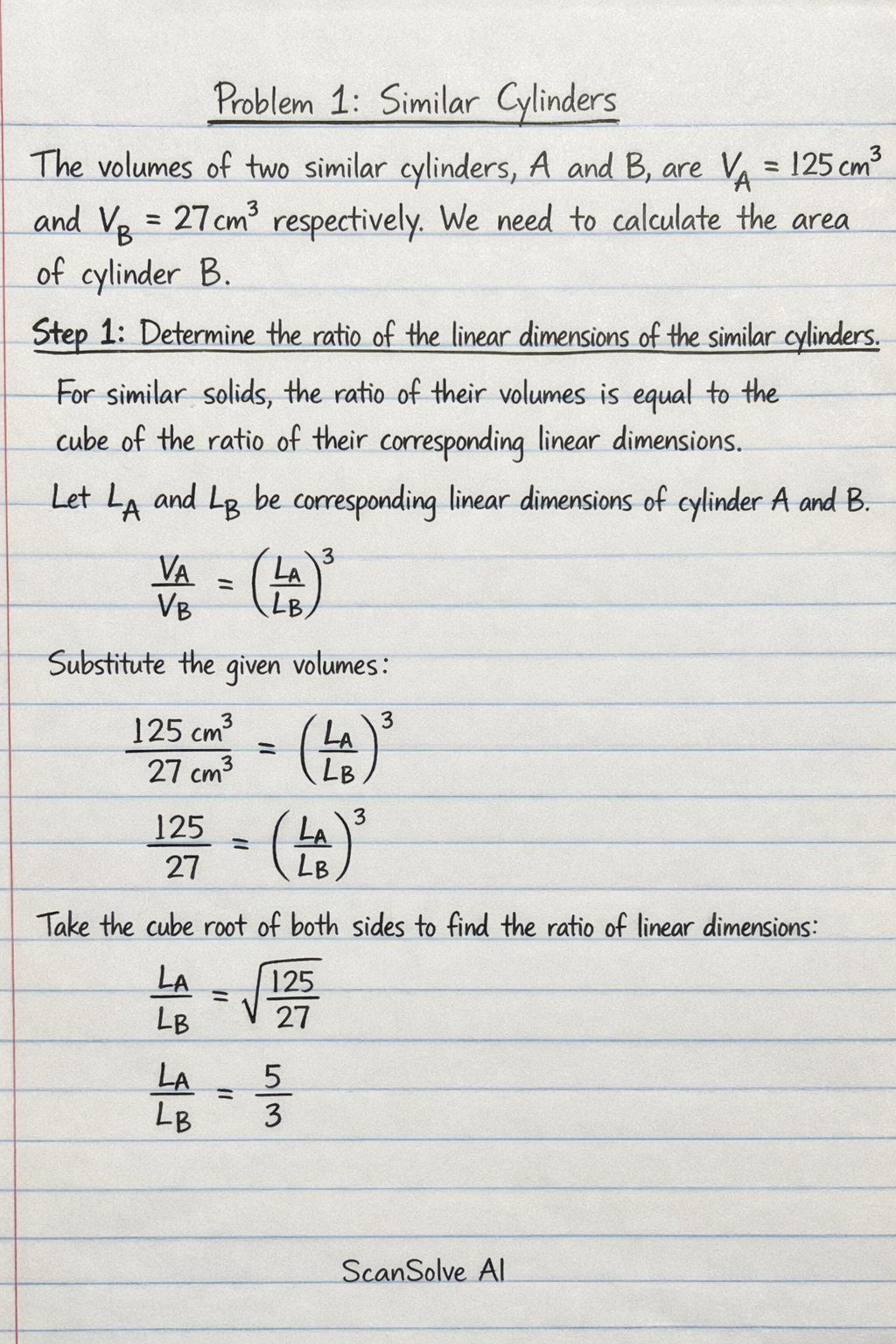
Problem 1: Similar Cylinders
The volumes of two similar cylinders, A and B, are $V_A = 125 \text{ cm}^3$ and $V_B = 27 \text{ cm}^3$ respectively. We need to calculate the area of cylinder B.
Step 1: Determine the ratio of the linear dimensions (e.g., radii or heights) of the similar cylinders.
For similar solids, the ratio of their volumes is equal to the cube of the ratio of their corresponding linear dimensions.
Let $L_A$ and $L_B$ be corresponding linear dimensions of cylinder A and B.
$$\frac{V_A}{V_B} = \left(\frac{L_A}{L_B}\right)^3$$
Substitute the given volumes:
$$\frac{125 \text{ cm}^3}{27 \text{ cm}^3} = \left(\frac{L_A}{L_B}\right)^3$$
$$\frac{125}{27} = \left(\frac{L_A}{L_B}\right)^3$$
Take the cube root of both sides to find the ratio of linear dimensions:
$$\frac{L_A}{L_B} = \sqrt[3]{\frac{125}{27}}$$
$$\frac{L_A}{L_B} = \frac{5}{3}$$
Step 2: Determine the ratio of the surface areas of the similar cylinders.
For similar solids, the ratio of their surface areas is equal to the square of the ratio of their corresponding linear dimensions.
Let $A_A$ and $A_B$ be the surface areas of cylinder A and B.
$$\frac{A_A}{A_B} = \left(\frac{L_A}{L_B}\right)^2$$
Substitute the ratio of linear dimensions found in Step 1:
$$\frac{A_A}{A_B} = \left(\frac{5}{3}\right)^2$$
$$\frac{A_A}{A_B} = \frac{25}{9}$$
Step 3: Conclude regarding the area of cylinder B.
From the ratio of areas, we have $A_B = \frac{9}{25} A_A$.
The problem asks to "Calculate the area of cylinder B". However, the area of cylinder A ($A_A$) is not provided, nor are any specific dimensions (like radius or height) that would allow us to calculate $A_A$. Therefore, the actual numerical value for the area of cylinder B cannot be determined from the given information alone. We can only express it in terms of the area of cylinder A.
The area of cylinder B is $\boxed{\text{not determinable without the area of cylinder A}}$.
---
Problem 2: Parallel Lines
Given that $y = 2^x x + 6$ and $4 + 2y = 16x$ are two parallel lines, we need to find the value of $x$.
Step 1: Find the slope of the second line.
The second equation is $4 + 2y = 16x$.
To find its slope, rearrange it into the slope-intercept form $y = mx + c$, where $m$ is the slope.
$$2y = 16x - 4$$
$$y = \frac{16x - 4}{2}$$
$$y = 8x
Determine the ratio of the linear dimensions (e.g., radii or heights) of the similar cylinders.
|Mathematics
Determine the ratio of the linear dimensions (e.g., radii or heights) of the similar cylinders.
ScanSolve AI Answer
Problem 1: Similar Cylinders
The volumes of two similar cylinders, A and B, are VA=125cm3 and VB=27cm3 respectively. We need to calculate the area of cylinder B.
Step 1: Determine the ratio of the linear dimensions (e.g., radii or heights) of the similar cylinders.
For similar solids, the ratio of their volumes is equal to the cube of the ratio of their corresponding linear dimensions.
Let LA and LB be corresponding linear dimensions of cylinder A and B.
VBVA=(LBLA)3
Substitute the given volumes:
27cm3125cm3=(LBLA)327125=(LBLA)3
Take the cube root of both sides to find the ratio of linear dimensions:
LBLA=327125LBLA=35
Step 2: Determine the ratio of the surface areas of the similar cylinders.
For similar solids, the ratio of their surface areas is equal to the square of the ratio of their corresponding linear dimensions.
Let AA and AB be the surface areas of cylinder A and B.
ABAA=(LBLA)2
Substitute the ratio of linear dimensions found in Step 1:
ABAA=(35)2ABAA=925
Step 3: Conclude regarding the area of cylinder B.
From the ratio of areas, we have AB=259AA.
The problem asks to "Calculate the area of cylinder B". However, the area of cylinder A (AA) is not provided, nor are any specific dimensions (like radius or height) that would allow us to calculate AA. Therefore, the actual numerical value for the area of cylinder B cannot be determined from the given information alone. We can only express it in terms of the area of cylinder A.
The area of cylinder B is notdeterminablewithouttheareaofcylinderA.
Problem 2: Parallel Lines
Given that y=2xx+6 and 4+2y=16x are two parallel lines, we need to find the value of x.
Step 1: Find the slope of the second line.
The second equation is 4+2y=16x.
To find its slope, rearrange it into the slope-intercept form y=mx+c, where m is the slope.
2y=16x−4y=216x−4
Need help with your own homework?
Get instant step-by-step solutions to any question. Free to start.