
We read your photo as:
Rearrange the terms of the quadratic expression into standard form ax² + bx + c.
ScanSolve AI Answer
Answer
(3d - 2)(-4d - 1)
Step-by-step solution
5 stepsRearrange the terms of the quadratic expression into standard form .
The given expression is .
Rearranging it gives:Factor out to make the leading coefficient positive, or factor directly.
Let's factor directly by finding two numbers that multiply to and add up to .
The two numbers are 8 and .Rewrite the middle term $5d$ using these two numbers.
Group the terms and factor out common factors from each group.
Factor from the first group and from the second group:
To make the binomials identical, we can factor out from the first group instead:
Factor out the common binomial .
This can also be written as by factoring out from the first factor and from the second factor, then multiplying the two s to get , or by factoring .
Let's verify the factorization:
This matches the original expression.
Try one yourself
A new problem that tests the same skill.
Still stuck on this one?
Ask a follow-up, and the answer starts from this question.
More Mathematics Questions
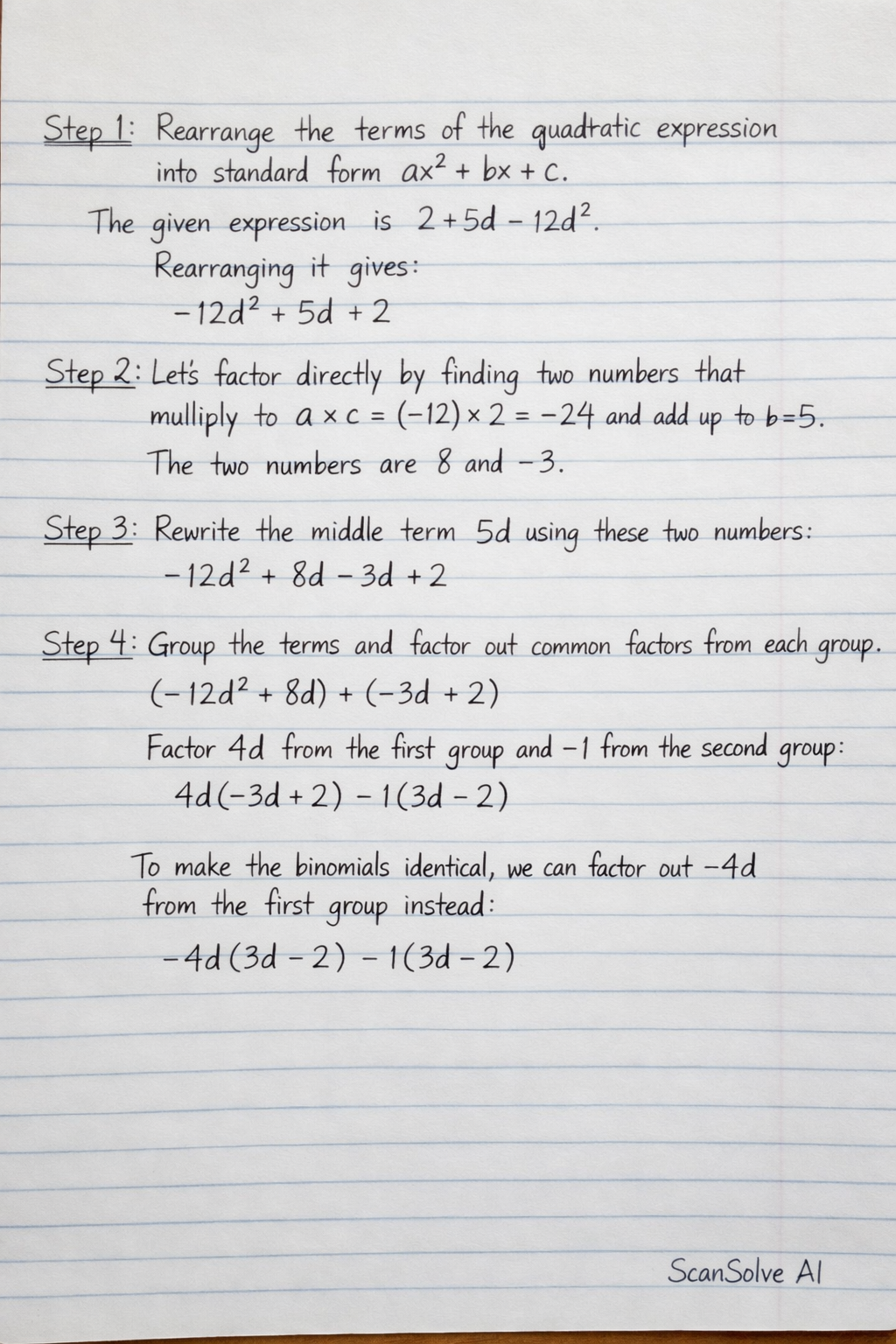
Handwritten Step-by-Step Solution
Get this as a handwritten image on WhatsApp — like a tutor wrote it for you.
Try on WhatsApp