
We read your photo as:
Give reason to show that none of the numbers given below is a perfect square.
ScanSolve AI Answer
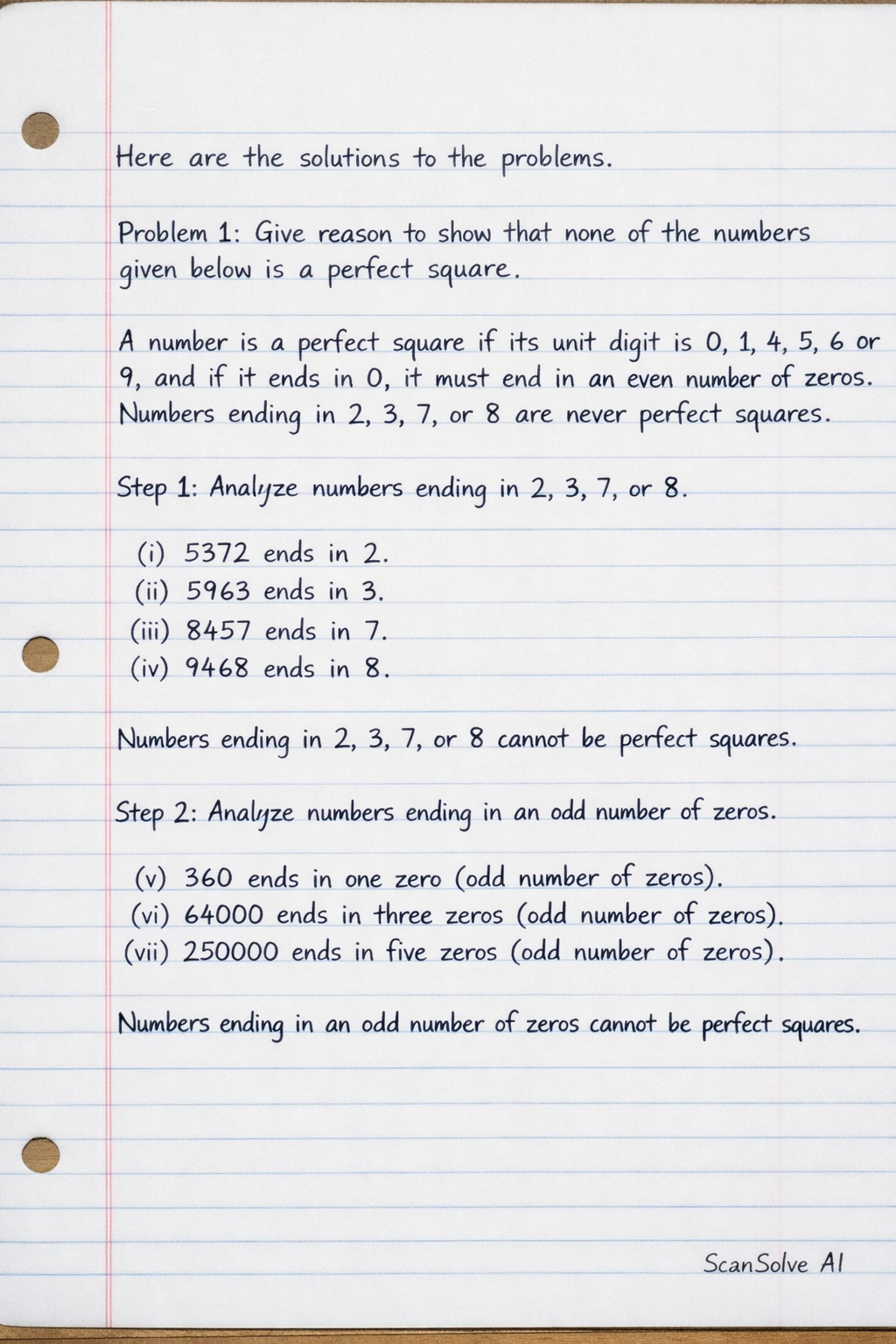
Here are the solutions to the problems.
: Give reason to show that none of the numbers given below is a perfect square.
A number is a perfect square if its unit digit is or 9, and if it ends in 0, it must end in an even number of zeros. Numbers ending in or 8 are never perfect squares.
-
Step 1: Analyze numbers ending in 2, 3, 7, or 8.
- (i) 5372 ends in 2.
- (ii) 5963 ends in 3.
- (iii) 8457 ends in 7.
- (iv) 9468 ends in 8. Numbers ending in or 8 cannot be perfect squares.
-
Step 2: Analyze numbers ending in an odd number of zeros.
- (v) 360 ends in one zero (odd number of zeros).
- (vi) 64000 ends in three zeros (odd number of zeros).
- (vii) 2500000 ends in five zeros (odd number of zeros). Numbers ending in an odd number of zeros cannot be perfect squares.
Therefore, none of the given numbers are perfect squares based on their unit digits or the number of trailing zeros.
: Which of the following are squares of even numbers?
To determine if a number is the square of an even number, we find its square root and check if the root is an even number.
-
Step 1: Check (i) 196
Since 14 is an even number, 196 is the square of an even number.
-
Step 2: Check (ii) 441
Since 21 is an odd number, 441 is the square of an odd number.
-
Step 3: Check (iii) 900
Since 30 is an even number, 900 is the square of an even number.
-
Step 4: Check (iv) 625
Since 25 is an odd number, 625 is the square of an odd number.
-
Step 5: Check (v) 324
Since 18 is an even number, 324 is the square of an even number.
The numbers that are squares of even numbers are (i) 196, (iii) 900, and (v) 324.
Still stuck on this one?
Ask a follow-up, and the answer starts from this question.
More Mathematics Questions
Handwritten Step-by-Step Solution
Get this as a handwritten image on WhatsApp — like a tutor wrote it for you.
Try on WhatsApp