

This mathematics problem involves applying core mathematical principles and formulas. Below you will find a complete step-by-step solution with detailed explanations for each step, helping you understand not just the answer but the method behind it.
ScanSolve AI Answer
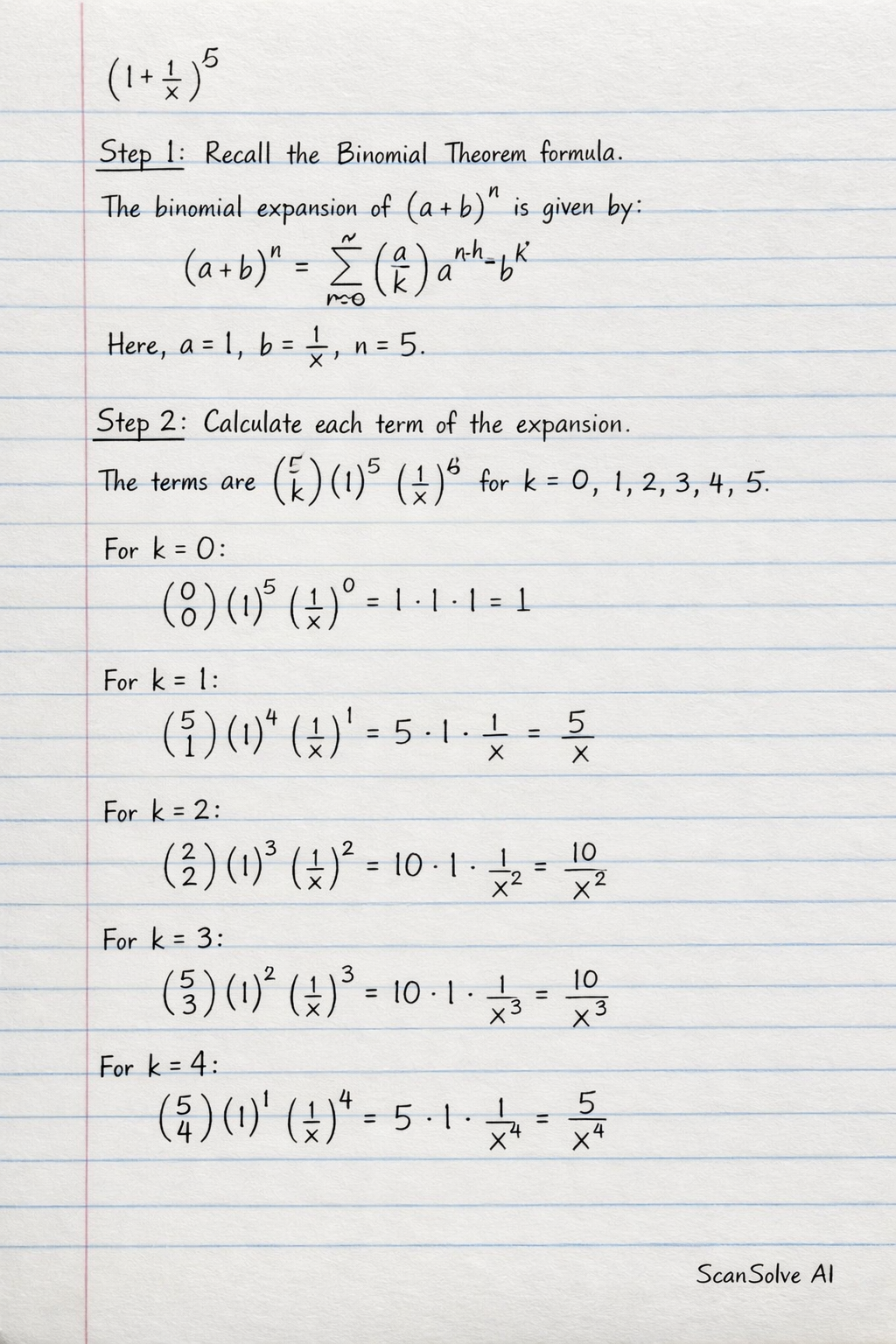
a) To write down the binomial expansion of (1 + (1)/(x)), a power is required. Assuming the question implies the power is 5, similar to part b), we will expand (1 + (1)/(x))^5. Step 1: Recall the Binomial Theorem formula. The binomial expansion of (a+b)^n is given by: (a+b)^n = _k=0^n nk a^n-k b^k In this case, a=1, b=(1)/(x), and n=5. Step 2: Calculate each term of the expansion. The terms are 5k (1)^5-k ((1)/(x))^k for k=0, 1, 2, 3, 4, 5. For k=0: 50 (1)^5 ((1)/(x))^0 = 1 · 1 · 1 = 1 For k=1: 51 (1)^4 ((1)/(x))^1 = 5 · 1 · (1)/(x) = (5)/(x) For k=2: 52 (1)^3 ((1)/(x))^2 = 10 · 1 · (1)/(x^2) = (10)/(x^2) For k=3: 53 (1)^2 ((1)/(x))^3 = 10 · 1 · (1)/(x^3) = (10)/(x^3) For k=4: 54 (1)^1 ((1)/(x))^4 = 5 · 1 · (1)/(x^4) = (5)/(x^4) For k=5: 55 (1)^0 ((1)/(x))^5 = 1 · 1 · (1)/(x^5) = (1)/(x^5) Step 3: Sum the terms to get the full expansion. (1 + (1)/(x))^5 = 1 + (5)/(x) + (10)/(x^2) + (10)/(x^3) + (5)/(x^4) + (1)/(x^5) The simplified binomial expansion is: 1 + (5)/(x) + (10)/(x^2) + (10)/(x^3) + (5)/(x^4) + (1)/(x^5) b) Evaluate (0.05)^5 correct to 4 decimal places. Step 1: Calculate the value of (0.05)^5. (0.05)^5 = (5 × 10^-2)^5 (0.05)^5 = 5^5 × (10^-2)^5 (0.05)^5 = 3125 × 10^-10 (0.05)^5 = 0.0000000003125 Step 2: Round the result to 4 decimal places. To round to 4 decimal places, we look at the fifth decimal place. The number is 0.0000000003125. The first four decimal places are 0, 0, 0, 0. The fifth decimal place is 0. Since the fifth decimal place is 0 (which is less than 5), we keep the fourth decimal place as it is. 0.0000 The value of (0.05)^5 correct to 4 decimal places is: 0.0000