

This mathematics problem involves applying core mathematical principles and formulas. Below you will find a complete step-by-step solution with detailed explanations for each step, helping you understand not just the answer but the method behind it.
ScanSolve AI Answer
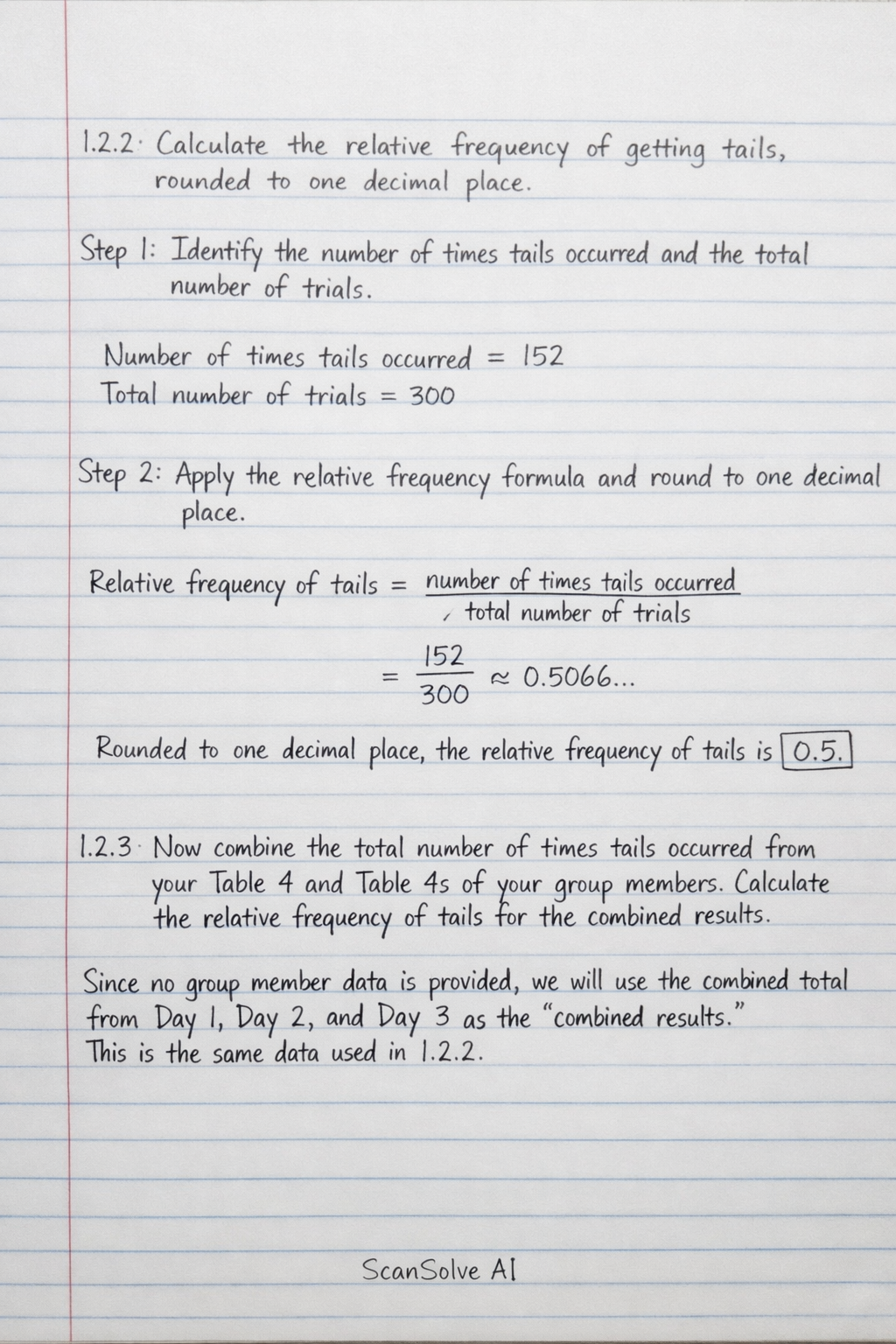
Here are the calculations based on the hypothetical data from the previous problem (Total Heads = 148, Total Tails = 152, Total Trials = 300). 1.2.2 Calculate the relative frequency of getting tails, rounded to one decimal place. Step 1: Identify the number of times tails occurred and the total number of trials. Number of times tails occurred = 152 Total number of trials = 300 Step 2: Apply the relative frequency formula and round to one decimal place. Relative frequency of tails = number of times tails occurredtotal number of trials = (152)/(300) ≈ 0.5066... Rounded to one decimal place, the relative frequency of tails is 0.5. 1.2.3 Now combine the total number of times tails occurred from your Table 4 and Table 4s of your group members. Calculate the relative frequency of the tails for the combined results. Since no group member data is provided, we will use the combined total from Day 1, Day 2, and Day 3 as the "combined results." This is the same data used in 1.2.2. Step 1: Identify the total number of tails and total trials for the combined results. Total number of tails (combined) = 152 Total number of trials (combined) = 300 Step 2: Calculate the relative frequency of tails for the combined results and round to one decimal place. Relative frequency of tails (combined) = (152)/(300) ≈ 0.5066... Rounded to one decimal place, the relative frequency of tails for the combined results is 0.5. 1.3.1 From the relative frequency in 1.2.3, calculate the expected number of tails if the coins are flipped 5 000 times. Step 1: Use the relative frequency of tails from 1.2.3 (0.5) and the new number of trials (5000). Relative frequency of tails = 0.5 Number of trials = 5000 Step 2: Apply the formula for expected number of tails. Expected number of tails = relative frequency × number of trials = 0.5 × 5000 = 2500 1.3.2 Hence, determine the number of heads. Step 1: Use the total number of trials and the expected number of tails. Total number of trials = 5000 Expected number of tails = 2500 Step 2: Calculate the expected number of heads. Expected number of heads = total number of trials - expected number of tails = 5000 - 2500 = 2500 Do you think that the relative frequency of getting tails will be close to the probability of tails if the number of trials were to be increased? Motivate your answer. Yes, the relative frequency of getting tails will be closer to the theoretical probability of tails (which is 0.5 for a fair coin) if the number of trials were to be increased. This is explained by the Law of Large Numbers, which states that as the number of trials in an experiment increases, the observed relative frequency of an event will tend to converge towards the true theoretical probability of that event.