We read your photo as:

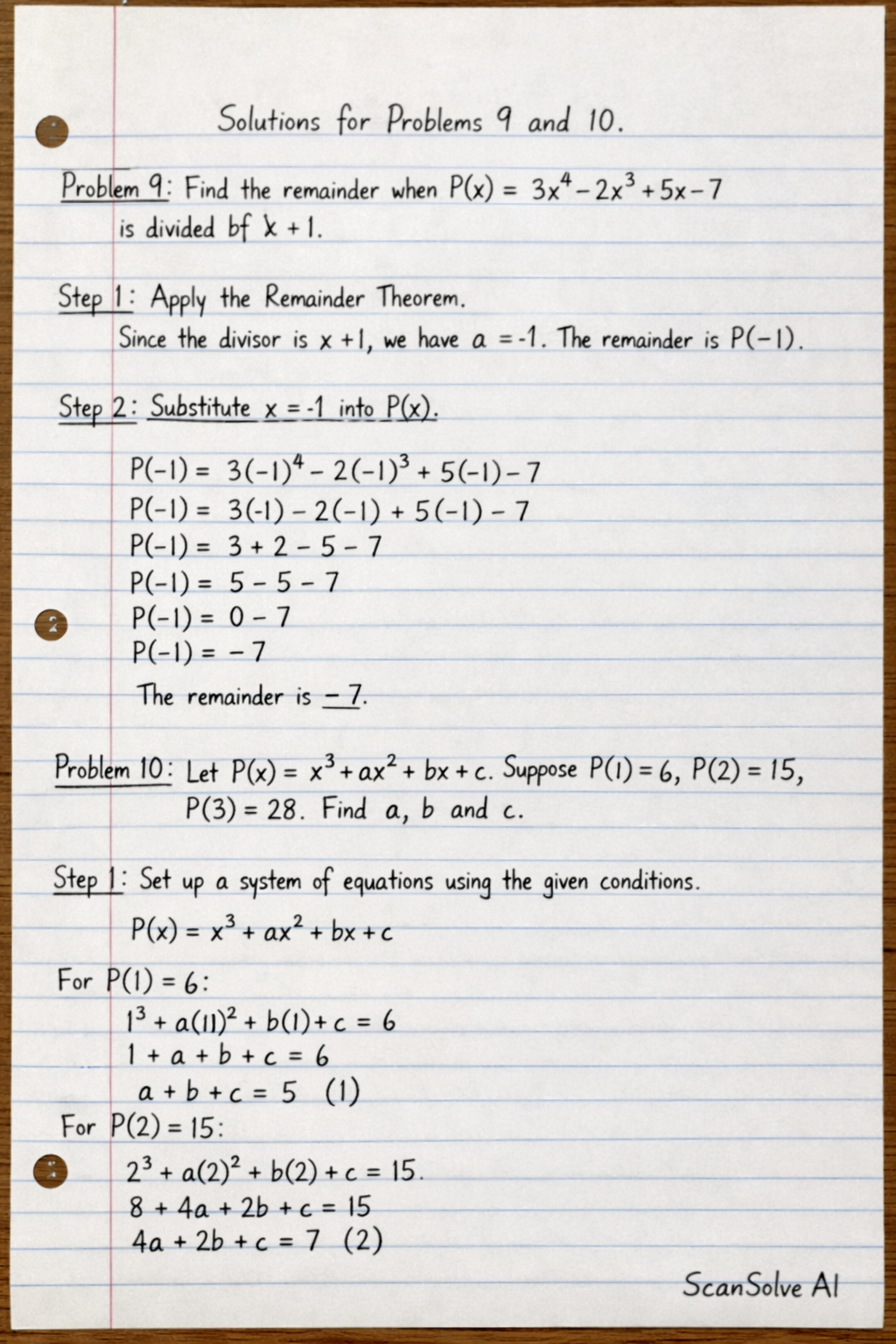
Find the remainder when P(x) = 3x4 − 2x3 + 5x − 7 is divided by x+1. Let P(x) = x3 + ax2 + bx + c. Find a,b,c if P(1)=6, P(2)=15, P(3)=28.

Mathematics

ScanSolve AI Answer

Answer

-7

a=−4,b=14,c=−5,P(x)=x3−4x2+14x−5a=-4, b=14, c=-5, P(x) = x^3 - 4x^2 + 14x - 5

Step-by-step solution

5 steps

Here are the solutions for problems 9 and 10.

: Find the remainder when P(x)=3x4−2x3+5x−7P(x) = 3x^4 - 2x^3 + 5x - 7 is divided by x+1x+1.

  1. Apply the Remainder Theorem.

    According to the Remainder Theorem, if a polynomial P(x)P(x) is divided by (x−a)(x-a), the remainder is P(a)P(a).
    Here, the divisor is x+1x+1, so a=−1a=-1. The remainder is P(−1)P(-1).

  2. Substitute x=−1x=-1 into P(x)P(x).

    P(−1)=3(−1)4−2(−1)3+5(−1)−7P(-1) = 3(-1)^4 - 2(-1)^3 + 5(-1) - 7 P(−1)=3(1)−2(−1)+5(−1)−7P(-1) = 3(1) - 2(-1) + 5(-1) - 7 P(−1)=3+2−5−7P(-1) = 3 + 2 - 5 - 7 P(−1)=5−5−7P(-1) = 5 - 5 - 7 P(−1)=0−7P(-1) = 0 - 7 P(−1)=−7P(-1) = -7

    The remainder is −7\boxed{-7}.

    : Let P(x)=x3+ax2+bx+cP(x) = x^3 + ax^2 + bx + c be a polynomial with real coefficients. Suppose that P(1)=6P(1)=6, P(2)=15P(2)=15, P(3)=28P(3)=28. Find the values of aa, bb, and cc. Hence determine the polynomial P(x)P(x).

  3. Set up a system of equations using the given conditions.

    Given P(x)=x3+ax2+bx+cP(x) = x^3 + ax^2 + bx + c:
    For P(1)=6P(1)=6:

    13+a(1)2+b(1)+c=61^3 + a(1)^2 + b(1) + c = 6 1+a+b+c=61 + a + b + c = 6 a+b+c=5(1)a + b + c = 5 \quad (1)

    For P(2)=15P(2)=15:

    23+a(2)2+b(2)+c=152^3 + a(2)^2 + b(2) + c = 15 8+4a+2b+c=158 + 4a + 2b + c = 15 4a+2b+c=7(2)4a + 2b + c = 7 \quad (2)

    For P(3)=28P(3)=28:

    33+a(3)2+b(3)+c=283^3 + a(3)^2 + b(3) + c = 28 27+9a+3b+c=2827 + 9a + 3b + c = 28 9a+3b+c=1(3)9a + 3b + c = 1 \quad (3)
  4. Solve the system of equations.

    Subtract (1) from (2):

    (4a+2b+c)−(a+b+c)=7−5(4a + 2b + c) - (a + b + c) = 7 - 5 3a+b=2(4)3a + b = 2 \quad (4)

    Subtract (2) from (3):

    (9a+3b+c)−(4a+2b+c)=1−7(9a + 3b + c) - (4a + 2b + c) = 1 - 7 5a+b=−6(5)5a + b = -6 \quad (5)

    Subtract (4) from (5):

    (5a+b)−(3a+b)=−6−2(5a + b) - (3a + b) = -6 - 2 2a=−82a = -8 a=−4a = -4

    Substitute a=−4a=-4 into equation (4):

    3(−4)+b=23(-4) + b = 2 −12+b=2-12 + b = 2 b=14b = 14

    Substitute a=−4a=-4 and b=14b=14 into equation (1):

    −4+14+c=5-4 + 14 + c = 5 10+c=510 + c = 5 c=−5c = -5
  5. State the values of a,b,ca, b, c and the polynomial P(x)P(x).

    The values are a=−4a = -4, b=14b = 14, and c=−5c = -5.
    The polynomial P(x)P(x) is x3−4x2+14x−5x^3 - 4x^2 + 14x - 5.
    The final answer is a=−4,b=14,c=−5,P(x)=x3−4x2+14x−5\boxed{a=-4, b=14, c=-5, P(x) = x^3 - 4x^2 + 14x - 5}.

Was this helpful?

Try one yourself

A new problem that tests the same skill.

Still stuck on this one?

Ask a follow-up, and the answer starts from this question.

Got a different question?Ask your own question
Handwritten step-by-step solution preview

Handwritten Step-by-Step Solution

Get this as a handwritten image on WhatsApp — like a tutor wrote it for you.

Try on WhatsApp