This mathematics problem involves applying core mathematical principles and formulas. Below you will find a complete step-by-step solution with detailed explanations for each step, helping you understand not just the answer but the method behind it.
ScanSolve AI Answer
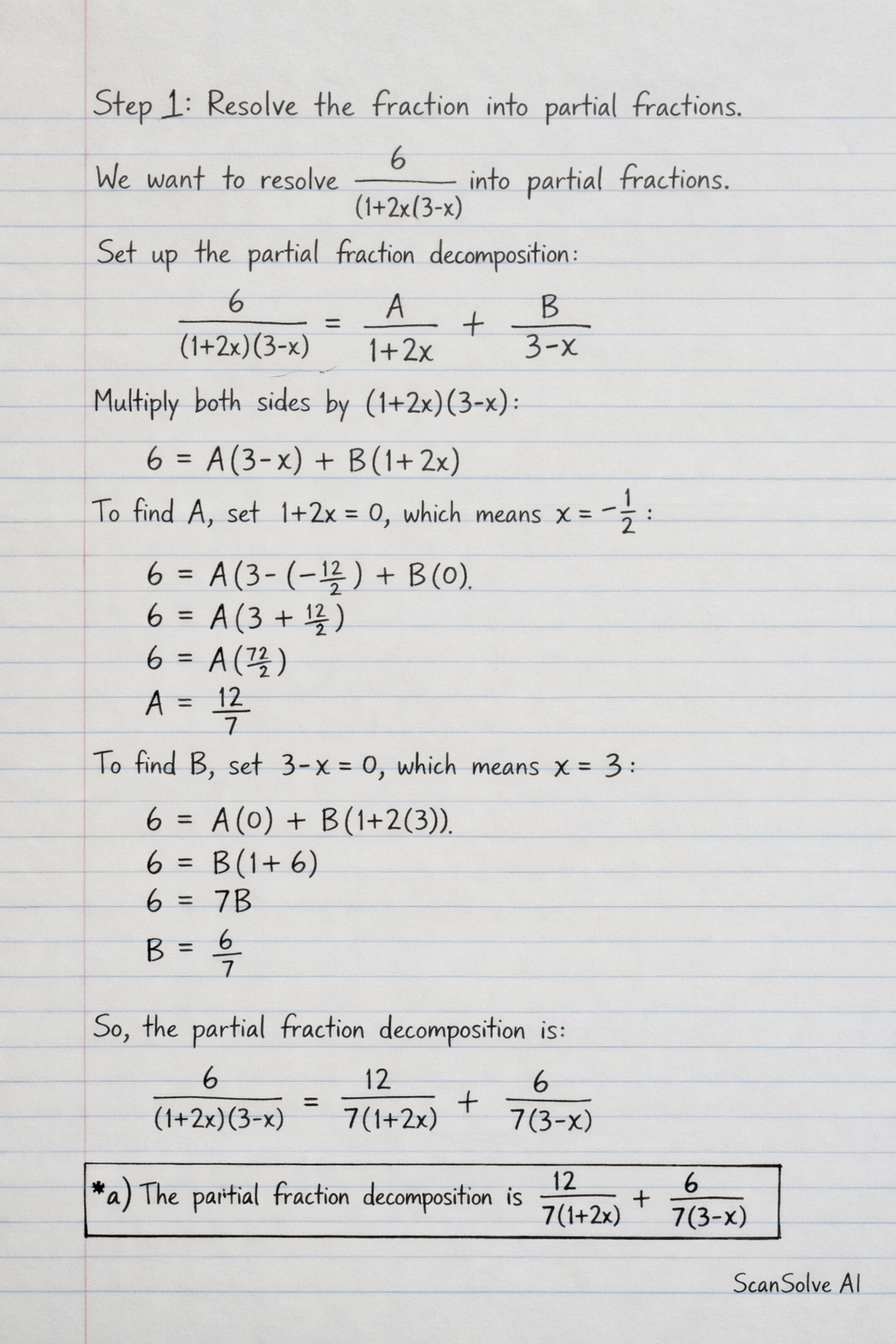
Step 1: Resolve the fraction into partial fractions.
We want to resolve $\frac{6}{(1+2x)(3-x)}$ into partial fractions.
Set up the partial fraction decomposition:
$$ \frac{6}{(1+2x)(3-x)} = \frac{A}{1+2x} + \frac{B}{3-x} $$
Multiply both sides by $(1+2x)(3-x)$:
$$ 6 = A(3-x) + B(1+2x) $$
To find $A$, set $1+2x=0$, which means $x = -\frac{1}{2}$:
$$ 6 = A\left(3 - \left(-\frac{1}{2}\right)\right) + B(0) $$
$$ 6 = A\left(3 + \frac{1}{2}\right) $$
$$ 6 = A\left(\frac{7}{2}\right) $$
$$ A = \frac{12}{7} $$
To find $B$, set $3-x=0$, which means $x = 3$:
$$ 6 = A(0) + B(1+2(3)) $$
$$ 6 = B(1+6) $$
$$ 6 = 7B $$
$$ B = \frac{6}{7} $$
So, the partial fraction decomposition is:
$$ \frac{6}{(1+2x)(3-x)} = \frac{12}{7(1+2x)} + \frac{6}{7(3-x)} $$
a) The partial fraction decomposition is $\boxed{\frac{12}{7(1+2x)} + \frac{6}{7(3-x)}}$.
Step 2: Solve the differential equation.
The given differential equation is $(1+2x)(3-x)\frac{dy}{dx} = 6(y-2)$.
Rearrange the equation to separate variables:
$$ \frac{dy}{y-2} = \frac{6}{(1+2x)(3-x)} dx $$
Using the result from part (a), substitute the partial fraction decomposition:
$$ \frac{dy}{y-2} = \left(\frac{12}{7(1+2x)} + \frac{6}{7(3-x)}\right) dx $$
Integrate both sides:
$$ \int \frac{1}{y-2} dy = \int \left(\frac{12}{7(1+2x)} + \frac{6}{7(3-x)}\right) dx $$
$$ \ln|y-2| = \frac{12}{7} \int \frac{1}{1+2x} dx + \frac{6}{7} \int \frac{1}{3-x} dx $$
For $\int \frac{1}{1+2x} dx$, let $u=1+2x$, so $du=2dx$. The integral becomes $\frac{1}{2}\int \frac{1}{u} du = \frac{1}{2}\ln|1+2x|$.
For $\int \frac{1}{3-x} dx$, let $v=3-x$, so $dv=-dx$. The integral becomes $-\int \frac{1}{v} dv = -\ln|3-x|$.
Substitute these back into the equation:
$$ \ln|y-2| = \frac{12}{7} \left(\frac{1}{2}\ln|1+2x|\right) + \frac{6}{7} (-\ln|3-x|) + C $$
$$ \ln|y-2| = \frac{6}{7}\ln|1+2x| - \frac{6}{7}\ln|3-x| + C $$
Combine the logarithmic terms on the right side:
$$ \ln|y-2| = \frac{6}{7}\ln\left|\frac{1+2x}{3-x}\right| + C $$
Step 3: Apply the initial condition to find $C$.
Given that $y=3$ when $x=0$:
$$ \ln|3-2| = \frac{6}{7}\ln\left|\frac{1+2(0)}{3-0}\right| + C $$
$$ \ln(1) = \frac{6}{7}\ln\left|\frac{1}{3}\right| + C $$
$$ 0 = \frac{6}{7}\ln\left(\frac{1}{3}\right) + C $$
Since $\ln\left(\frac{1}{3}\right) = \ln(3^{-1}) = -\ln(3)$:
$$ 0 = \frac{6}{7}(-\ln(3)) + C $$
$$ C = \frac{6}{7}\ln(3) $$
Step 4: Write the particular solution.
Substitute the value of $C$ back into the general solution:
$$ \ln|y-2| = \frac{6}{7}\ln\left|\frac{1+2x}{3-x}\right| + \frac{6}{7}\ln(3) $$
$$ \ln|y-2| = \frac{6}{7}\left(\ln\left|\frac{1+2x}{3-x}\right| + \ln(3)\right) $$
Using the logarithm property $\ln a + \ln b = \ln(ab)$:
$$ \ln|y-2| = \frac{6}{7}\ln\left|3 \cdot \frac{1+2x}{3-x}\right| $$
Using the logarithm property $k\ln a = \ln(a^k)$:
$$ \ln|y-2| = \ln\left|\left(\frac{3(1+2x)}{3-x}\right)^{6/7}\right| $$
Exponentiate both sides to remove the logarithm:
$$ |y-2| = \left|\left(\frac{3(1+2x)}{3-x}\right)^{6/7}\right| $$
Since $y=3$ when $x=0$, $y-2=1 > 0$. Also, $\frac{3(1+2(0))}{3-0} = \frac{3}{3} = 1 > 0$. Therefore, we can remove the absolute value signs.
$$ y-2 = \left(\frac{3(1+2x)}{3-x}\right)^{6/7} $$
$$ y = 2 + \left(\frac{3(1+2x)}{3-x}\right)^{6/7} $$
b) The solution to the differential equation is $\boxed{y = 2 + \left(\frac{3(1+2x)}{3-x
Question
Resolve the fraction into partial fractions.
|Mathematics
Resolve the fraction into partial fractions.
Answer
Step 1: Resolve the fraction into partial fractions.
We want to resolve (1+2x)(3−x)6 into partial fractions.
Set up the partial fraction decomposition:
(1+2x)(3−x)6=1+2xA+3−xB
Multiply both sides by (1+2x)(3−x):
6=A(3−x)+B(1+2x)
To find A, set 1+2x=0, which means x=−21:
6=A(3−(−21))+B(0)6=A(3+21)6=A(27)A=712
To find B, set 3−x=0, which means x=3:
6=A(0)+B(1+2(3))6=B(1+6)6=7BB=76
So, the partial fraction decomposition is:
(1+2x)(3−x)6=7(1+2x)12+7(3−x)6a) The partial fraction decomposition is 7(1+2x)12+7(3−x)6.
Step 2: Solve the differential equation.
The given differential equation is (1+2x)(3−x)dxdy=6(y−2).
Rearrange the equation to separate variables:
y−2dy=(1+2x)(3−x)6dx
Using the result from part (a), substitute the partial fraction decomposition:
y−2dy=(7(1+2x)12+7(3−x)6)dx
Integrate both sides:
∫y−21dy=∫(7(1+2x)12+7(3−x)6)dxln∣y−2∣=712∫1+2x1dx+76∫3−x1dx
For ∫1+2x1dx, let u=1+2x, so du=2dx. The integral becomes 21∫u1du=21ln∣1+2x∣.
For ∫3−x1dx, let v=3−x, so dv=−dx. The integral becomes −∫v1dv=−ln∣3−x∣.
Substitute these back into the equation:
ln∣y−2∣=712(21ln∣1+2x∣)+76(−ln∣3−x∣)+Cln∣y−2∣=76ln∣1+2x∣−76ln∣3−x∣+C
Combine the logarithmic terms on the right side:
ln∣y−2∣=76ln3−x1+2x+C
Step 3: Apply the initial condition to find C.
Given that y=3 when x=0:
ln∣3−2∣=76ln3−01+2(0)+Cln(1)=76ln31+C0=76ln(31)+C
Since ln(31)=ln(3−1)=−ln(3):
0=76(−ln(3))+CC=76ln(3)
Step 4: Write the particular solution.
Substitute the value of C back into the general solution:
ln∣y−2∣=76ln3−x1+2x+76ln(3)ln∣y−2∣=76(ln3−x1+2x+ln(3))
Using the logarithm property lna+lnb=ln(ab):
ln∣y−2∣=76ln3⋅3−x1+2x
Using the logarithm property klna=ln(ak):
ln∣y−2∣=ln(3−x3(1+2x))6/7
Exponentiate both sides to remove the logarithm:
∣y−2∣=(3−x3(1+2x))6/7
Since y=3 when x=0, y−2=1>0. Also, 3−03(1+2(0))=33=1>0. Therefore, we can remove the absolute value signs.
y−2=(3−x3(1+2x))6/7y=2+(3−x3(1+2x))6/7b) The solution to the differential equation is $\boxed{y = 2 + \left(\frac{3(1+2x)}{3-x
Need help with your own homework?
Get instant step-by-step solutions to any question. Free to start.