
We read your photo as:
Rewrite the differential equation in standard linear form.
ScanSolve AI Answer
Answer
Step-by-step solution
5 stepsRewrite the differential equation in standard linear form.
The given equation is:
Divide by (which is equivalent to multiplying by ):
Rearrange into the standard form :
Here, and .
Calculate the integrating factor .
The integrating factor is given by .
Multiply the standard form equation by the integrating factor.
The left side of the equation is the derivative of the product :
Integrate both sides with respect to .
To evaluate the integral on the right side, use a substitution. Let , so .
The integral becomes:This integral requires integration by parts, .
Let and .
Then and .Factor out :
Substitute back :
Substitute the result of the integral back into the equation and solve for .
Divide both sides by :
Try one yourself
A new problem that tests the same skill.
Still stuck on this one?
Ask a follow-up, and the answer starts from this question.
More Mathematics Questions
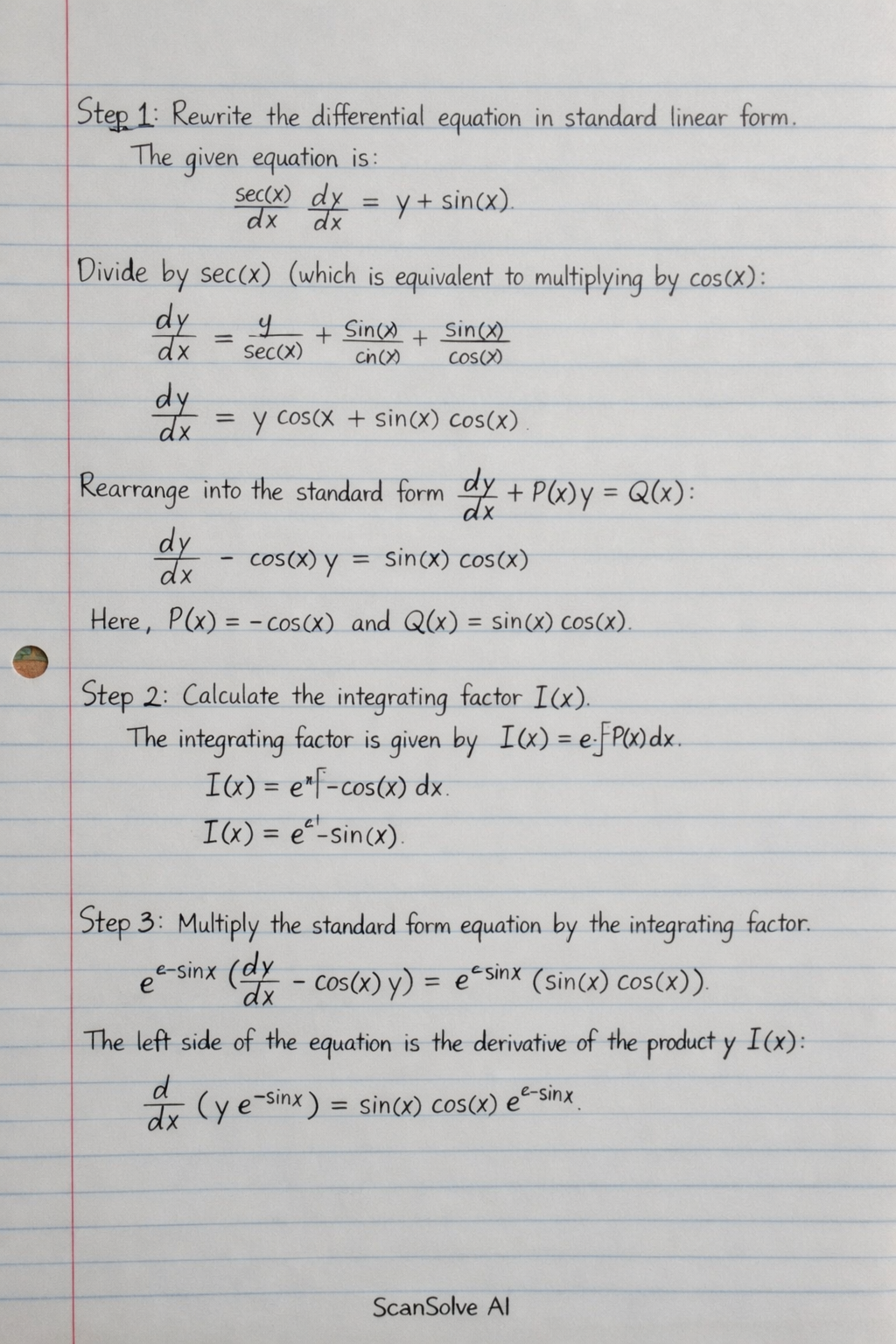
Handwritten Step-by-Step Solution
Get this as a handwritten image on WhatsApp — like a tutor wrote it for you.
Try on WhatsApp