Solve for x: 3.1 x2-2x-3>0, 3.2 x2+x-6<0, 3.3 x2-2x≥0, 3.4 x2+x-12≤0, 3.5 2-x-x2>0, 3.6 10+x≤2x2, 3.7 x2>4

Mathematics
Solve for x: 3.1 x2-2x-3>0, 3.2 x2+x-6<0, 3.3 x2-2x≥0, 3.4 x2+x-12≤0, 3.5 2-x-x2>0, 3.6 10+x≤2x2, 3.7 x2>4

ScanSolve AI Answer

Answer

x < -1 \quad or \quad x > 3

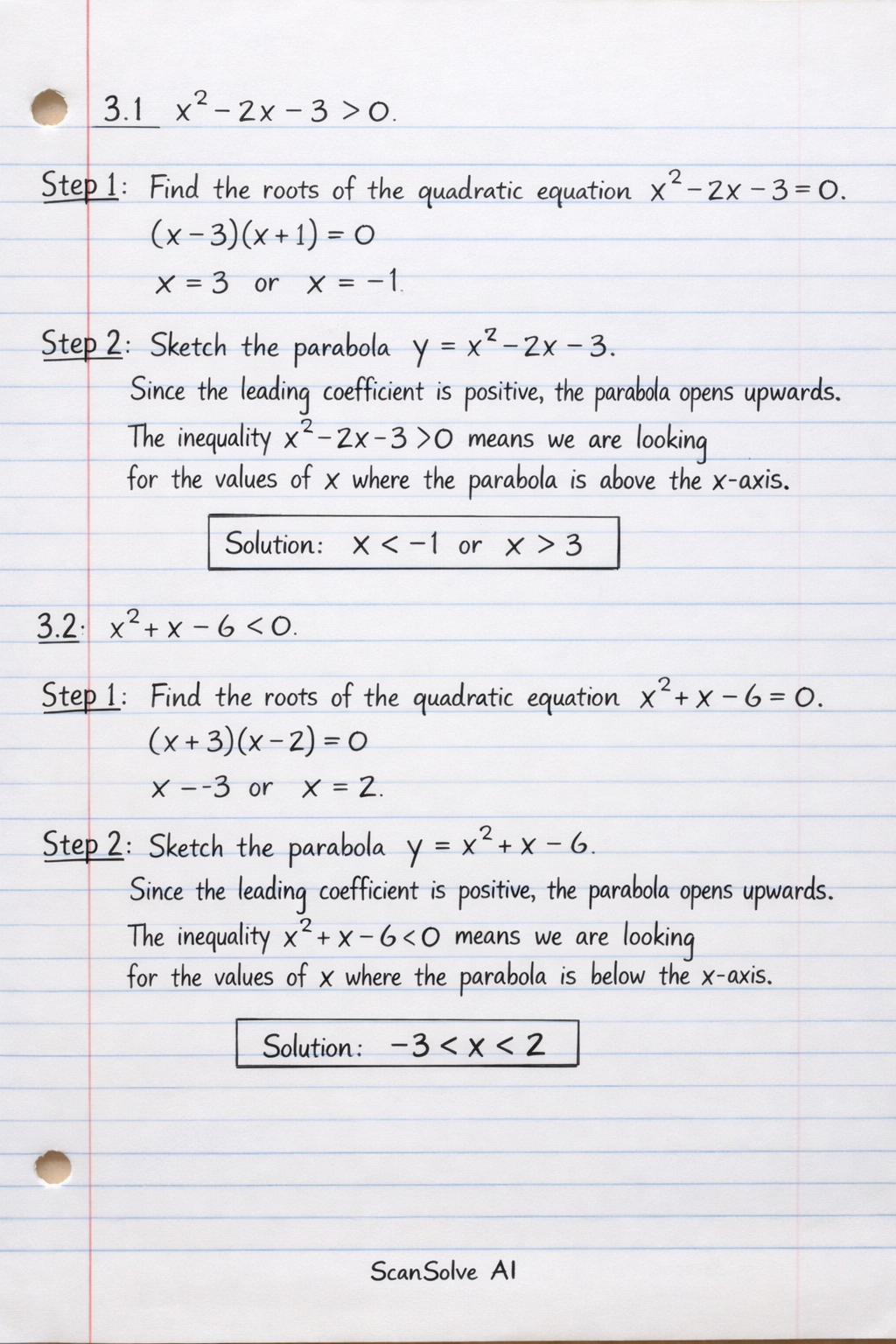
3.1 x22x3>0x^2 - 2x - 3 > 0 Step 1: Find the roots of the quadratic equation x22x3=0x^2 - 2x - 3 = 0. (x3)(x+1)=0(x-3)(x+1) = 0 x=3orx=1x = 3 \quad or \quad x = -1 Step 2: Sketch the parabola y=x22x3y = x^2 - 2x - 3. Since the leading coefficient is positive, the parabola opens upwards. The inequality x22x3>0x^2 - 2x - 3 > 0 means we are looking for the values of xx where the parabola is above the x-axis. Solution: x<1orx>3\boxed{x < -1 \quad or \quad x > 3}

3.2 x2+x6<0x^2 + x - 6 < 0 Step 1: Find the roots of the quadratic equation x2+x6=0x^2 + x - 6 = 0. (x+3)(x2)=0(x+3)(x-2) = 0 x=3orx=2x = -3 \quad or \quad x = 2 Step 2: Sketch the parabola y=x2+x6y = x^2 + x - 6. Since the leading coefficient is positive, the parabola opens upwards. The inequality x2+x6<0x^2 + x - 6 < 0 means we are looking for the values of xx where the parabola is below the x-axis. Solution: 3<x<2\boxed{-3 < x < 2}

3.3 x22x0x^2 - 2x \ge 0 Step 1: Find the roots of the quadratic equation x22x=0x^2 - 2x = 0. x(x2)=0x(x-2) = 0 x=0orx=2x = 0 \quad or \quad x = 2 Step 2: Sketch the parabola y=x22xy = x^2 - 2x. Since the leading coefficient is positive, the parabola opens upwards. The inequality x22x0x^2 - 2x \ge 0 means we are looking for the values of xx where the parabola is above or on the x-axis. Solution: x0orx2\boxed{x \le 0 \quad or \quad x \ge 2}

3.4 x2+x120x^2 + x - 12 \le 0 Step 1: Find the roots of the quadratic equation x2+x12=0x^2 + x - 12 = 0. (x+4)(x3)=0(x+4)(x-3) = 0 x=4orx=3x = -4 \quad or \quad x = 3 Step 2: Sketch the parabola y=x2+x12y = x^2 + x - 12. Since the leading coefficient is positive, the parabola opens upwards. The inequality x2+x120x^2 + x - 12 \le 0 means we are looking for the values of xx where the parabola is below or on the x-axis. Solution: 4x3\boxed{-4 \le x \le 3}

3.5 2xx2>02 - x - x^2 > 0 Step 1: Rewrite the inequality by multiplying by -1 and reversing the sign. x2x+2>0-x^2 - x + 2 > 0 x2+x2<0x^2 + x - 2 < 0 Step 2: Find the roots of the quadratic equation x2+x2=0x^2 + x - 2 = 0. (x+2)(x1)=0(x+2)(x-1) = 0 x=2orx=1x = -2 \quad or \quad x = 1 Step 3: Sketch the parabola y=x2+x2y = x^2 + x - 2. Since the leading coefficient is positive, the parabola opens upwards. The inequality x2+x2<0x^2 + x - 2 < 0 means we are looking for the values of xx where the parabola is below the x-axis. Solution: 2<x<1\boxed{-2 < x < 1}

3.6 10+x2x210 + x \le 2x^2 Step 1: Rearrange the inequality to have 0 on one side. 02x2x100 \le 2x^2 - x - 10 2x2x1002x^2 - x - 10 \ge 0 Step 2: Find the roots of the quadratic equation 2x2x10=02x^2 - x - 10 = 0 using the quadratic formula x=b±b24ac2ax = \frac{-b \pm \sqrt{b^2 - 4ac}}{2a}. x=(1)±(1)24(2)(10)2(2)x = \frac{-(-1) \pm \sqrt{(-1)^2 - 4(2)(-10)}}{2(2)} x=1±1+804x = \frac{1 \pm \sqrt{1 + 80}}{4} x=1±814x = \frac{1 \pm \sqrt{81}}{4} x=1±94x = \frac{1 \pm 9}{4} x1=1+94=104=52x_1 = \frac{1 + 9}{4} = \frac{10}{4} = \frac{5}{2} x2=194=84=2x_2 = \frac{1 - 9}{4} = \frac{-8}{4} = -2 Step 3: Sketch the parabola y=2x2x10y = 2x^2 - x - 10. Since the leading coefficient is positive, the parabola opens upwards. The inequality 2x2x1002x^2 - x - 10 \ge 0 means we are looking for the values of xx where the parabola is above or on the x-axis. Solution: x2orx52\boxed{x \le -2 \quad or \quad x \ge \frac{5}{2}}

3.7 x2>4x^2 > 4 Step 1: Rearrange the inequality to have 0 on one side. x24>0x^2 - 4 > 0 Step 2: Find the roots of the quadratic equation x24=0x^2 - 4 = 0. (x2)(x+2)=0(x-2)(x+2) = 0 x=2orx=2x = 2 \quad or \quad x = -2 Step 3: Sketch the parabola y=x24y = x^2 - 4. Since the leading coefficient is positive, the parabola opens upwards. The inequality x24>0x^2 - 4 > 0 means we are looking for the values of xx where the parabola is above the x-axis. Solution: x<2orx>2\boxed{x < -2 \quad or \quad x > 2}

Was this helpful?

Need help with your own homework?

Get instant step-by-step solutions to any question. Free to start.

Ask Your Question
Handwritten step-by-step solution preview

Handwritten Step-by-Step Solution

Get this as a handwritten image on WhatsApp — like a tutor wrote it for you.

Try on WhatsApp

Still have questions?

Quick Answer

3.1 x^2 - 2x - 3 > 0 Step 1: Find the roots of the quadratic equation x^2 - 2x - 3 = 0.

Solve for x: 3.1 x2-2x-3>0, 3.2 x2+x-6<0, 3.3 x2-2x≥0, 3.4 x2+x-12≤0, 3.5 2-x-x2>0, 3.6 10+x≤2x2, 3.7 x2>4
Mathematics

This mathematics problem involves applying core mathematical principles and formulas. Below you will find a complete step-by-step solution with detailed explanations for each step, helping you understand not just the answer but the method behind it.

ScanSolve AI Answer
3.1 x^2 - 2x - 3 > 0 Step 1: Find the roots of the quadratic equation x^2 - 2x - 3 = 0. (x-3)(x+1) = 0 x = 3 or x = -1 Step 2: Sketch the parabola y = x^2 - 2x - 3. Since the leading coefficient is positive, the parabola opens upwards. The inequality x^2 - 2x - 3 > 0 means we are looking for the values of x where the parabola is above the x-axis. Solution: x < -1 or x > 3 3.2 x^2 + x - 6 < 0 Step 1: Find the roots of the quadratic equation x^2 + x - 6 = 0. (x+3)(x-2) = 0 x = -3 or x = 2 Step 2: Sketch the parabola y = x^2 + x - 6. Since the leading coefficient is positive, the parabola opens upwards. The inequality x^2 + x - 6 < 0 means we are looking for the values of x where the parabola is below the x-axis. Solution: -3 < x < 2 3.3 x^2 - 2x 0 Step 1: Find the roots of the quadratic equation x^2 - 2x = 0. x(x-2) = 0 x = 0 or x = 2 Step 2: Sketch the parabola y = x^2 - 2x. Since the leading coefficient is positive, the parabola opens upwards. The inequality x^2 - 2x 0 means we are looking for the values of x where the parabola is above or on the x-axis. Solution: x 0 or x 2 3.4 x^2 + x - 12 0 Step 1: Find the roots of the quadratic equation x^2 + x - 12 = 0. (x+4)(x-3) = 0 x = -4 or x = 3 Step 2: Sketch the parabola y = x^2 + x - 12. Since the leading coefficient is positive, the parabola opens upwards. The inequality x^2 + x - 12 0 means we are looking for the values of x where the parabola is below or on the x-axis. Solution: -4 x 3 3.5 2 - x - x^2 > 0 Step 1: Rewrite the inequality by multiplying by -1 and reversing the sign. -x^2 - x + 2 > 0 x^2 + x - 2 < 0 Step 2: Find the roots of the quadratic equation x^2 + x - 2 = 0. (x+2)(x-1) = 0 x = -2 or x = 1 Step 3: Sketch the parabola y = x^2 + x - 2. Since the leading coefficient is positive, the parabola opens upwards. The inequality x^2 + x - 2 < 0 means we are looking for the values of x where the parabola is below the x-axis. Solution: -2 < x < 1 3.6 10 + x 2x^2 Step 1: Rearrange the inequality to have 0 on one side. 0 2x^2 - x - 10 2x^2 - x - 10 0 Step 2: Find the roots of the quadratic equation 2x^2 - x - 10 = 0 using the quadratic formula x = -b ± sqrt(b^2 - 4ac)2a. x = -(-1) ± sqrt((-1)^2 - 4(2)(-10))2(2) x = 1 ± sqrt(1 + 80)4 x = 1 ± sqrt(81)4 x = (1 ± 9)/(4) x_1 = (1 + 9)/(4) = (10)/(4) = (5)/(2) x_2 = (1 - 9)/(4) = (-8)/(4) = -2 Step 3: Sketch the parabola y = 2x^2 - x - 10. Since the leading coefficient is positive, the parabola opens upwards. The inequality 2x^2 - x - 10 0 means we are looking for the values of x where the parabola is above or on the x-axis. Solution: x -2 or x (5)/(2) 3.7 x^2 > 4 Step 1: Rearrange the inequality to have 0 on one side. x^2 - 4 > 0 Step 2: Find the roots of the quadratic equation x^2 - 4 = 0. (x-2)(x+2) = 0 x = 2 or x = -2 Step 3: Sketch the parabola y = x^2 - 4. Since the leading coefficient is positive, the parabola opens upwards. The inequality x^2 - 4 > 0 means we are looking for the values of x where the parabola is above the x-axis. Solution: x < -2 or x > 2