This mathematics problem involves applying core mathematical principles and formulas. Below you will find a complete step-by-step solution with detailed explanations for each step, helping you understand not just the answer but the method behind it.
ScanSolve AI Answer
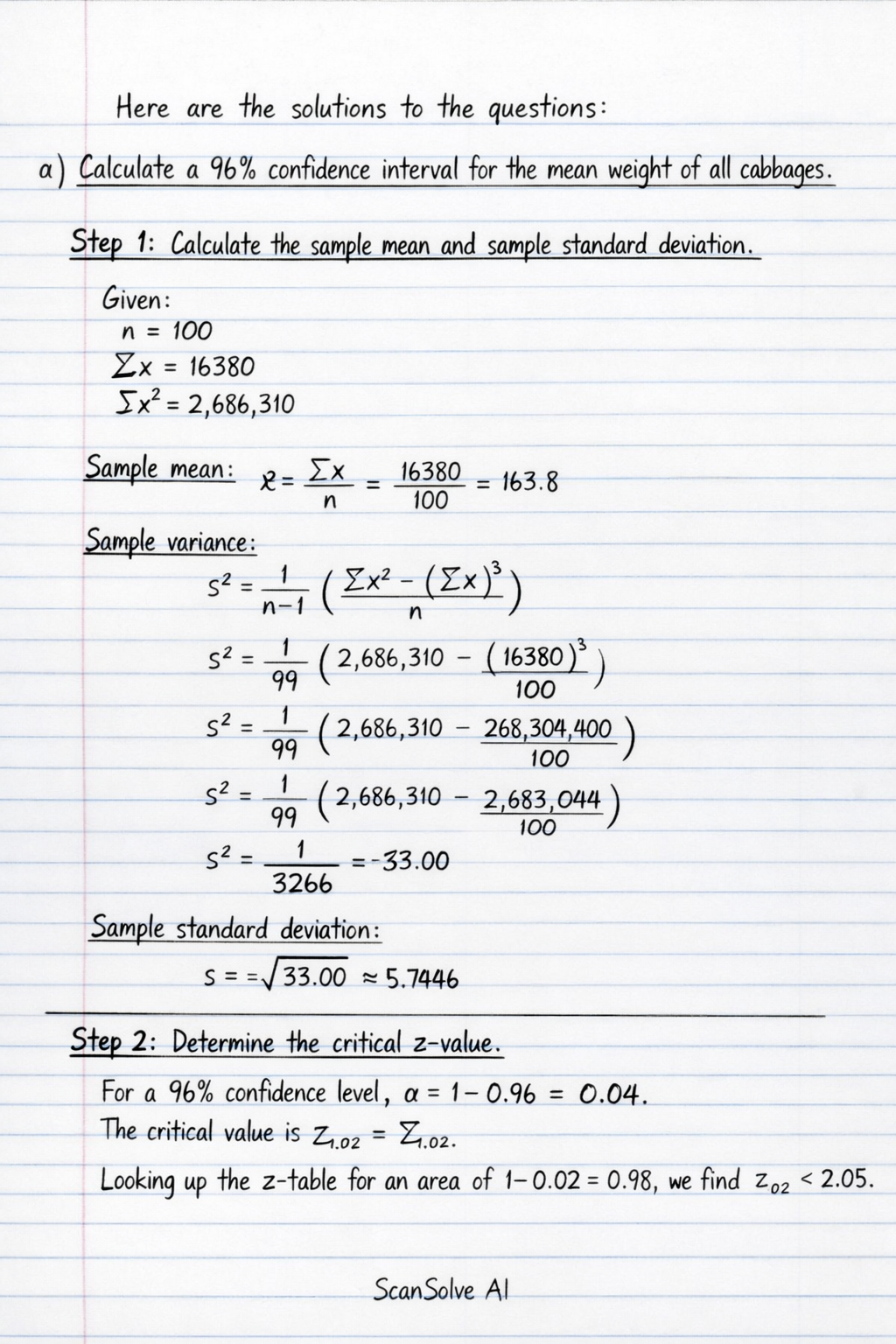
Here are the solutions to the questions:
a) Calculate a 96% confidence interval for the mean weight of all cabbages.
Step 1: Calculate the sample mean and sample standard deviation.
Given:
Sample size, $n = 100$
Sum of weights, $\sum x = 16380$
Sum of squared weights, $\sum x^2 = 2,686,310$
Sample mean:
$$ \bar{x} = \frac{\sum x}{n} = \frac{16380}{100} = 163.8 $$
Sample variance:
$$ s^2 = \frac{1}{n-1} \left( \sum x^2 - \frac{(\sum x)^2}{n} \right) $$
$$ s^2 = \frac{1}{100-1} \left( 2,686,310 - \frac{(16380)^2}{100} \right) $$
$$ s^2 = \frac{1}{99} \left( 2,686,310 - \frac{268304400}{100} \right) $$
$$ s^2 = \frac{1}{99} \left( 2,686,310 - 2,683,044 \right) $$
$$ s^2 = \frac{3266}{99} \approx 33.00 $$
Sample standard deviation:
$$ s = \sqrt{33.00} \approx 5.7446 $$
Step 2: Determine the critical z-value.
For a 96% confidence level, $\alpha = 1 - 0.96 = 0.04$.
The critical value is $z_{\alpha/2} = z_{0.02}$.
Looking up the z-table for an area of $1 - 0.02 = 0.98$, we find $z_{0.02} \approx 2.05$.
Step 3: Calculate the margin of error.
The margin of error ($E$) is given by:
$$ E = z_{\alpha/2} \frac{s}{\sqrt{n}} $$
$$ E = 2.05 \times \frac{5.7446}{\sqrt{100}} $$
$$ E = 2.05 \times \frac{5.7446}{10} $$
$$ E = 2.05 \times 0.57446 \approx 1.1776 $$
Step 4: Construct the confidence interval.
The confidence interval is $\bar{x} \pm E$:
$$ 163.8 \pm 1.1776 $$
Lower bound: $163.8 - 1.1776 = 162.6224$
Upper bound:
Calculate the sample mean and sample standard deviation.
|Mathematics
Calculate the sample mean and sample standard deviation.
ScanSolve AI Answer
Here are the solutions to the questions:
a) Calculate a 96% confidence interval for the mean weight of all cabbages.
Step 1: Calculate the sample mean and sample standard deviation.
Given:
Sample size, n=100
Sum of weights, ∑x=16380
Sum of squared weights, ∑x2=2,686,310
Sample mean:
xˉ=n∑x=10016380=163.8
Sample variance:
s2=n−11(∑x2−n(∑x)2)s2=100−11(2,686,310−100(16380)2)s2=991(2,686,310−100268304400)s2=991(2,686,310−2,683,044)s2=993266≈33.00
Sample standard deviation:
s=33.00≈5.7446
Step 2: Determine the critical z-value.
For a 96% confidence level, α=1−0.96=0.04.
The critical value is zα/2=z0.02.
Looking up the z-table for an area of 1−0.02=0.98, we find z0.02≈2.05.
Step 3: Calculate the margin of error.
The margin of error (E) is given by:
E=zα/2nsE=2.05×1005.7446E=2.05×105.7446E=2.05×0.57446≈1.1776
Step 4: Construct the confidence interval.
The confidence interval is xˉ±E:
163.8±1.1776
Lower bound: 163.8−1.1776=162.6224
Upper bound:
Need help with your own homework?
Get instant step-by-step solutions to any question. Free to start.