
We read your photo as:
Set up the partial fraction decomposition.
ScanSolve AI Answer
Step-by-step solution
12 stepsSet up the partial fraction decomposition.
The denominator has a linear factor and an irreducible quadratic factor .
Multiply both sides by the common denominator .
Solve for , , and .
Substitute :
Expand the equation:
Equate coefficients:
Coefficient of :Substitute :
Coefficient of :
Substitute :
Constant term (for verification):
Substitute and :
The values are consistent.
Write the partial fraction decomposition.
The final answer is .
Set up the partial fraction decomposition.
The denominator has a linear factor and an irreducible quadratic factor .
Multiply both sides by the common denominator .
Solve for , , and .
Substitute :
Expand the equation:
Equate coefficients:
Coefficient of :Substitute :
Coefficient of :
Substitute :
Constant term (for verification):
Substitute and :
The values are consistent.
Write the partial fraction decomposition.
The final answer is .
The given equation is
Multiply both sides by the common denominator .
Solve for and .
To find , substitute :
To find , substitute :
Evaluate .
The final answer is .
Still stuck on this one?
Ask a follow-up, and the answer starts from this question.
More Mathematics Questions
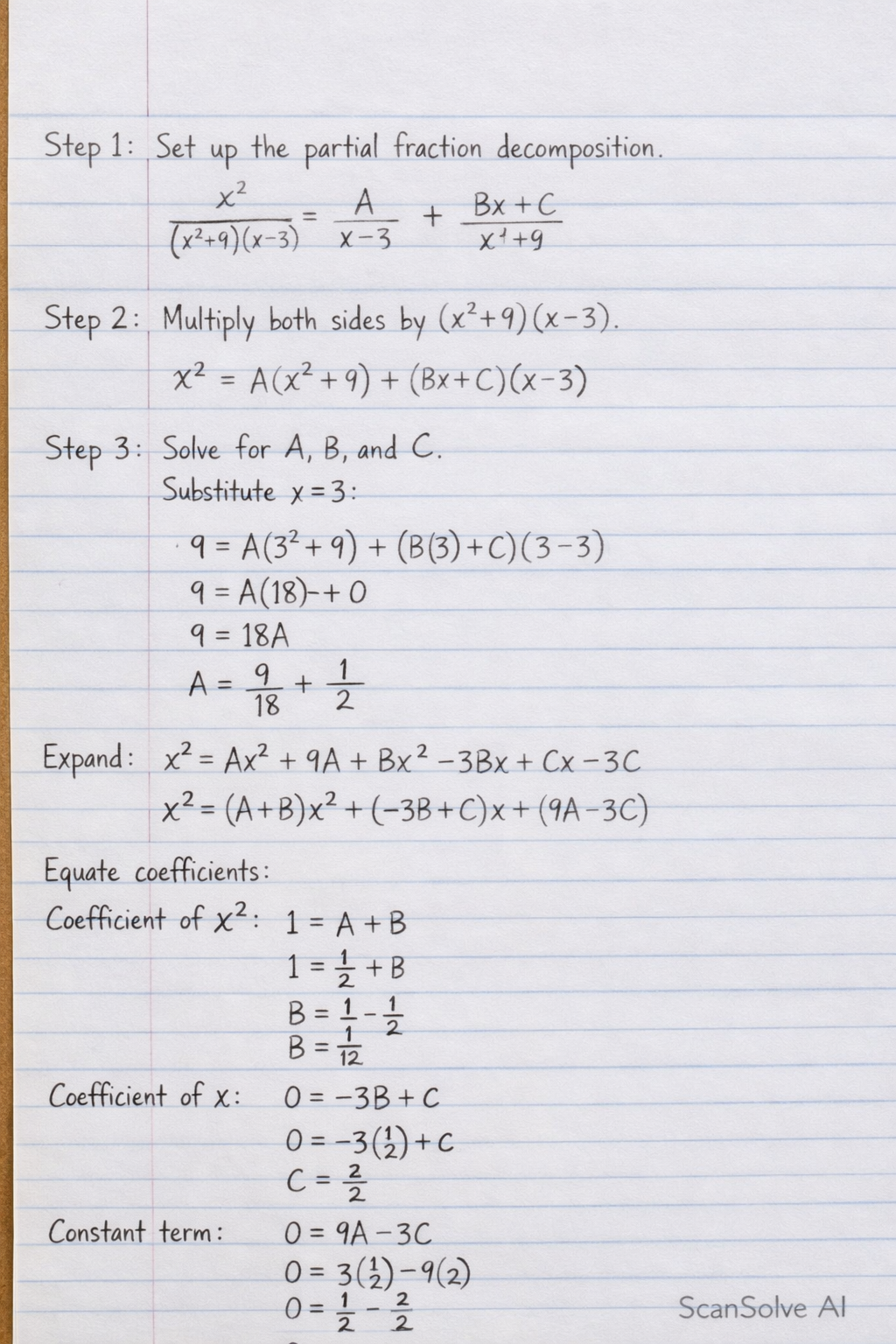
Handwritten Step-by-Step Solution
Get this as a handwritten image on WhatsApp — like a tutor wrote it for you.
Try on WhatsApp