We read your photo as:

Find the shortest distance between the two skew lines L and M given by their symmetric equations.

Mathematics

ScanSolve AI Answer

Answer

68230115\frac{68\sqrt{230}}{115}

Step-by-step solution

6 steps

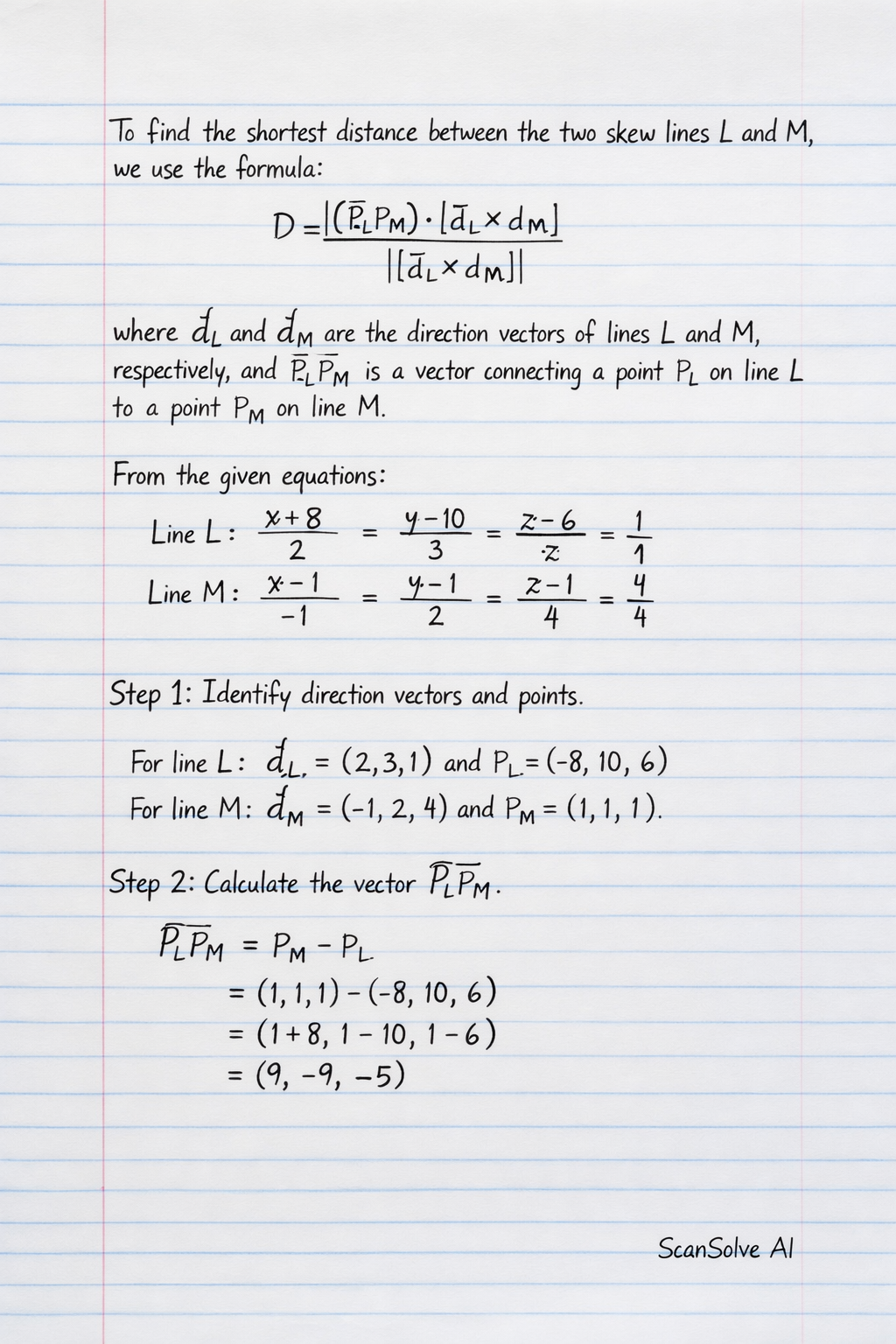
To find the shortest distance between the two skew lines L and M, we use the formula:

D=∣(PLPM⃗)⋅(dL⃗×dM⃗)∣∥dL⃗×dM⃗∥D = \frac{|(\vec{P_L P_M}) \cdot (\vec{d_L} \times \vec{d_M})|}{\|\vec{d_L} \times \vec{d_M}\|}

where dL⃗\vec{d_L} and dM⃗\vec{d_M} are the direction vectors of lines L and M, respectively, and PLPM⃗\vec{P_L P_M} is a vector connecting a point PLP_L on line L to a point PMP_M on line M.

From the given equations:
Line L: x+82=y−103=z−61\frac{x+8}{2} = \frac{y-10}{3} = \frac{z-6}{1}
Line M: x−1−1=y−12=z−14\frac{x-1}{-1} = \frac{y-1}{2} = \frac{z-1}{4}

  1. Identify direction vectors and points.

    For line L: dL⃗=(231)\vec{d_L} = \begin{pmatrix} 2 \\ 3 \\ 1 \end{pmatrix} and PL=(−8,10,6)P_L = (-8, 10, 6).
    For line M: dM⃗=(−124)\vec{d_M} = \begin{pmatrix} -1 \\ 2 \\ 4 \end{pmatrix} and PM=(1,1,1)P_M = (1, 1, 1).

  2. Calculate the vector PLPM⃗\vec{P_L P_M}.

    PLPM⃗=PM−PL=(1−(−8),1−10,1−6)=(9,−9,−5)\vec{P_L P_M} = P_M - P_L = (1 - (-8), 1 - 10, 1 - 6) = (9, -9, -5)
  3. Calculate the cross product of the direction vectors, dL⃗×dM⃗\vec{d_L} \times \vec{d_M}.

    dL⃗×dM⃗=∣ijk231−124∣\vec{d_L} \times \vec{d_M} = \begin{vmatrix} \mathbf{i} & \mathbf{j} & \mathbf{k} \\ 2 & 3 & 1 \\ -1 & 2 & 4 \end{vmatrix} =i((3)(4)−(1)(2))−j((2)(4)−(1)(−1))+k((2)(2)−(3)(−1))= \mathbf{i}((3)(4) - (1)(2)) - \mathbf{j}((2)(4) - (1)(-1)) + \mathbf{k}((2)(2) - (3)(-1)) =i(12−2)−j(8−(−1))+k(4−(−3))= \mathbf{i}(12 - 2) - \mathbf{j}(8 - (-1)) + \mathbf{k}(4 - (-3)) =10i−9j+7k= 10\mathbf{i} - 9\mathbf{j} + 7\mathbf{k}

    So, dL⃗×dM⃗=(10−97)\vec{d_L} \times \vec{d_M} = \begin{pmatrix} 10 \\ -9 \\ 7 \end{pmatrix}.

  4. Calculate the magnitude of the cross product, ∥dL⃗×dM⃗∥\|\vec{d_L} \times \vec{d_M}\|.

    ∥dL⃗×dM⃗∥=102+(−9)2+72\|\vec{d_L} \times \vec{d_M}\| = \sqrt{10^2 + (-9)^2 + 7^2} =100+81+49= \sqrt{100 + 81 + 49} =230= \sqrt{230}
  5. Calculate the scalar triple product, (PLPM⃗)⋅(dL⃗×dM⃗)(\vec{P_L P_M}) \cdot (\vec{d_L} \times \vec{d_M}).

    (PLPM⃗)⋅(dL⃗×dM⃗)=(9)(10)+(−9)(−9)+(−5)(7)(\vec{P_L P_M}) \cdot (\vec{d_L} \times \vec{d_M}) = (9)(10) + (-9)(-9) + (-5)(7) =90+81−35= 90 + 81 - 35 =171−35= 171 - 35 =136= 136
  6. Calculate the shortest distance.

    D=∣136∣230D = \frac{|136|}{\sqrt{230}} D=136230D = \frac{136}{\sqrt{230}}

    To rationalize the denominator, multiply the numerator and denominator by 230\sqrt{230}:

    D=136230230D = \frac{136\sqrt{230}}{230}

    Simplify the fraction:

    D=68230115D = \frac{68\sqrt{230}}{115}

    The shortest distance between the lines L and M is 68230115\frac{68\sqrt{230}}{115}.

Was this helpful?

Try one yourself

A new problem that tests the same skill.

Still stuck on this one?

Ask a follow-up, and the answer starts from this question.

Got a different question?Ask your own question
Handwritten step-by-step solution preview

Handwritten Step-by-Step Solution

Get this as a handwritten image on WhatsApp — like a tutor wrote it for you.

Try on WhatsApp