We read your photo as:

Simple interest and compound interest are two methods of appreciation. Under which method will investments appreciate faster?

Mathematics

ScanSolve AI Answer

Step-by-step solution

8 steps
  1. Answer Question 5.1.

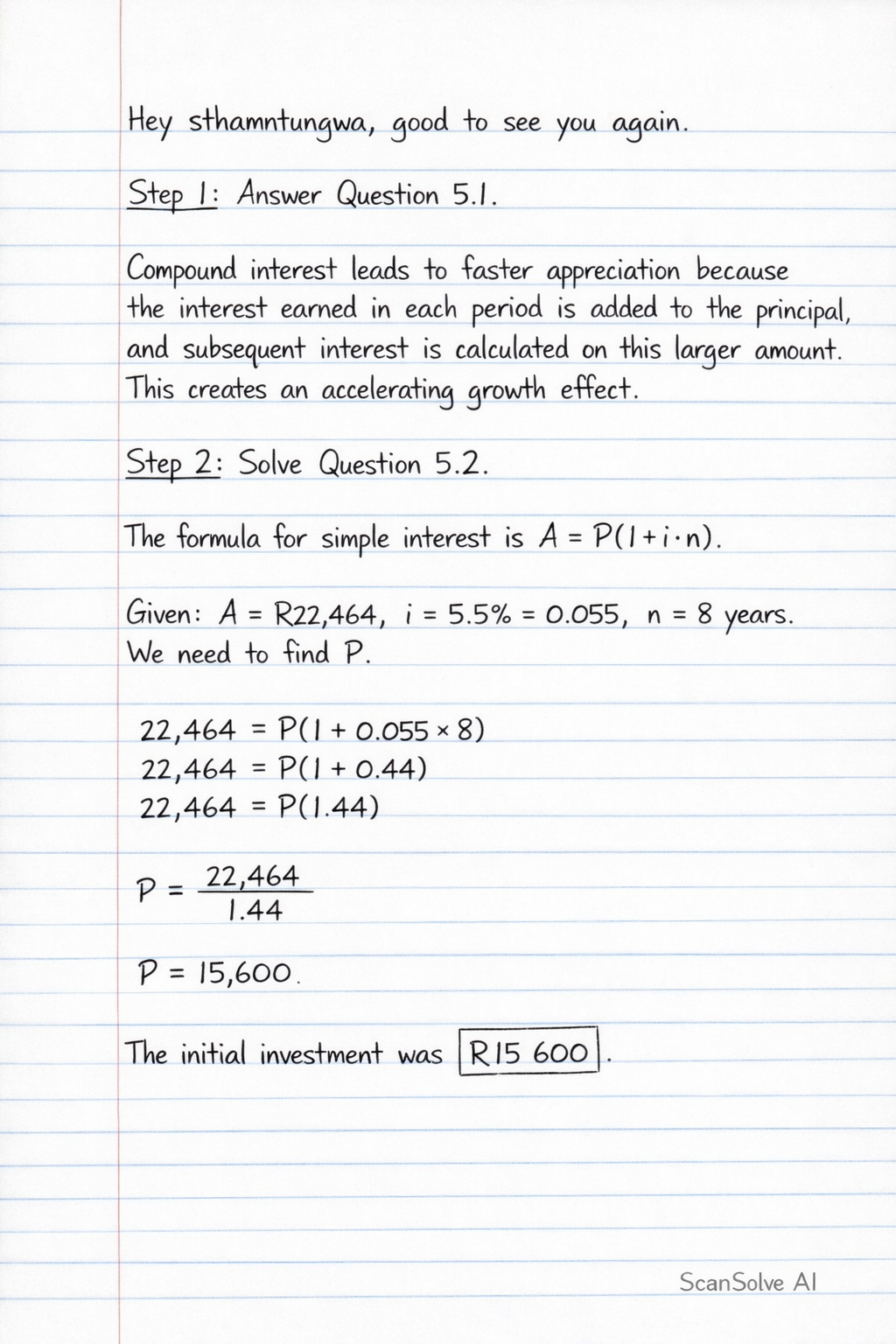
    Compound interest leads to faster appreciation because the interest earned in each period is added to the principal, and subsequent interest is calculated on this larger amount. This creates an accelerating growth effect.

  2. Solve Question 5.2.

    The formula for simple interest is A=P(1+i⋅n)A = P(1 + i \cdot n).
    Given: A=R22 464A = R22\,464, i=5.5%=0.055i = 5.5\% = 0.055, n=8n = 8 years.
    We need to find PP.

    22 464=P(1+0.055×8)22\,464 = P(1 + 0.055 \times 8) 22 464=P(1+0.44)22\,464 = P(1 + 0.44) 22 464=P(1.44)22\,464 = P(1.44) P=22 4641.44P = \frac{22\,464}{1.44} P=15 600P = 15\,600

    The initial investment was R15 600\boxed{\text{R15 600}}.

  3. Solve Question 5.3.1.

    The formula for compound interest compounded quarterly is A=P(1+im)n⋅mA = P(1 + \frac{i}{m})^{n \cdot m}.
    Given: P=R17 500P = R17\,500, i=7.5%=0.075i = 7.5\% = 0.075, n=12n = 12 years, m=4m = 4 (quarterly).

    A=17 500(1+0.0754)12×4A = 17\,500 \left(1 + \frac{0.075}{4}\right)^{12 \times 4} A=17 500(1+0.01875)48A = 17\,500 (1 + 0.01875)^{48} A=17 500(1.01875)48A = 17\,500 (1.01875)^{48} A=17 500×2.450659...A = 17\,500 \times 2.450659... A=42 886.53A = 42\,886.53

    The amount of her investment after 12 years is R42 886.53\boxed{\text{R42 886.53}}.

  4. Solve Question 5.3.2.

    The interest earned is the final amount minus the initial principal.

    I=A−PI = A - P I=R42 886.53−R17 500I = R42\,886.53 - R17\,500 I=R25 386.53I = R25\,386.53

    The interest her investment would earn is R25 386.53\boxed{\text{R25 386.53}}.

  5. Solve Question 5.4.

    First, calculate the depreciated value of the old car. The formula for reducing balance depreciation is A=P(1−i)nA = P(1 - i)^n.
    Given: P=R350 000P = R350\,000, i=20%=0.20i = 20\% = 0.20, n=7n = 7 years.

    Aold=350 000(1−0.20)7A_{old} = 350\,000 (1 - 0.20)^7 Aold=350 000(0.80)7A_{old} = 350\,000 (0.80)^7 Aold=350 000×0.2097152A_{old} = 350\,000 \times 0.2097152 Aold=R73 400.32A_{old} = R73\,400.32

    Next, calculate the appreciated value of the new car. The formula for simple interest appreciation is A=P(1+i⋅n)A = P(1 + i \cdot n).
    Given: P=R350 000P = R350\,000, i=5%=0.05i = 5\% = 0.05, n=7n = 7 years.

    Anew=350 000(1+0.05×7)A_{new} = 350\,000 (1 + 0.05 \times 7) Anew=350 000(1+0.35)A_{new} = 350\,000 (1 + 0.35) Anew=350 000(1.35)A_{new} = 350\,000 (1.35) Anew=R472 500A_{new} = R472\,500

    Finally, calculate the amount Musi will pay.

    Amount to pay=Anew−Aold\text{Amount to pay} = A_{new} - A_{old} Amount to pay=R472 500−R73 400.32\text{Amount to pay} = R472\,500 - R73\,400.32 Amount to pay=R399 099.68\text{Amount to pay} = R399\,099.68

    Musi will pay R399 099.68\boxed{\text{R399 099.68}}.

  6. Define Question 5.5.1.

    Taxable income is the portion of an individual's or company's gross income that is subject to income tax. It is calculated by subtracting allowable deductions from gross income.

  7. Define Question 5.5.2.

    A tax rebate is an amount by which a taxpayer's tax liability is reduced. It directly lowers the amount of tax owed, rather than reducing the taxable income.

  8. Solve Question 5.6.

    First, calculate Mary's total annual gross income.

    Gross annual salary=R150 000×12=R1 800 000\text{Gross annual salary} = R150\,000 \times 12 = R1\,800\,000 Total annual gross income=Gross annual salary+13th cheque+Annual performance bonus\text{Total annual gross income} = \text{Gross annual salary} + \text{13th cheque} + \text{Annual performance bonus} Total annual gross income=R1 800 000+R100 000+R75 000\text{Total annual gross income} = R1\,800\,000 + R100\,000 + R75\,000 Total annual gross income=R1 975 000\text{Total annual gross income} = R1\,975\,000

    This is Mary's taxable income, assuming no other deductions.
    To calculate Mary's actual tax liability and determine if she overpaid or underpaid, the individual tax rate table for the financial year 2024 from SARS is required. This table is not provided in the image. Without the tax brackets, rates, and applicable rebates for a 70-year-old, the final tax calculation cannot be completed.

    Her total annual taxable income is R1 975 000\boxed{\text{R1 975 000}}.

Was this helpful?

Still stuck on this one?

Ask a follow-up, and the answer starts from this question.

Got a different question?Ask your own question
Handwritten step-by-step solution preview

Handwritten Step-by-Step Solution

Get this as a handwritten image on WhatsApp — like a tutor wrote it for you.

Try on WhatsApp