Calculate the simple interest on N720,000.00 for 3 years at 5½% per annum. Hence, find the amount at the end of 3 years.
|Mathematics
Calculate the simple interest on N720,000.00 for 3 years at 5½% per annum. Hence, find the amount at the end of 3 years.
ScanSolve AI Answer
Answer
a=53
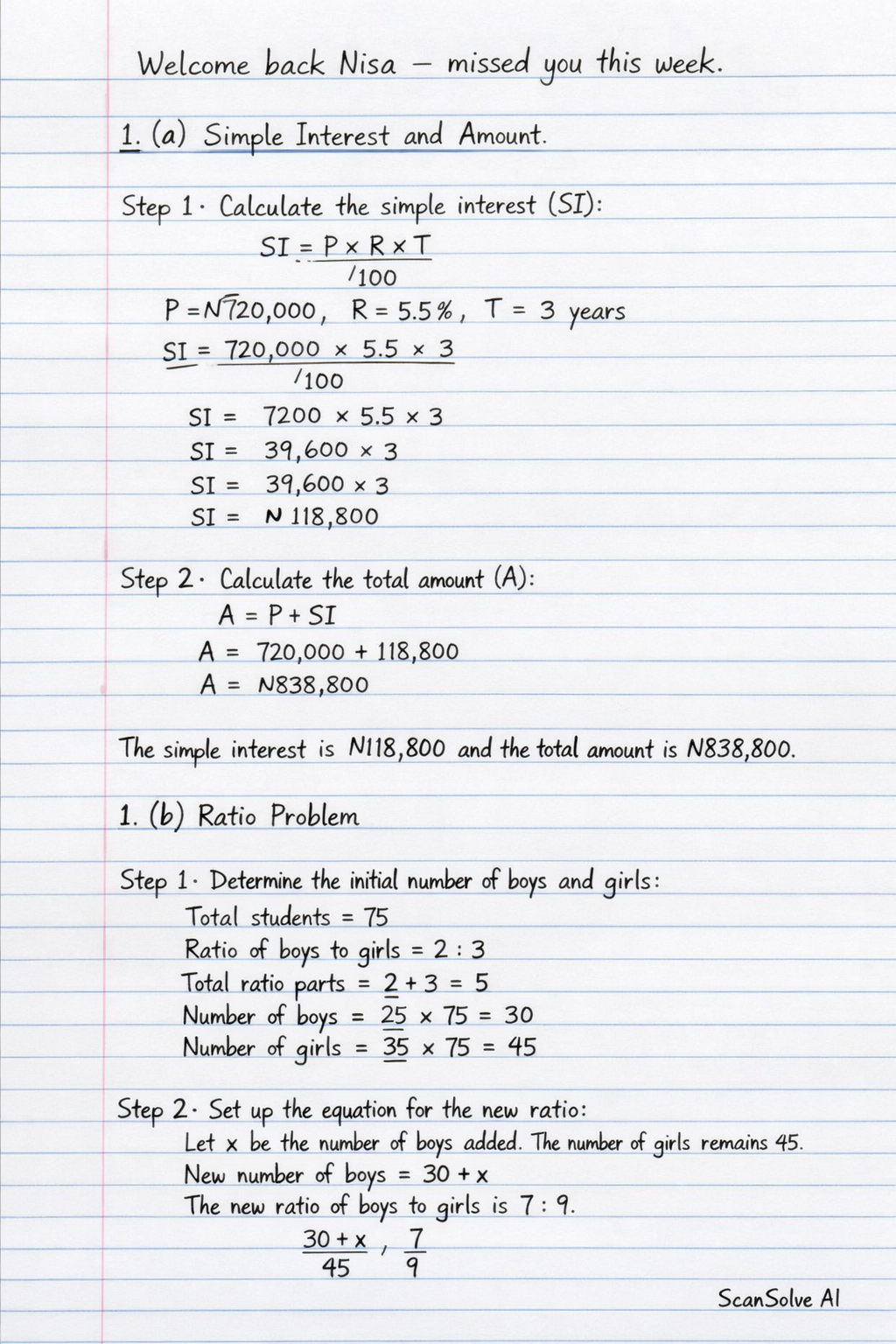
1. (a) Simple Interest and Amount
Step 1: Calculate the simple interest (SI) using the formula SI=100P×R×T.
Given: Principal (P) = N720,000, Rate (R) = 521%=5.5%, Time (T) = 3 years.
SI=100720000×5.5×3SI=7200×5.5×3SI=39600×3SI=N118,800
Step 2: Calculate the total amount (A) at the end of 3 years using the formula A=P+SI.
A=720000+118800A=N838,800
The simple interest is N118,800 and the total amount is N838,800.
1. (b) Ratio Problem
Step 1: Determine the initial number of boys and girls.
Total students = 75. Ratio of boys to girls = 2:3.
Total ratio parts = 2+3=5.
Number of boys = 52×75=30.
Number of girls = 53×75=45.
Step 2: Set up the equation for the new ratio.
Let x be the number of boys added. The number of girls remains 45.
New number of boys = 30+x.
The new ratio of boys to girls is 7:9.
4530+x=97
Step 3: Solve for x.
Multiply both sides by 45:
30+x=97×4530+x=7×530+x=35x=35−30x=55 boys should be added to the class.
2. (a) Solve the Equation
Step 1: Combine the terms on the right side of the equation.
a3=a+12+3a−13
Find a common denominator for the right side, which is (a+1)(3a−1).
a3=(a+1)(3a−1)2(3a−1)+3(a+1)a3=(a+1)(3a−1)6a−2+3a+3a3=(a+1)(3a−1)9a+1
Step 2: Cross-multiply and expand the equation.
3(a+1)(3a−1)=a(9a+1)3(3a2−a+3a−1)=9a2+a3(3a2+2a−1)=9a2+a9a2+6a−3=9a2+a
Step 3: Simplify and solve for a.
Subtract 9a2 from both sides:
6a−3=a
Subtract a from both sides and add 3 to both sides:
6a−a=35a=3a=53
The solution is a=53.
2. (b) Simplify Expression
Step 1: Rewrite the division as multiplication by the reciprocal of the second fraction.
y+xx−y÷x+yy−x=y+xx−y×y−xx+y
Step 2: Recognize that y+x=x+y and y−x=−(x−y).
Substitute these into the expression:
=x+yx−y×−(x−y)x+y
Step 3: Cancel common terms.
=11×−11=−1
The simplified expression is −1.
3. (a) Shortest Distance from A to C
Step 1: Draw a diagram and determine the angle ∠ABC.
A man travels 5 km due east from A to B. So, AB = 5 km.
Then he travels 7 km on a bearing of 162∘ from B to C. So, BC = 7 km.
The bearing of 162∘ is measured clockwise from the North line at B.
Since AB is due East, the angle from the North line at B to the East direction is 90∘.
The angle from the East direction (extension of AB) to BC is 162∘−90∘=72∘.
The interior angle ∠ABC in triangle ABC is 180∘−72∘=108∘.
Step 2: Use the Cosine Rule to find the distance AC.
The Cosine Rule states c2=a2+b2−2abcosC. Here, AC2=AB2+BC2−2(AB)(BC)cos(∠ABC).
AC2=52+72−2(5)(7)cos(108∘)AC2=25+49−70(−0.3090)AC2=74+21.63AC2=95.63AC=95.63AC≈9.779 km
Step 3: Correct to the nearest km.
AC≈10 km
The shortest distance from A to C is 10km.
3. (b) Bearing of C from A
Step 1: Use the Sine Rule to find ∠BAC.
The Sine Rule states sinAa=sinBb. Here, sin(∠BAC)BC=sin(∠ABC)AC.
sin(∠BAC)7=sin(108∘)9.779sin(∠BAC)=9.7797×sin(108∘)sin(∠BAC)=9.7797×0.9511sin(∠BAC)=9.7796.6577sin(∠BAC)≈0.6808∠BAC=arcsin(0.6808)∠BAC≈42.9∘
Step 2: Calculate the bearing of C from A.
Since A to B is due East, the bearing of B from A is 090∘.
The angle ∠BAC is measured clockwise from AB.
The bearing of C from A is 90∘+∠BAC.
Bearing = 90∘+42.9∘=132.9∘.
Step 3: Correct to the nearest degree.
Bearing ≈133∘.
The bearing of C from A is 133∘.
4. (a) Simplify Algebraic Expression
Step 1: Factorize the denominators.
3r2−488−3r2−12r43r2−48=3(r2−16)=3(r−4)(r+4)3r2−12r=3r(r−4)
Substitute the factored denominators back into the expression:
=3(r−4)(r+4)8−3r(r−4)4
Step 2: Find a common denominator and combine the fractions.
The common denominator is 3r(r−4)(r+4).
=3r(r−4)(r+4)8r−3r(r−4)(r+4)4(r+4)=3r(r−4)(r+4)8r−4(r+4)=3r(r−4)(r+4)8r−4r−16=3r(r−4)(r+4)4r−16
Step 3: Factor the numerator and simplify.
=3r(r−4)(r+4)4(r−4)
Cancel out the common factor (r−4):
=3r(r+4)4
The simplified expression is 3r(r+4)4.
4. (b) Evaluate Integral
Step 1: Expand the integrand (3x2+2)2.
(3x2+2)2=(3x2)2+2(3x2)(2)+22=9x4+12x2+4
Step 2: Integrate each term with respect to x.
∫(9x4+12x2+4)dx=4+19x4+1+2+112x2+1+4x+C=59x5+312x3+4x+C
Step 3: Simplify the expression.
=59x5+4x3+4x+C
The evaluated integral is 59x5+4x3+4x+C.
Send me the next one 📸
Was this helpful?
Need help with your own homework?
Get instant step-by-step solutions to any question. Free to start.
This mathematics problem involves applying core mathematical principles and formulas. Below you will find a complete step-by-step solution with detailed explanations for each step, helping you understand not just the answer but the method behind it.
ScanSolve AI Answer
1. (a) Simple Interest and Amount Step 1: Calculate the simple interest (SI) using the formula SI = (P × R × T)/(100). Given: Principal (P) = N720,000, Rate (R) = 5(1)/(2)\% = 5.5\%, Time (T) = 3 years. SI = (720000 × 5.5 × 3)/(100) SI = 7200 × 5.5 × 3 SI = 39600 × 3 SI = N118,800 Step 2: Calculate the total amount (A) at the end of 3 years using the formula A = P + SI. A = 720000 + 118800 A = N838,800 The simple interest is N118,800 and the total amount is N838,800. 1. (b) Ratio Problem Step 1: Determine the initial number of boys and girls. Total students = 75. Ratio of boys to girls = 2:3. Total ratio parts = 2+3 = 5. Number of boys = (2)/(5) × 75 = 30. Number of girls = (3)/(5) × 75 = 45. Step 2: Set up the equation for the new ratio. Let x be the number of boys added. The number of girls remains 45. New number of boys = 30+x. The new ratio of boys to girls is 7:9. (30+x)/(45) = (7)/(9) Step 3: Solve for x. Multiply both sides by 45: 30+x = (7)/(9) × 45 30+x = 7 × 5 30+x = 35 x = 35 - 30 x = 5 5 boys should be added to the class. 2. (a) Solve the Equation Step 1: Combine the terms on the right side of the equation. (3)/(a) = (2)/(a+1) + (3)/(3a-1) Find a common denominator for the right side, which is (a+1)(3a-1). (3)/(a) = (2(3a-1) + 3(a+1))/((a+1)(3a-1)) (3)/(a) = (6a-2 + 3a+3)/((a+1)(3a-1)) (3)/(a) = (9a+1)/((a+1)(3a-1)) Step 2: Cross-multiply and expand the equation. 3(a+1)(3a-1) = a(9a+1) 3(3a^2 - a + 3a - 1) = 9a^2 + a 3(3a^2 + 2a - 1) = 9a^2 + a 9a^2 + 6a - 3 = 9a^2 + a Step 3: Simplify and solve for a. Subtract 9a^2 from both sides: 6a - 3 = a Subtract a from both sides and add 3 to both sides: 6a - a = 3 5a = 3 a = (3)/(5) The solution is a = (3)/(5). 2. (b) Simplify Expression Step 1: Rewrite the division as multiplication by the reciprocal of the second fraction. (x-y)/(y+x) ÷ (y-x)/(x+y) = (x-y)/(y+x) × (x+y)/(y-x) Step 2: Recognize that y+x = x+y and y-x = -(x-y). Substitute these into the expression: = (x-y)/(x+y) × (x+y)/(-(x-y)) Step 3: Cancel common terms. = (1)/(1) × (1)/(-1) = -1 The simplified expression is -1. 3. (a) Shortest Distance from A to C Step 1: Draw a diagram and determine the angle ABC. A man travels 5 km due east from A to B. So, AB = 5 km. Then he travels 7 km on a bearing of 162^ from B to C. So, BC = 7 km. The bearing of 162^ is measured clockwise from the North line at B. Since AB is due East, the angle from the North line at B to the East direction is 90^. The angle from the East direction (extension of AB) to BC is 162^ - 90^ = 72^. The interior angle ABC in triangle ABC is 180^ - 72^ = 108^. Step 2: Use the Cosine Rule to find the distance AC. The Cosine Rule states c^2 = a^2 + b^2 - 2ab C. Here, AC^2 = AB^2 + BC^2 - 2(AB)(BC)( ABC). AC^2 = 5^2 + 7^2 - 2(5)(7)(108^) AC^2 = 25 + 49 - 70(-0.3090) AC^2 = 74 + 21.63 AC^2 = 95.63 AC = sqrt(95.63) AC ≈ 9.779 km Step 3: Correct to the nearest km. AC ≈ 10 km The shortest distance from A to C is 10 km. 3. (b) Bearing of C from A Step 1: Use the Sine Rule to find BAC. The Sine Rule states (a)/( A) = (b)/( B). Here, (BC)/(( BAC)) = (AC)/(( ABC)). (7)/(( BAC)) = (9.779)/((108^)) ( BAC) = (7 × (108^))/(9.779) ( BAC) = (7 × 0.9511)/(9.779) ( BAC) = (6.6577)/(9.779) ( BAC) ≈ 0.6808 BAC = (0.6808) BAC ≈ 42.9^ Step 2: Calculate the bearing of C from A. Since A to B is due East, the bearing of B from A is 090^. The angle BAC is measured clockwise from AB. The bearing of C from A is 90^ + BAC. Bearing = 90^ + 42.9^ = 132.9^. Step 3: Correct to the nearest degree. Bearing ≈ 133^. The bearing of C from A is 133^. 4. (a) Simplify Algebraic Expression Step 1: Factorize the denominators. (8)/(3r^2-48) - (4)/(3r^2-12r) 3r^2-48 = 3(r^2-16) = 3(r-4)(r+4) 3r^2-12r = 3r(r-4) Substitute the factored denominators back into the expression: = (8)/(3(r-4)(r+4)) - (4)/(3r(r-4)) Step 2: Find a common denominator and combine the fractions. The common denominator is 3r(r-4)(r+4). = (8r)/(3r(r-4)(r+4)) - (4(r+4))/(3r(r-4)(r+4)) = (8r - 4(r+4))/(3r(r-4)(r+4)) = (8r - 4r - 16)/(3r(r-4)(r+4)) = (4r - 16)/(3r(r-4)(r+4)) Step 3: Factor the numerator and simplify. = (4(r-4))/(3r(r-4)(r+4)) Cancel out the common factor (r-4): = (4)/(3r(r+4)) The simplified expression is (4)/(3r(r+4)). 4. (b) Evaluate Integral Step 1: Expand the integrand (3x^2+2)^2. (3x^2+2)^2 = (3x^2)^2 + 2(3x^2)(2) + 2^2 = 9x^4 + 12x^2 + 4 Step 2: Integrate each term with respect to x. (9x^4 + 12x^2 + 4) dx = 9x^4+14+1 + 12x^2+12+1 + 4x + C = (9x^5)/(5) + (12x^3)/(3) + 4x + C Step 3: Simplify the expression. = (9)/(5)x^5 + 4x^3 + 4x + C The evaluated integral is (9)/(5)x^5 + 4x^3 + 4x + C. Send me the next one 📸