
We read your photo as:
Simplify: 1.a) (34 x 3⁻²)/33, 1.b) Express 0.00032 in standard form, 2.a) Expand and simplify: (2x-3)(x+5)-(x-4)2
ScanSolve AI Answer
Step-by-step solution
19 steps1.a) Simplify:
We use the exponent rules and .
Simplify the numerator.
Divide the result by the denominator.
Express with a positive exponent.
The simplified expression is .
1.b) Express 0.00032 in standard form:
To express a number in standard form, we move the decimal point until there is one non-zero digit to its left.Move the decimal point to the right until it is after the first non-zero digit (3).
Count the number of places the decimal point was moved.
It was moved 4 places to the right.
Since the original number was less than 1, the exponent of 10 will be negative.
The number in standard form is .
2.a) Expand and simplify:
Expand the first product using FOIL.
Expand the second term using the formula .
Substitute the expanded terms back into the original expression and simplify.
Remember to distribute the negative sign to all terms in the second expansion.
Combine like terms.
The expanded and simplified expression is .
2.b) Factorise completely:
We are looking for two numbers that multiply to and add up to . These numbers are and 1.Rewrite the middle term using these two numbers.
Factor by grouping.
Factor out the common binomial factor .
The completely factorised expression is .
2.c) Solve:
This is a difference of squares, , where and .Factor the expression.
Set each factor equal to zero and solve for .
The solutions are .
3. Solve:
We will use the elimination method.Multiply Equation 2 by 2 to make the coefficients of opposites.
Add Equation 1 and Equation 3.
Solve for .
Substitute the value of into Equation 2 to solve for .
The solutions are .
4. Two similar cones have radii 3 cm and 9 cm.
Let cm (smaller cone) and cm (larger cone).4.a) Find the scale factor.
The scale factor is the ratio of corresponding linear dimensions. We'll use the ratio of the larger radius to the smaller radius.The scale factor is .
4.b) If the smaller cone has volume 40 cm, find the volume of the larger cone.
For similar solids, the ratio of their volumes is the cube of the scale factor.
Let be the volume of the smaller cone and be the volume of the larger cone.The volume of the larger cone is .
4.c) If the slant height of the smaller cone is 5 cm, find that of the larger cone.
For similar solids, the ratio of their corresponding linear dimensions (like slant height) is equal to the scale factor.
Let be the slant height of the smaller cone and be the slant height of the larger cone.The slant height of the larger cone is .
5. A cylindrical water tank has radius 7 m and height 10 m.
Given: m, m.5.a) Find its volume.
The formula for the volume of a cylinder is .The volume of the tank is .
5.b) Find its total surface area.
The formula for the total surface area of a cylinder is .The total surface area of the tank is .
5.c) If water costs KSh 50 per cubic meter, find the cost to fill the tank.
Cost to fill the tank = Volume Cost per cubic meter.
Using the volume from 5.a):If we use :
The cost to fill the tank is (or approximately ).
Still stuck on this one?
Ask a follow-up, and the answer starts from this question.
More Mathematics Questions
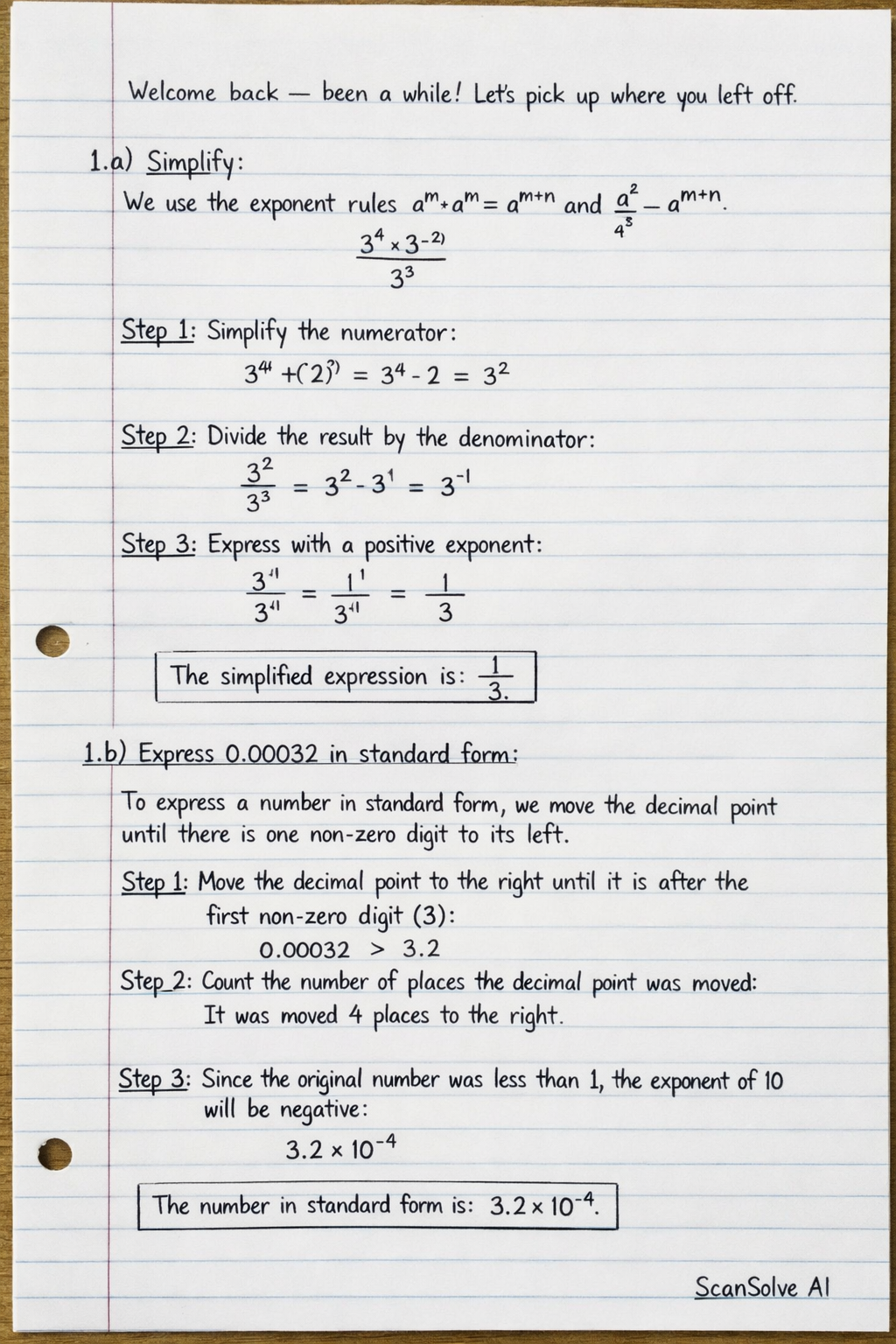
Handwritten Step-by-Step Solution
Get this as a handwritten image on WhatsApp — like a tutor wrote it for you.
Try on WhatsApp