
We read your photo as:
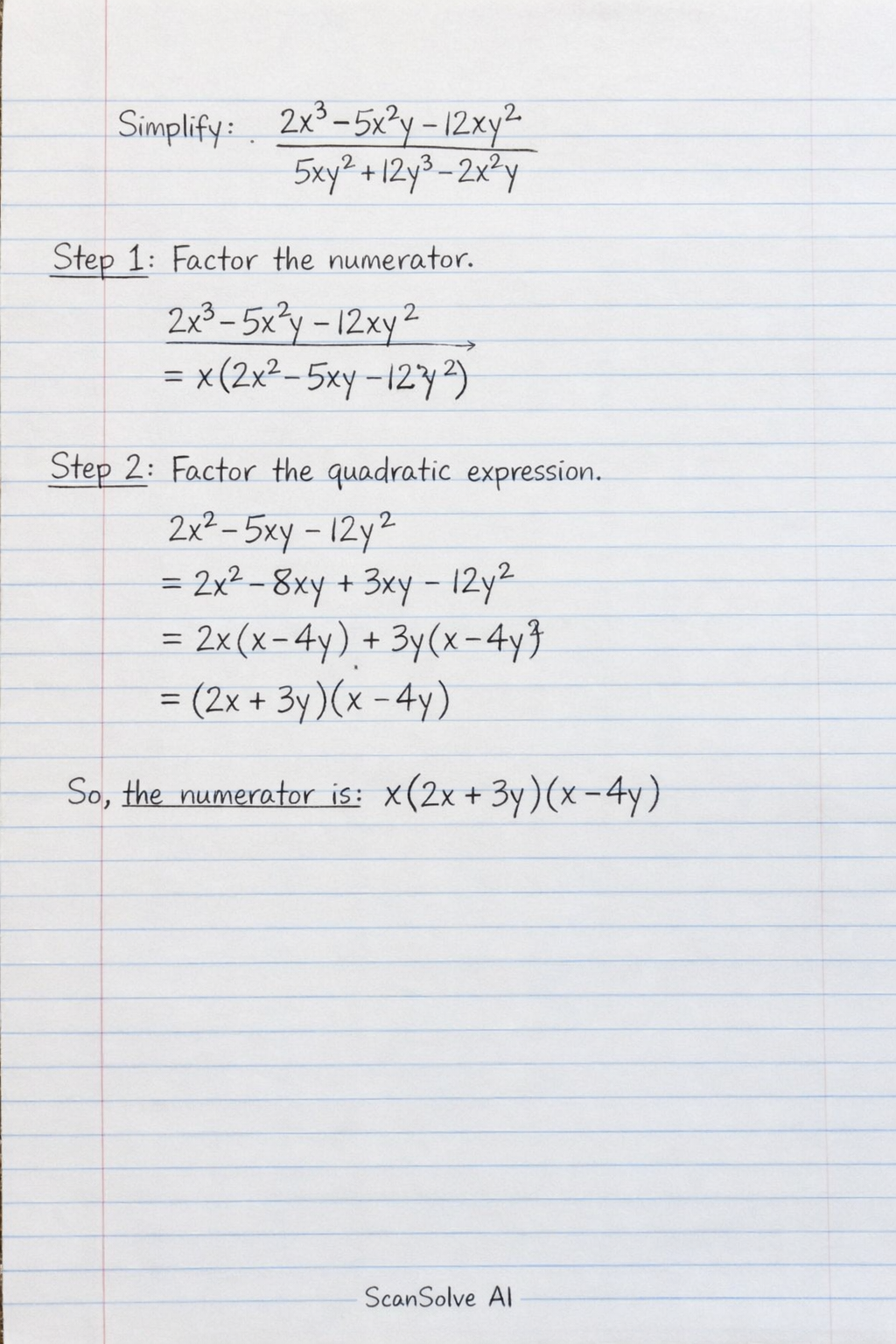
Simplify: (2x³ - y(5x + 12y))/(5xy² + 12y³ - 2x²y)
ScanSolve AI Answer
Answers
2 partsStep-by-step solution
4 stepsHere are the solutions to the problems:
4. Simplify:
Assumption: Based on the typical structure of such simplification problems, it is highly probable that the numerator was intended to be instead of . We will proceed with this assumption to allow for simplification.
Step 1: Expand the numerator and factor out common terms.
Assuming the numerator is :
Step 2: Factor the quadratic expression in the numerator.
We need two numbers that multiply to and add to . These numbers are and 3.
So, the numerator is .
Step 3: Factor the denominator.
Factor out :
Rearrange the terms inside the parenthesis:
Step 4: Factor the quadratic expression in the denominator.
We need two numbers that multiply to and add to 5. These numbers are 8 and .
So, the denominator is .
Step 5: Substitute the factored expressions back into the fraction and simplify.
Assuming and , we can cancel the common factors:
The simplified expression is .
5. The masses of two similar solids are 324g and 768g. Find:
First, determine the ratio of the masses. For similar solids, the ratio of their volumes (and thus masses) is equal to the cube of the ratio of their corresponding linear dimensions.
Let (smaller solid) and (bigger solid).
Let and be corresponding linear dimensions.
Simplify the mass ratio:
So,
Take the cube root of both sides to find the linear scale factor:
Part a· 2 steps
Height of the smaller solid if height of the bigger solid is 20cm.
Let be the height of the smaller solid and be the height of the bigger solid.
Use the linear scale factor.
Substitute the given height and solve for .
The height of the smaller solid is .
Part b
Surface area of the smaller solid if the surface area of the bigger solid is 40cm².
For similar solids, the ratio of their surface areas is equal to the square of the ratio of their corresponding linear dimensions.
Let be the surface area of the smaller solid and be the surface area of the bigger solid.
Use the square of the linear scale factor.
Substitute the given surface area and solve for .
The surface area of the smaller solid is .
Try one yourself
A new problem that tests the same skill.
Still stuck on this one?
Ask a follow-up, and the answer starts from this question.
More Mathematics Questions
Handwritten Step-by-Step Solution
Get this as a handwritten image on WhatsApp — like a tutor wrote it for you.
Try on WhatsApp