

This mathematics problem involves applying core mathematical principles and formulas. Below you will find a complete step-by-step solution with detailed explanations for each step, helping you understand not just the answer but the method behind it.
ScanSolve AI Answer
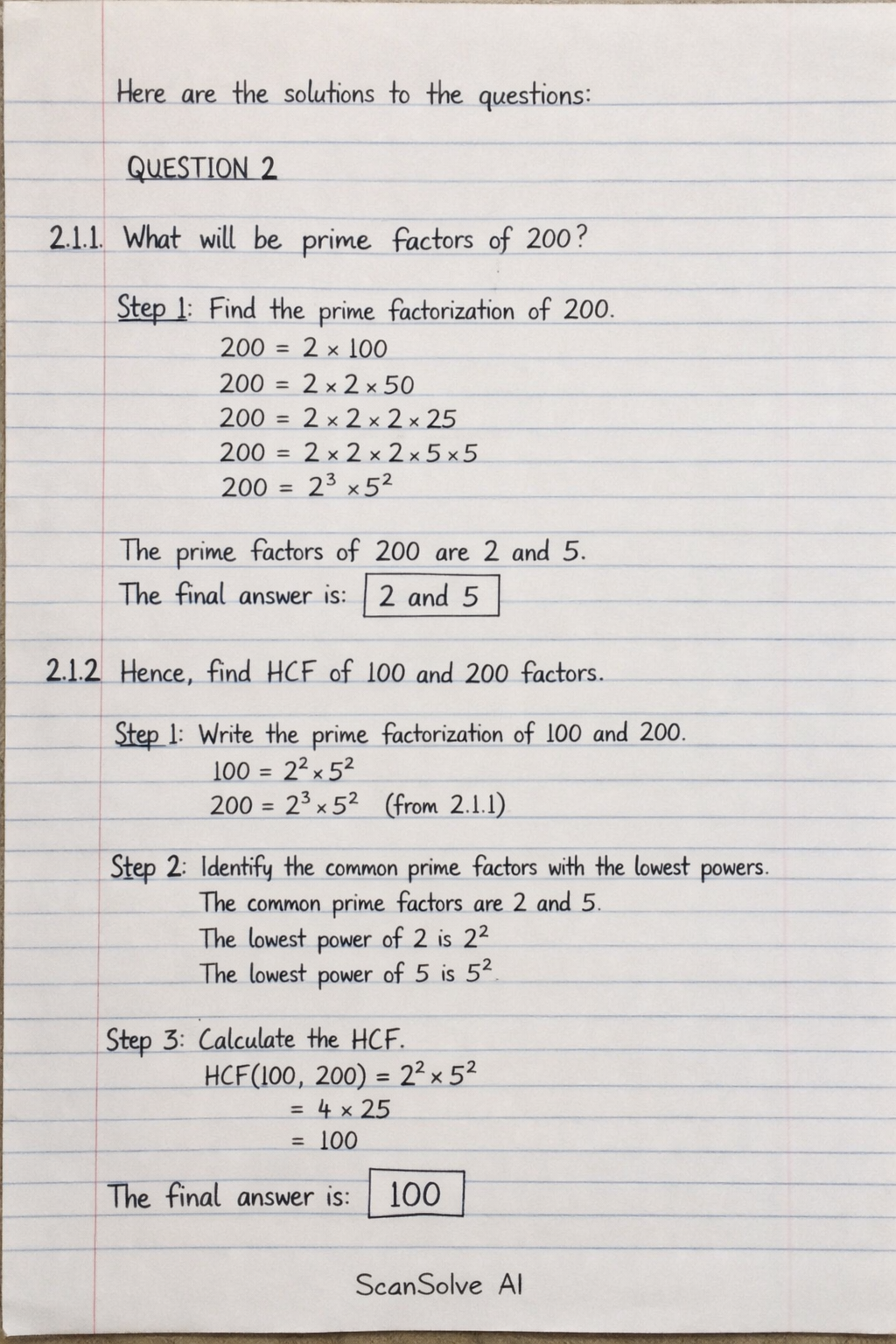
Here are the solutions to the questions: QUESTION 2 2.1.1 What will be prime factors of 200? Step 1: Find the prime factorization of 200. 200 = 2 × 100 200 = 2 × 2 × 50 200 = 2 × 2 × 2 × 25 200 = 2 × 2 × 2 × 5 × 5 200 = 2^3 × 5^2 The prime factors of 200 are 2 and 5. The final answer is 2 and 5 2.1.2 Hence, find HCF of 100 and 200 factors. Step 1: Write the prime factorization of 100 and 200. Given 100 = 2^2 × 5^2. From 2.1.1, 200 = 2^3 × 5^2. Step 2: Identify the common prime factors with the lowest powers. The common prime factors are 2 and 5. The lowest power of 2 is 2^2. The lowest power of 5 is 5^2. Step 3: Calculate the HCF. HCF(100, 200) = 2^2 × 5^2 = 4 × 25 = 100 The final answer is 100 2.2 John and Anna, share a total profit of R315 in the ratio 3:4. Calculate how much money Anna will receive? Step 1: Determine the total number of parts in the ratio. Total parts = 3 + 4 = 7. Step 2: Calculate Anna's share of the profit. Anna's share is 4 parts out of 7. Anna's share = (4)/(7) × R315 Anna's share = 4 × (315)/(7) Anna's share = 4 × 45 Anna's share = R180 The final answer is R180 2.3 A local supermarket sells tomatoes for: 3 kg bag costs R70 2 kg bag costs R50 Calculate the price per kg for each option, which option is expensive. Step 1: Calculate the price per kg for the 3 kg bag. Price per kg (3 kg bag) = R703 kg ≈ R23.33 per kg Step 2: Calculate the price per kg for the 2 kg bag. Price per kg (2 kg bag) = R502 kg = R25.00 per kg Step 3: Compare the prices to determine which option is more expensive. R25.00 is greater than R23.33. The 2 kg bag is more expensive per kg. The final answer is 3 kg bag: R23.33/kg, 2 kg bag: R25.00/kg. The 2 kg bag is more expensive. 2.4 Mr Khumalo invests R2000 in a savings account at a financial institution that offers a simple interest rate of 4\% per annum. Calculate the total value of her investment over a period of 3 years. Step 1: Identify the given values. Principal (P) = R2000. Interest rate (R) = 4\% = 0.04. Time (T) = 3 years. Step 2: Calculate the simple interest (I). I = P × R × T I = 2000 × 0.04 × 3 I = 80 × 3 I = R240 Step 3: Calculate the total value of the investment (A). A = P + I A = 2000 + 240 A = R2240 The final answer is R2240 QUESTION 3 3.1.1 Simplify M^x · M^y. Step 1: Apply the rule for multiplying exponents with the same base: a^m · a^n = a^m+n. M^x · M^y = M^x+y The final answer is M^x+y 3.1.2 Simplify (M^x)^y. Step 1: Apply the rule for a power of a power: (a^m)^n = a^m · n. (M^x)^y = M^x · y The final answer is M^xy 3.2 Simplify sqrt(125) + ((2)/(3))^0 - (2 ÷ 0.2). Step 1: Simplify sqrt(125). sqrt(125) = sqrt(25 × 5) = sqrt(25) × sqrt(5) = 5sqrt(5) Step 2: Simplify ((2)/(3))^0. Any non-zero number raised to the power of 0 is 1. ((2)/(3))^0 = 1 Step 3: Simplify (2 ÷ 0.2). 2 ÷ 0.2 = 2 ÷ (2)/(10) = 2 × (10)/(2) = 10 Step 4: Combine the simplified terms. 5sqrt(5) + 1 - 10 5sqrt(5) - 9 The final answer is 5sqrt(5) - 9 3.3 Simplify expression using laws exponents. ((x^2y^3)^3)/(x^5y^5). Step 1: Apply the power of a product rule (ab)^n = a^n b^n and power of a power rule (a^m)^n = a^mn to the numerator. (x^2y^3)^3 = (x^2)^3 (y^3)^3 = x^2 × 3 y^3 × 3 = x^6 y^9 Step 2: Rewrite the expression with the simplified numerator. (x^6 y^9)/(x^5 y^5) Step 3: Apply the division rule for exponents (a^m)/(a^n) = a^m-n. x^6-5 y^9-5 x^1 y^4 xy^4 The final answer is xy^4 3.4 A scientist estimates that a water sample contains approximately 50,700,000 microorganisms. Express this number of bacteria in scientific notation. Step 1: Move the decimal point to the left until there is only one non-zero digit to its left. The number is 50,700,000. The decimal point is initially after the last 0. Move it 7 places to the left to get 5.07. Step 2: Count the number of places the decimal point was moved. This number will be the exponent of 10. Since the original number is greater than 1, the exponent is positive. The decimal point was moved 7 places. 50,700,000 = 5.07 × 10^7 The final answer is 5.07 × 10^7 QUESTION 4 4.1 Simplify 3x^3 - 3x^2 + 4x^3 + 4x^2. Step 1: Group like terms together. (3x^3 + 4x^3) + (-3x^2 + 4x^2) Step 2: Combine the coefficients of the like terms. (3+4)x^3 + (-3+4)x^2 7x^3 + 1x^2 7x^3 + x^2 The final answer is 7x^3 + x^2 4.2 Given: x + x^6 + (x)/(2) - 2 - 4x^2. 4.2.1 Write down the value of the constant term. The constant term is the term that does not contain any variables. In the expression, the constant term is -2. The final answer is -2 4.2.2 State the coefficient of x^3. The coefficient of x^3 is the numerical factor multiplying x^3. In the given expression, there is no x^3 term. This means its coefficient is 0. The final answer is 0 4.2.3 What is the degree of polynomial? The degree of a polynomial is the highest exponent of the variable in the polynomial. The terms in the polynomial are x^1, x^6, x^1, x^0, x^2. The exponents are 1, 6, 1, 0, 2. The highest exponent is 6. The final answer is 6 4.3 Simplify: 4(-x^2 + x - 2) - 4x. Step 1: Distribute the 4 into the parenthesis. 4(-x^2) + 4(x) + 4(-2) - 4x -4x^2 + 4x - 8 - 4x Step 2: Combine like terms. -4x^2 + (4x - 4x) - 8 -4x^2 + 0x - 8 -4x^2 - 8 The final answer is -4x^2 - 8 4.4 Simplify: (18x^2y^3 + 6x^3y^2 - 12x^2y)/(3xy^2). Step 1: Divide each term in the numerator by the denominator. (18x^2y^3)/(3xy^2) + (6x^3y^2)/(3xy^2) - (12x^2y)/(3xy^2) Step 2: Simplify each term using exponent rules ((a^m)/(a^n) = a^m-n). For the first term: (18)/(3) x^2-1 y^3-2 = 6xy^1 = 6xy For the second term: (6)/(3) x^3-1 y^2-2 = 2x^2y^0 = 2x^2(1) = 2x^2 For the third term: (-12)/(3) x^2-1 y^1-2 = -4xy^-1 = -(4x)/(y) Step 3: Combine the simplified terms. 6xy + 2x^2 - (4x)/(y) The final answer is 6xy + 2x^2 - (4x)/(y) QUESTION 5 5.1 Consider: 7; 11; 15; 19; ... 5.1.1 Write down next two terms. Step 1: Find the common difference (d) between consecutive terms. d = 11 - 7 = 4 d = 15 - 11 = 4 d = 19 - 15 = 4 The common difference is 4. Step 2: Add the common difference to the last given term to find the next terms. The 5^th term: 19 + 4 = 23. The 6^th term: 23 + 4 = 27. The final answer is 23; 27 5.1.2 Find the general rule for the pattern (T_n). Step 1: Use the formula for the n^th term of an arithmetic sequence: T_n = a + (n-1)d. Here, a (first term) = 7 and d (common difference) = 4. Step 2: Substitute the values into the formula. T_n = 7 + (n-1)4 T_n = 7 + 4n - 4 T_n = 4n + 3 The final answer is T_n = 4n + 3 5.2 Solve for x: 3 - 3x = -15. Step 1: Subtract 3 from both sides of the equation. 3 - 3x - 3 = -15 - 3 -3x = -18 Step 2: Divide both sides by -3. (-3x)/(-3) = (-18)/(-3) x = 6 The final answer is x = 6 5.3 When a certain number is divided by 4 and then decreased by 3, the result is equal to the same number divided by 2 and then decreased by 9. Set up an algebraic equation to describe the problem and solve the equation. Step 1: Let the certain number be y. Step 2: Translate the first part of the problem into an algebraic expression: "a certain number is divided by 4 and then decreased by 3". (y)/(4) - 3 Step 3: Translate the second part of the problem into an algebraic expression: "the same number divided by 2 and then decreased by 9". (y)/(2) - 9 Step 4: Set up the equation by equating the two expressions. (y)/(4) - 3 = (y)/(2) - 9 Step 5: Solve the equation for y. Multiply the entire equation by the least common multiple (LCM) of the denominators (4 and 2), which is 4, to eliminate fractions. 4 ( (y)/(4) - 3 ) = 4 ( (y)/(2) - 9 ) 4 · (y)/(4) - 4 · 3 = 4 · (y)/(2) - 4 · 9 y - 12 = 2y - 36 Step 6: Gather y terms on one side and constant terms on the other. Subtract y from both sides: -12 = 2y - y - 36 -12 = y - 36 Add 36 to both sides: -12 + 36 = y y = 24 The final answer is Equation: (y)/(4) - 3 = (y)/(2) - 9, Solution: y = 24 That's 2 down. 3 left today — send the next one.