
We read your photo as:
Simplify 4(x + 5) - (3x + 10) - 2x + 5.
Mathematics
ScanSolve AI Answer
Step-by-step solution
7 stepsHere are the solutions to the problems:
1) Evaluate
Simplify the fraction inside the parenthesis.
So the expression becomes:
Apply the fractional exponent.
The exponent means taking the cube root first, then squaring the result.
Calculate the cube root.
So the expression becomes:
Square the result.
The evaluated value is .
2) Simplify
Distribute the 4 into the first parenthesis and distribute the negative sign into the second parenthesis.
The expression becomes:
Group the like terms (terms with and constant terms).
Combine the like terms.
The simplified expression is:
Was this helpful?
Still stuck on this one?
Ask a follow-up, and the answer starts from this question.
Got a different question?Ask your own question
More Mathematics Questions
QSimplify the expression (x2 - 5x − 3) − (4x2 + 8x − 9).QSimplify 3(x + 3) − 2x(x − 1).QSimplify the expression 5(x+4) + 2(x−4)
Browse by topic:Algebra
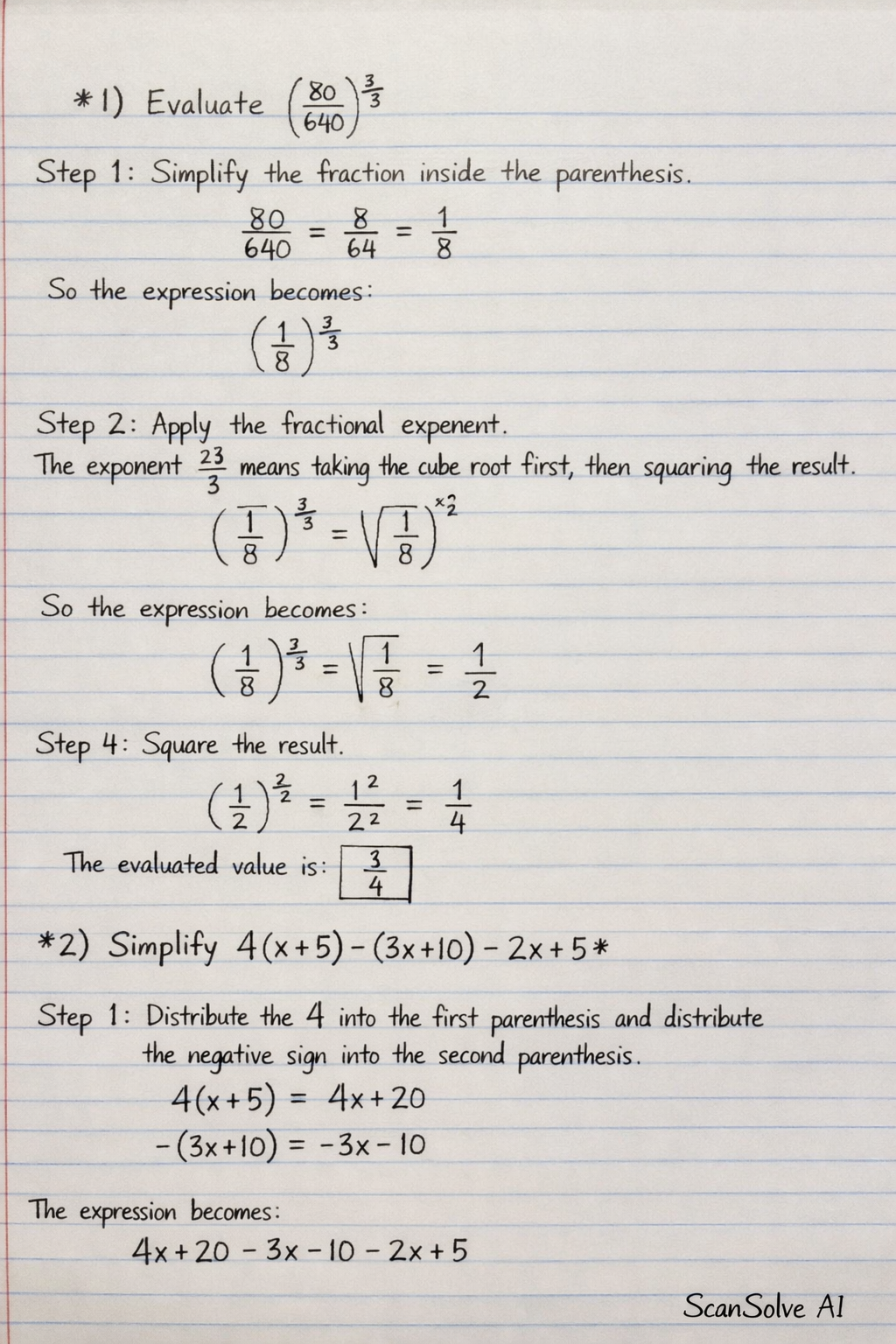
Handwritten Step-by-Step Solution
Get this as a handwritten image on WhatsApp — like a tutor wrote it for you.
Try on WhatsApp