We read your photo as:

Simplify (6x2 + 7x - 5) / (2x - 1) by dividing out.

Mathematics

ScanSolve AI Answer

Step-by-step solution

5 steps

Here's the solution for Question Q3:

To simplify the expression 6x2+7x−52x−1\frac{6x^2 + 7x - 5}{2x - 1} by dividing out, we can use polynomial long division.

  1. Set up the polynomial long division.

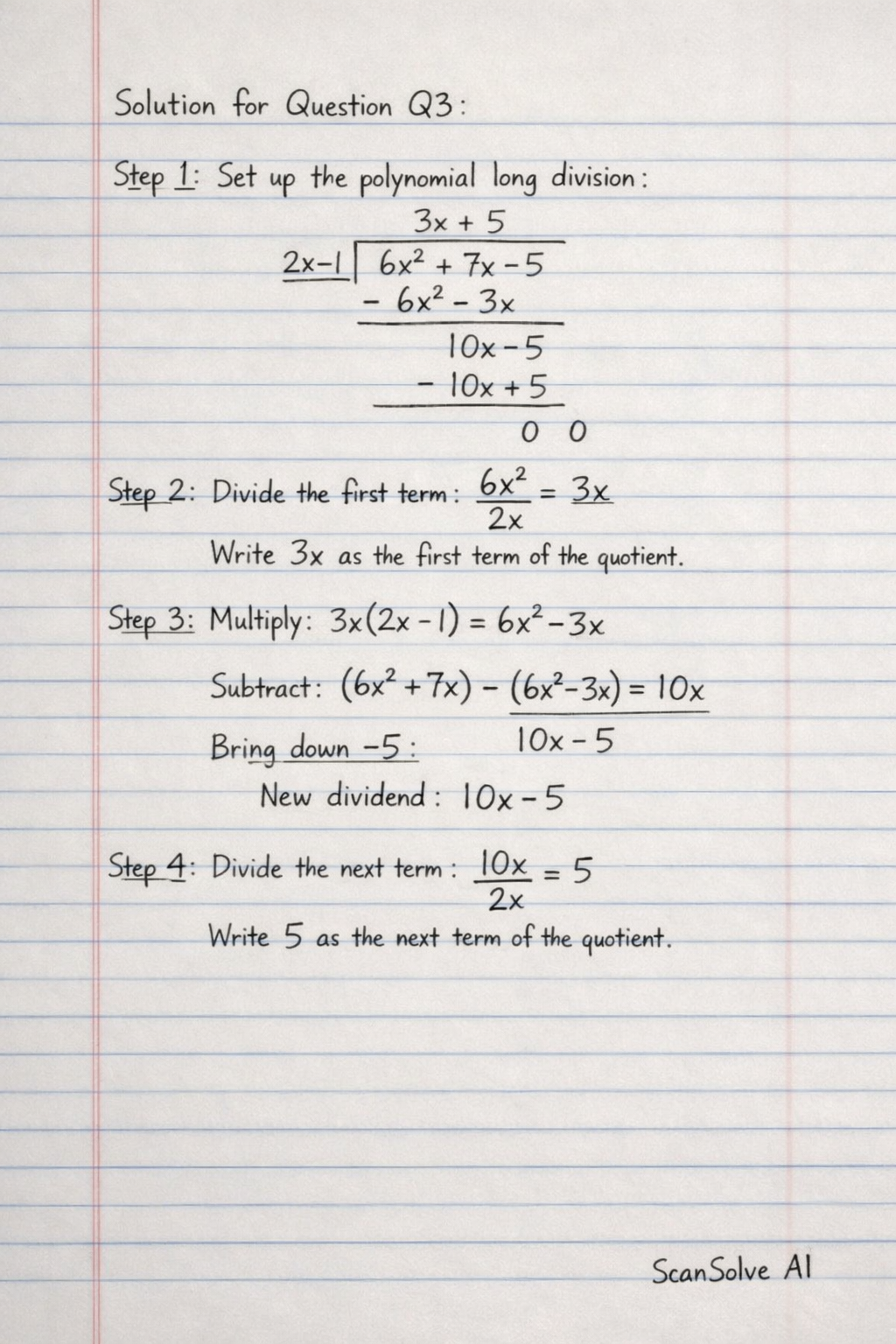
    \multicolumn2r3x+5\cline2−52x−16x2+7x−5\multicolumn2r−(6x2−3x)\cline2−3\multicolumn2r010x−5\multicolumn2r−(10x−5)\cline3−4\multicolumn2r00\begin{array}{c|cc cc} \multicolumn{2}{r}{3x} & +5 \\ \cline{2-5} 2x-1 & 6x^2 & +7x & -5 \\ \multicolumn{2}{r}{-(6x^2} & -3x) \\ \cline{2-3} \multicolumn{2}{r}{0} & 10x & -5 \\ \multicolumn{2}{r}{} & -(10x & -5) \\ \cline{3-4} \multicolumn{2}{r}{} & 0 & 0 \\ \end{array}
  2. Divide the first term of the dividend (6x26x^2) by the first term of the divisor (2x2x).

    6x22x=3x\frac{6x^2}{2x} = 3x

    Write 3x3x as the first term of the quotient.

  3. Multiply the divisor (2x−12x - 1) by 3x3x.

    3x(2x−1)=6x2−3x3x(2x - 1) = 6x^2 - 3x

    Subtract this result from the dividend.

    (6x2+7x)−(6x2−3x)=10x(6x^2 + 7x) - (6x^2 - 3x) = 10x

    Bring down the next term, −5-5. The new dividend is 10x−510x - 5.

  4. Divide the first term of the new dividend ($10x$) by the first term of the divisor ($2x$).

    10x2x=5\frac{10x}{2x} = 5

    Write 5 as the next term of the quotient.

  5. Multiply the divisor (2x−12x - 1) by 5.

    5(2x−1)=10x−55(2x - 1) = 10x - 5

    Subtract this result from the new dividend.

    (10x−5)−(10x−5)=0(10x - 5) - (10x - 5) = 0

    The remainder is 0.

    The quotient is 3x+53x + 5.

    Alternatively, by factoring the numerator:
    We look for two numbers that multiply to 6×−5=−306 \times -5 = -30 and add to 7. These numbers are 10 and −3-3.

    6x2+7x−5=6x2+10x−3x−56x^2 + 7x - 5 = 6x^2 + 10x - 3x - 5 =2x(3x+5)−1(3x+5)= 2x(3x + 5) - 1(3x + 5) =(2x−1)(3x+5)= (2x - 1)(3x + 5)

    Now, substitute this back into the fraction:

    (2x−1)(3x+5)2x−1\frac{(2x - 1)(3x + 5)}{2x - 1}

    Assuming 2x−1≠02x - 1 \neq 0, we can cancel out the common factor (2x−1)(2x - 1).

    =3x+5= 3x + 5

    The simplified expression is 3x+5\boxed{\text{}3x + 5\text{}}

Was this helpful?

Still stuck on this one?

Ask a follow-up, and the answer starts from this question.

Got a different question?Ask your own question
Handwritten step-by-step solution preview

Handwritten Step-by-Step Solution

Get this as a handwritten image on WhatsApp — like a tutor wrote it for you.

Try on WhatsApp