
We read your photo as:
Simplify completely 3n+3 - 3ⁿ+14 x 3n+2 and solve for y in 2 y = 2 3 + 2 7 + 22 y
ScanSolve AI Answer
This answer stops before the end.
It was cut off when it was first written. Ask ScanSolve this question again for the full working.
here are the solutions to your questions.
1. Simplify completely
Step 1: Factor out the common term in the numerator.
The common term in and is .
Step 2: Simplify the numerator.
Step 3: Rewrite the denominator using exponent rules.
Step 4: Substitute the simplified numerator and denominator back into the fraction and simplify.
The simplified expression is .
2. Solve for in
Step 1: Use logarithm properties to combine terms on the right side.
Recall the properties: and .
Step 2: Combine the terms on the right side further.
Step 3: Since the bases are the same, equate the arguments.
Step 4: Solve the resulting algebraic equation for .
Factor out :
This gives two possible solutions: or .
Step 5: Check for valid solutions.
The argument of a logarithm must be positive.
If , is undefined, so is not a valid solution.
If , then , which means . This value is positive, so it is a valid solution.
The solution is .
3. Five spheres of radius 2cm are melted and recast into a cone.
This problem asks for the volume of the cone formed by melting and recasting five spheres. The volume of the cone will be equal to the total volume of the five spheres.
Step 1: Calculate the volume of one sphere.
The formula for the volume of a sphere is .
Given radius cm.
Step 2: Calculate the total volume of five spheres.
Step 3: State the volume of the cone.
Since the five spheres are melted and recast into a cone, the volume of the cone is equal to the total volume of the spheres. Using as suggested by your work:
Still stuck on this one?
Ask a follow-up, and the answer starts from this question.
More Mathematics Questions
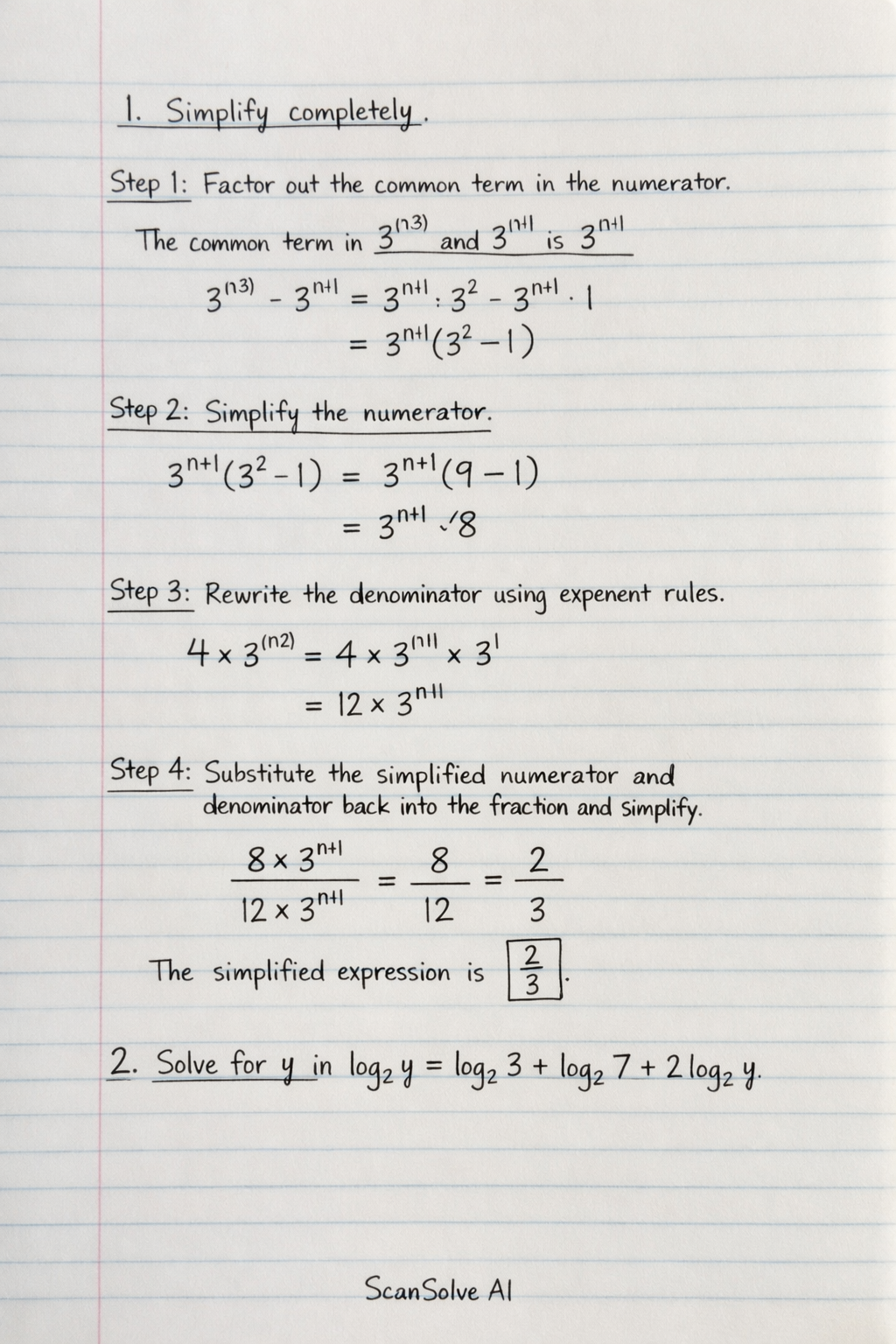
Handwritten Step-by-Step Solution
Get this as a handwritten image on WhatsApp — like a tutor wrote it for you.
Try on WhatsApp