
We read your photo as:
Simplify the expression: \(2 - (y5)/(4)y(1)/(4) - y^-(1)/(4)\).
ScanSolve AI Answer
This answer stops before the end.
It was cut off when it was first written. Ask ScanSolve this question again for the full working.
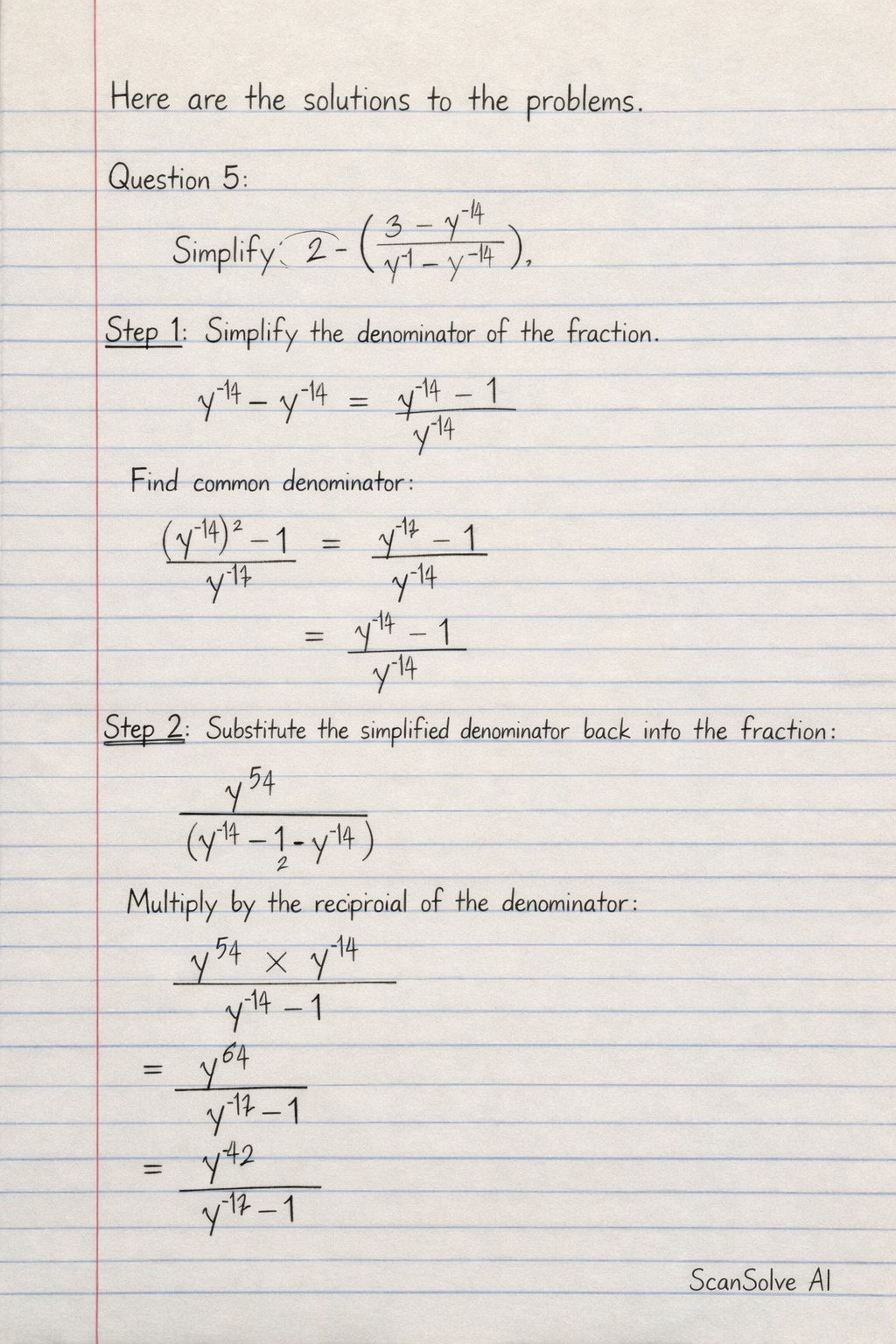
Here are the solutions to the problems.
Question 5:
Simplify .
Step 1: Simplify the denominator of the fraction.
Find a common denominator:
Step 2: Substitute the simplified denominator back into the fraction and simplify.
Multiply by the reciprocal of the denominator:
Combine the terms in the numerator using exponent rules ():
Step 3: Substitute this simplified fraction back into the original expression and combine terms.
Find a common denominator, which is :
Rearrange the terms in the numerator:
This can also be written by multiplying the numerator and denominator by :
The simplified expression is .
Question 6:
Split into partial fractions.
Step 1: Set up the partial fraction decomposition.
For distinct linear factors, the form is:
Step 2: Multiply both sides by the common denominator .
Step 3: Solve for A and B.
To find A, let :
To find B, let :
Step 4: Substitute the values of A and B back into the partial fraction form.
The partial fraction decomposition is .
Question 7:
Split into partial fractions.
Step 1: Set up the partial fraction decomposition.
For a repeated linear factor and a distinct linear factor , the form is:
Step 2: Multiply both sides by the common denominator .
Step 3: Solve for A, B, and C.
To find B, let :
To find C, let :
To find A, substitute , and choose a convenient value for , for example :
Still stuck on this one?
Ask a follow-up, and the answer starts from this question.
More Mathematics Questions
Handwritten Step-by-Step Solution
Get this as a handwritten image on WhatsApp — like a tutor wrote it for you.
Try on WhatsApp