Choose the correct options in the following questions: (i) If y = elogx then dy/dx is: (ii) Radius of a circle is increasing at the rate of 2 m/s. Rate of change of its circumference is:

Mathematics
Choose the correct options in the following questions: (i) If y = elogx then dy/dx is: (ii) Radius of a circle is increasing at the rate of 2 m/s. Rate of change of its circumference is:

ScanSolve AI Answer

Answer

1

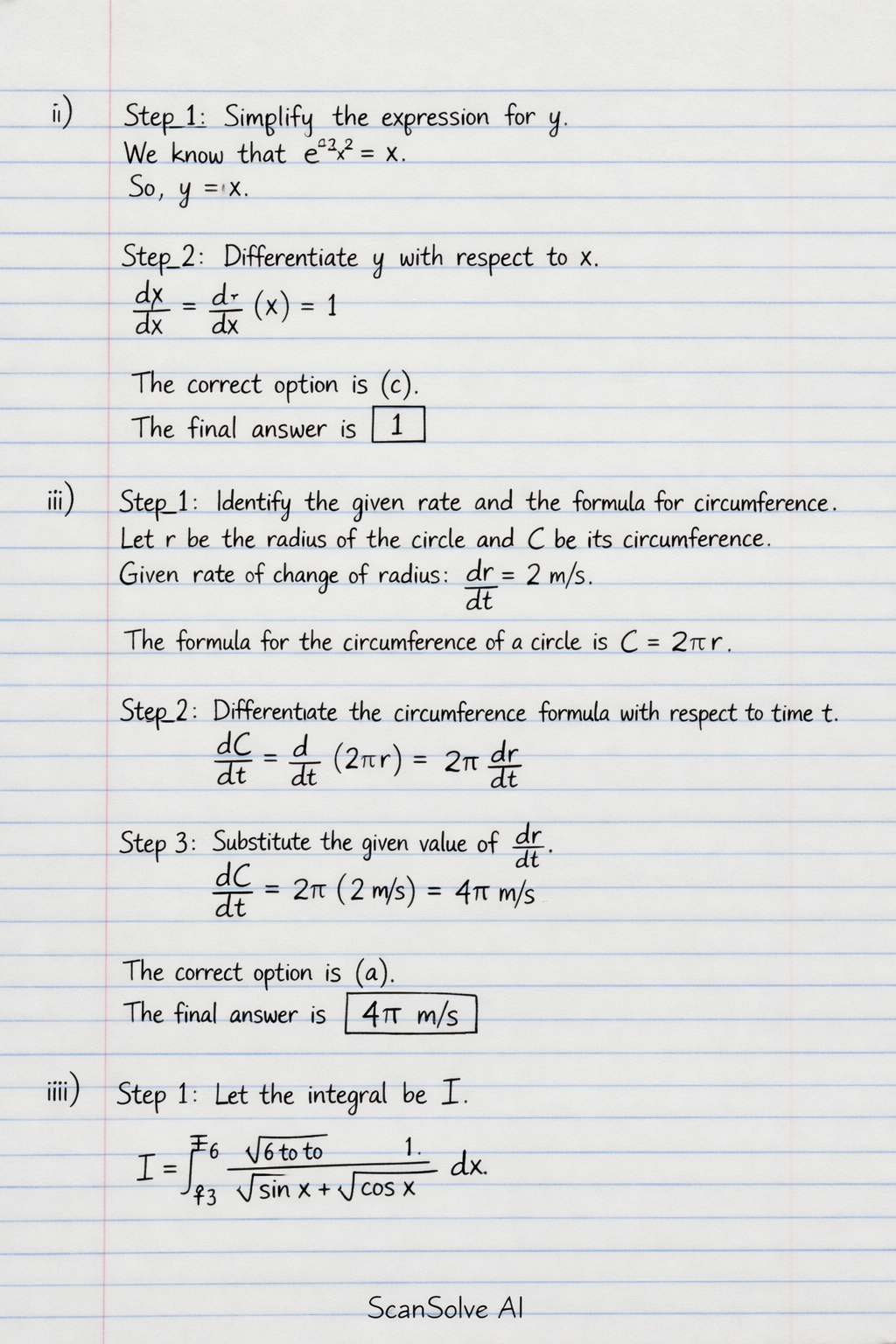
i) Step 1: Simplify the expression for yy. We know that elogx=xe^{\log x} = x. So, y=xy = x.

Step 2: Differentiate yy with respect to xx. dydx=ddx(x)=1\frac{dy}{dx} = \frac{d}{dx}(x) = 1 The correct option is (c). The final answer is 1\boxed{1}.

ii) Step 1: Identify the given rate and the formula for circumference. Let rr be the radius of the circle and CC be its circumference. Given rate of change of radius: drdt=2 m/s\frac{dr}{dt} = 2 \text{ m/s}. The formula for the circumference of a circle is C=2πrC = 2\pi r.

Step 2: Differentiate the circumference formula with respect to time tt. dCdt=ddt(2πr)=2πdrdt\frac{dC}{dt} = \frac{d}{dt}(2\pi r) = 2\pi \frac{dr}{dt}

Step 3: Substitute the given value of drdt\frac{dr}{dt}. dCdt=2π(2m/s)=4πm/s\frac{dC}{dt} = 2\pi (2 m/s) = 4\pi m/s The correct option is (a). The final answer is 4πm/s\boxed{4\pi m/s}.

iii) Step 1: Let the integral be II. I=π/6π/3cosxsinx+cosxdxI = \int_{\pi/6}^{\pi/3} \frac{\sqrt{\cos x}}{\sqrt{\sin x} + \sqrt{\cos x}} dx

Step 2: Apply the property of definite integrals abf(x)dx=abf(a+bx)dx\int_a^b f(x) dx = \int_a^b f(a+b-x) dx. Here, a=π6a = \frac{\pi}{6} and b=π3b = \frac{\pi}{3}. So, a+b=π6+π3=π2a+b = \frac{\pi}{6} + \frac{\pi}{3} = \frac{\pi}{2}. I=π/6π/3cos(π2x)sin(π2x)+cos(π2x)dxI = \int_{\pi/6}^{\pi/3} \frac{\sqrt{\cos(\frac{\pi}{2} - x)}}{\sqrt{\sin(\frac{\pi}{2} - x)} + \sqrt{\cos(\frac{\pi}{2} - x)}} dx Using the identities cos(π2x)=sinx\cos(\frac{\pi}{2} - x) = \sin x and sin(π2x)=cosx\sin(\frac{\pi}{2} - x) = \cos x: I=π/6π/3sinxcosx+sinxdxI = \int_{\pi/6}^{\pi/3} \frac{\sqrt{\sin x}}{\sqrt{\cos x} + \sqrt{\sin x}} dx

Step 3: Add the original integral and the transformed integral. 2I=π/6π/3cosxsinx+cosxdx+π/6π/3sinxcosx+sinxdx2I = \int_{\pi/6}^{\pi/3} \frac{\sqrt{\cos x}}{\sqrt{\sin x} + \sqrt{\cos x}} dx + \int_{\pi/6}^{\pi/3} \frac{\sqrt{\sin x}}{\sqrt{\cos x} + \sqrt{\sin x}} dx 2I=π/6π/3cosx+sinxsinx+cosxdx2I = \int_{\pi/6}^{\pi/3} \frac{\sqrt{\cos x} + \sqrt{\sin x}}{\sqrt{\sin x} + \sqrt{\cos x}} dx 2I=π/6π/31dx2I = \int_{\pi/6}^{\pi/3} 1 \, dx

Step 4: Evaluate the integral. 2I=[x]π/6π/32I = [x]_{\pi/6}^{\pi/3} 2I=π3π62I = \frac{\pi}{3} - \frac{\pi}{6} 2I=2π6π62I = \frac{2\pi}{6} - \frac{\pi}{6} 2I=π62I = \frac{\pi}{6} I=π12I = \frac{\pi}{12} The correct option is (c). The final answer is π12\boxed{\frac{\pi}{12}}.

iv) Step 1: Recognize the standard integral form. The integral is 01dx1+x2\int_0^1 \frac{dx}{1+x^2}. We know that 11+x2dx=arctanx+C\int \frac{1}{1+x^2} dx = \arctan x + C.

Step 2: Evaluate the definite integral using the limits. 01dx1+x2=[arctanx]01\int_0^1 \frac{dx}{1+x^2} = [\arctan x]_0^1 =arctan(1)arctan(0)= \arctan(1) - \arctan(0)

Step 3: Substitute the known values of arctan\arctan. We know that arctan(1)=π4\arctan(1) = \frac{\pi}{4} and arctan(0)=0\arctan(0) = 0. =π40= \frac{\pi}{4} - 0 =π4= \frac{\pi}{4} The correct option is (b). The final answer is π4\boxed{\frac{\pi}{4}}.

Was this helpful?

Need help with your own homework?

Get instant step-by-step solutions to any question. Free to start.

Ask Your Question
Handwritten step-by-step solution preview

Handwritten Step-by-Step Solution

Get this as a handwritten image on WhatsApp — like a tutor wrote it for you.

Try on WhatsApp

Still have questions?

Quick Answer

i) Step 1: Simplify the expression for y. We know that e^ x = x.

Choose the correct options in the following questions: (i) If y = elogx then dy/dx is: (ii) Radius of a circle is increasing at the rate of 2 m/s. Rate of change of its circumference is:
Mathematics

This mathematics problem involves applying core mathematical principles and formulas. Below you will find a complete step-by-step solution with detailed explanations for each step, helping you understand not just the answer but the method behind it.

ScanSolve AI Answer
i) Step 1: Simplify the expression for y. We know that e^ x = x. So, y = x. Step 2: Differentiate y with respect to x. (dy)/(dx) = (d)/(dx)(x) = 1 The correct option is (c). The final answer is 1. ii) Step 1: Identify the given rate and the formula for circumference. Let r be the radius of the circle and C be its circumference. Given rate of change of radius: (dr)/(dt) = 2 m/s. The formula for the circumference of a circle is C = 2 r. Step 2: Differentiate the circumference formula with respect to time t. (dC)/(dt) = (d)/(dt)(2 r) = 2 (dr)/(dt) Step 3: Substitute the given value of (dr)/(dt). (dC)/(dt) = 2 (2 m/s) = 4 m/s The correct option is (a). The final answer is 4 m/s. iii) Step 1: Let the integral be I. I = _/6^/3 sqrt( x)sqrt( x) + sqrt( x) dx Step 2: Apply the property of definite integrals _a^b f(x) dx = _a^b f(a+b-x) dx. Here, a = ()/(6) and b = ()/(3). So, a+b = ()/(6) + ()/(3) = ()/(2). I = _/6^/3 (sqrt(()/(2) - x))sqrt((()/(2) - x)) + sqrt((()/(2) - x)) dx Using the identities (()/(2) - x) = x and (()/(2) - x) = x: I = _/6^/3 sqrt( x)sqrt( x) + sqrt( x) dx Step 3: Add the original integral and the transformed integral. 2I = _/6^/3 sqrt( x)sqrt( x) + sqrt( x) dx + _/6^/3 sqrt( x)sqrt( x) + sqrt( x) dx 2I = _/6^/3 sqrt( x) + sqrt( x)sqrt( x) + sqrt( x) dx 2I = _/6^/3 1 \, dx Step 4: Evaluate the integral. 2I = [x]_/6^/3 2I = ()/(3) - ()/(6) 2I = (2)/(6) - ()/(6) 2I = ()/(6) I = ()/(12) The correct option is (c). The final answer is ()/(12). iv) Step 1: Recognize the standard integral form. The integral is _0^1 (dx)/(1+x^2). We know that (1)/(1+x^2) dx = x + C. Step 2: Evaluate the definite integral using the limits. _0^1 (dx)/(1+x^2) = [ x]_0^1 = (1) - (0) Step 3: Substitute the known values of . We know that (1) = ()/(4) and (0) = 0. = ()/(4) - 0 = ()/(4) The correct option is (b). The final answer is ()/(4).