
We read your photo as:
Simplify the following expression: (1 + 1)/((1+i)ⁿ - 1)(1+i)ⁿ - 1
Mathematics
ScanSolve AI Answer
Answer
Step-by-step solution
4 stepsLet's simplify this expression step by step.
Identify the given expression.
The expression from the image is:
Simplify the numerator of the main fraction.
The numerator is . To combine these terms, find a common denominator, which is .
Combine the numerators:
Substitute the simplified numerator back into the main expression.
Now the expression becomes:
Simplify the complex fraction.
To simplify a complex fraction , we can rewrite it as .
In this case, , , and .Multiply the numerators and the denominators:
Was this helpful?
Try one yourself
A new problem that tests the same skill.
Still stuck on this one?
Ask a follow-up, and the answer starts from this question.
Got a different question?Ask your own question
More Mathematics Questions
QSimplify the expression 1/((1+S')^(n−1)) given that S' = i.QSimplify the following: 4/i (1-i)/(1+i) (4+5i)/(6−5i) 4i/((1+2i)2)QEvaluate (1+i)⁻¹ and express the result in the form a+bi.QSimplify the complex number (1+2i)/(2+i).QSimplify the following expression: [(36)^(2n+1) (9)ⁿ (4)^(2n)] / [(18)ⁿ (2)ⁿ (12)^(2n)]
Browse by topic:Algebra
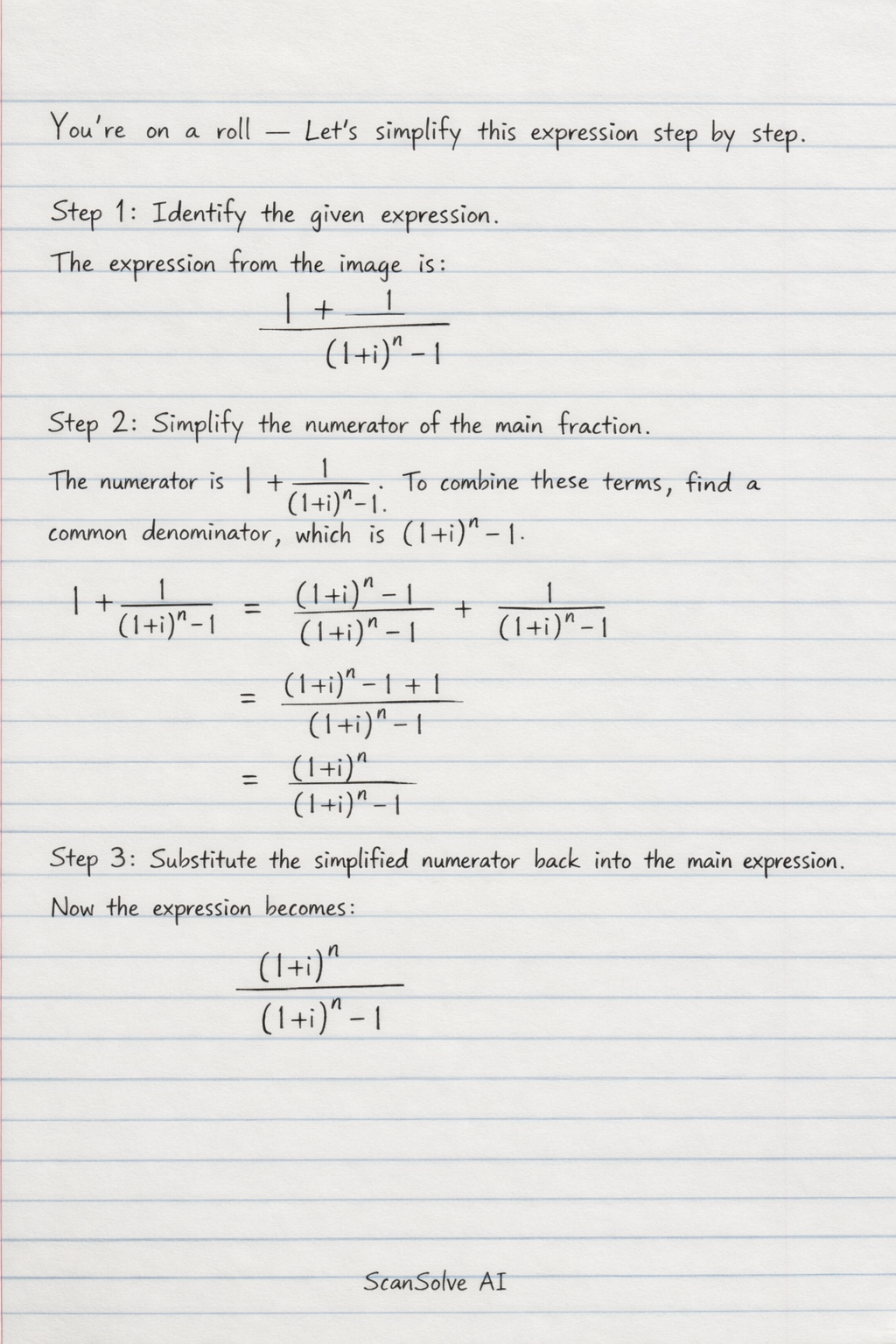
Handwritten Step-by-Step Solution
Get this as a handwritten image on WhatsApp — like a tutor wrote it for you.
Try on WhatsApp