We read your photo as:

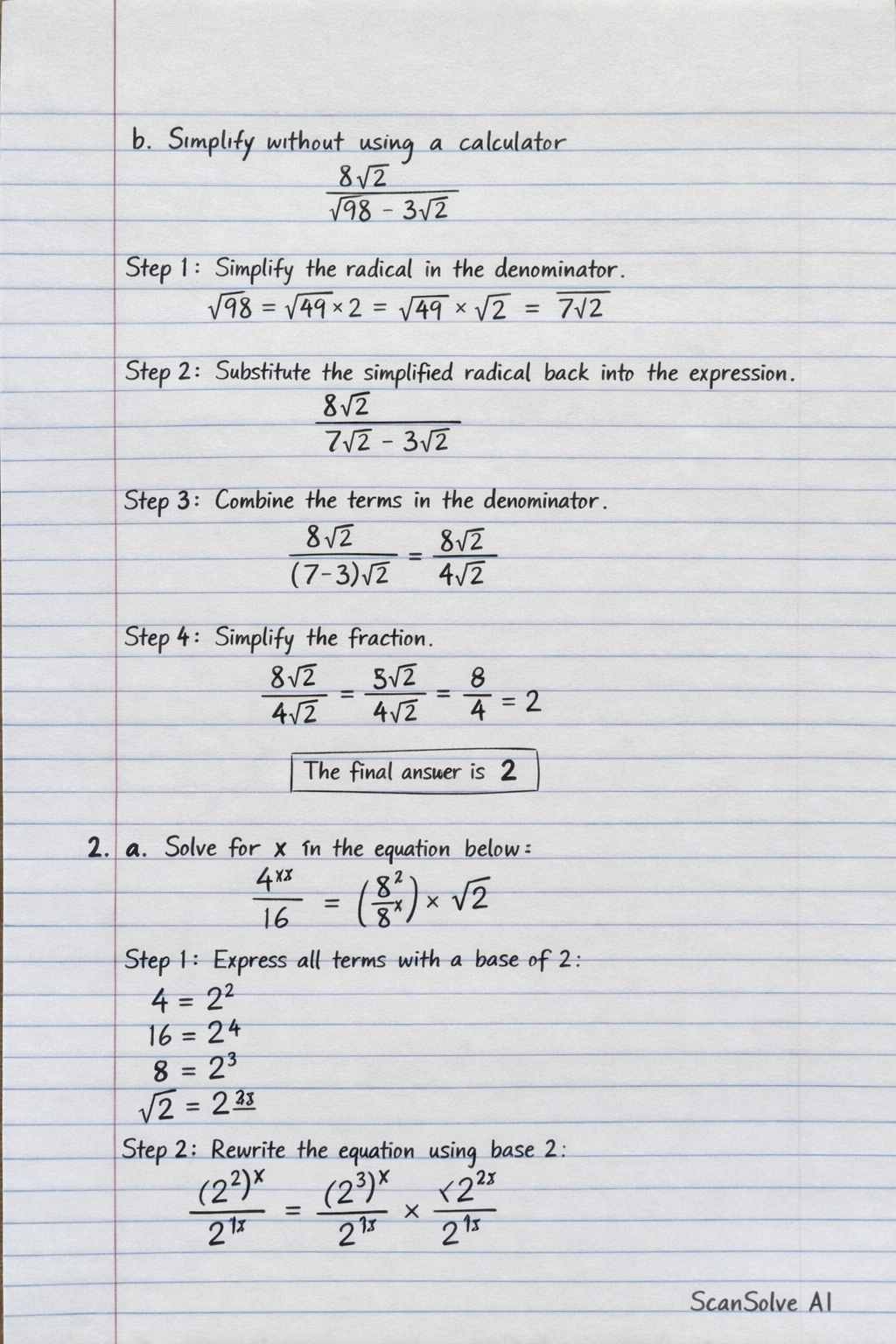
Simplify the following expressions: b. 8sqrt(2)sqrt(98)-3sqrt(2) and 2. a. (4^x)/(16) = ((8^x)/(8)) x sqrt(2)

Mathematics

ScanSolve AI Answer

Step-by-step solution

12 steps

b. Simplify without using a calculator

8298−32\frac{8\sqrt{2}}{\sqrt{98} - 3\sqrt{2}}
  1. Simplify the radical in the denominator.

    98=49×2=49×2=72\sqrt{98} = \sqrt{49 \times 2} = \sqrt{49} \times \sqrt{2} = 7\sqrt{2}
  2. Substitute the simplified radical back into the expression.

    8272−32\frac{8\sqrt{2}}{7\sqrt{2} - 3\sqrt{2}}
  3. Combine the terms in the denominator.

    82(7−3)2=8242\frac{8\sqrt{2}}{(7-3)\sqrt{2}} = \frac{8\sqrt{2}}{4\sqrt{2}}
  4. Simplify the fraction.

    8242=84=2\frac{8\sqrt{2}}{4\sqrt{2}} = \frac{8}{4} = 2

    The final answer is 2\boxed{2}.

    2. a. Solve for xx in the equation below

    4x16=(8x8)×2\frac{4^x}{16} = \left(\frac{8^x}{8}\right) \times \sqrt{2}
  5. Express all terms with a base of 2.

    4=224 = 2^2 16=2416 = 2^4 8=238 = 2^3 2=21/2\sqrt{2} = 2^{1/2}
  6. Rewrite the equation using base 2.

    (22)x24=((23)x23)×21/2\frac{(2^2)^x}{2^4} = \left(\frac{(2^3)^x}{2^3}\right) \times 2^{1/2} 22x24=23x23×21/2\frac{2^{2x}}{2^4} = \frac{2^{3x}}{2^3} \times 2^{1/2}
  7. Apply the exponent rules am/an=am−na^m/a^n = a^{m-n} and am×an=am+na^m \times a^n = a^{m+n}.

    22x−4=23x−3×21/22^{2x-4} = 2^{3x-3} \times 2^{1/2} 22x−4=23x−3+122^{2x-4} = 2^{3x-3 + \frac{1}{2}} 22x−4=23x−62+122^{2x-4} = 2^{3x - \frac{6}{2} + \frac{1}{2}} 22x−4=23x−522^{2x-4} = 2^{3x - \frac{5}{2}}
  8. Equate the exponents and solve for xx.

    2x−4=3x−522x-4 = 3x - \frac{5}{2}

    Multiply the entire equation by 2 to eliminate the fraction:

    2(2x−4)=2(3x−52)2(2x-4) = 2\left(3x - \frac{5}{2}\right) 4x−8=6x−54x-8 = 6x - 5 4x−6x=−5+84x - 6x = -5 + 8 −2x=3-2x = 3 x=−32x = -\frac{3}{2}

    The final answer is −32\boxed{-\frac{3}{2}}.

    b. The curve y=ax2+bx+cy = ax^2 + bx + c has a maximum value at (4,6)(4, 6) and passes through the point (2,−2)(2, -2). Find the values of a,ba, b and cc.

  9. Use the vertex form of a quadratic equation, y=a(x−h)2+ky = a(x-h)^2 + k, where (h,k)(h,k) is the vertex.

    Given the vertex is (4,6)(4,6), substitute h=4h=4 and k=6k=6:

    y=a(x−4)2+6y = a(x-4)^2 + 6
  10. Substitute the given point (2,−2)(2,-2) into the equation to find the value of aa.

    −2=a(2−4)2+6-2 = a(2-4)^2 + 6 −2=a(−2)2+6-2 = a(-2)^2 + 6 −2=4a+6-2 = 4a + 6 −2−6=4a-2 - 6 = 4a −8=4a-8 = 4a a=−2a = -2
  11. Substitute the value of aa back into the vertex form and expand to the standard form y=ax2+bx+cy = ax^2 + bx + c.

    y=−2(x−4)2+6y = -2(x-4)^2 + 6 y=−2(x2−8x+16)+6y = -2(x^2 - 8x + 16) + 6 y=−2x2+16x−32+6y = -2x^2 + 16x - 32 + 6 y=−2x2+16x−26y = -2x^2 + 16x - 26
  12. Identify the values of a,b,a, b, and cc by comparing with y=ax2+bx+cy = ax^2 + bx + c.

    a=−2a = -2 b=16b = 16 c=−26c = -26

    The final answer is a=−2,b=16,c=−26\boxed{a=-2, b=16, c=-26}.

Was this helpful?

Still stuck on this one?

Ask a follow-up, and the answer starts from this question.

Got a different question?Ask your own question
Handwritten step-by-step solution preview

Handwritten Step-by-Step Solution

Get this as a handwritten image on WhatsApp — like a tutor wrote it for you.

Try on WhatsApp