
We read your photo as:
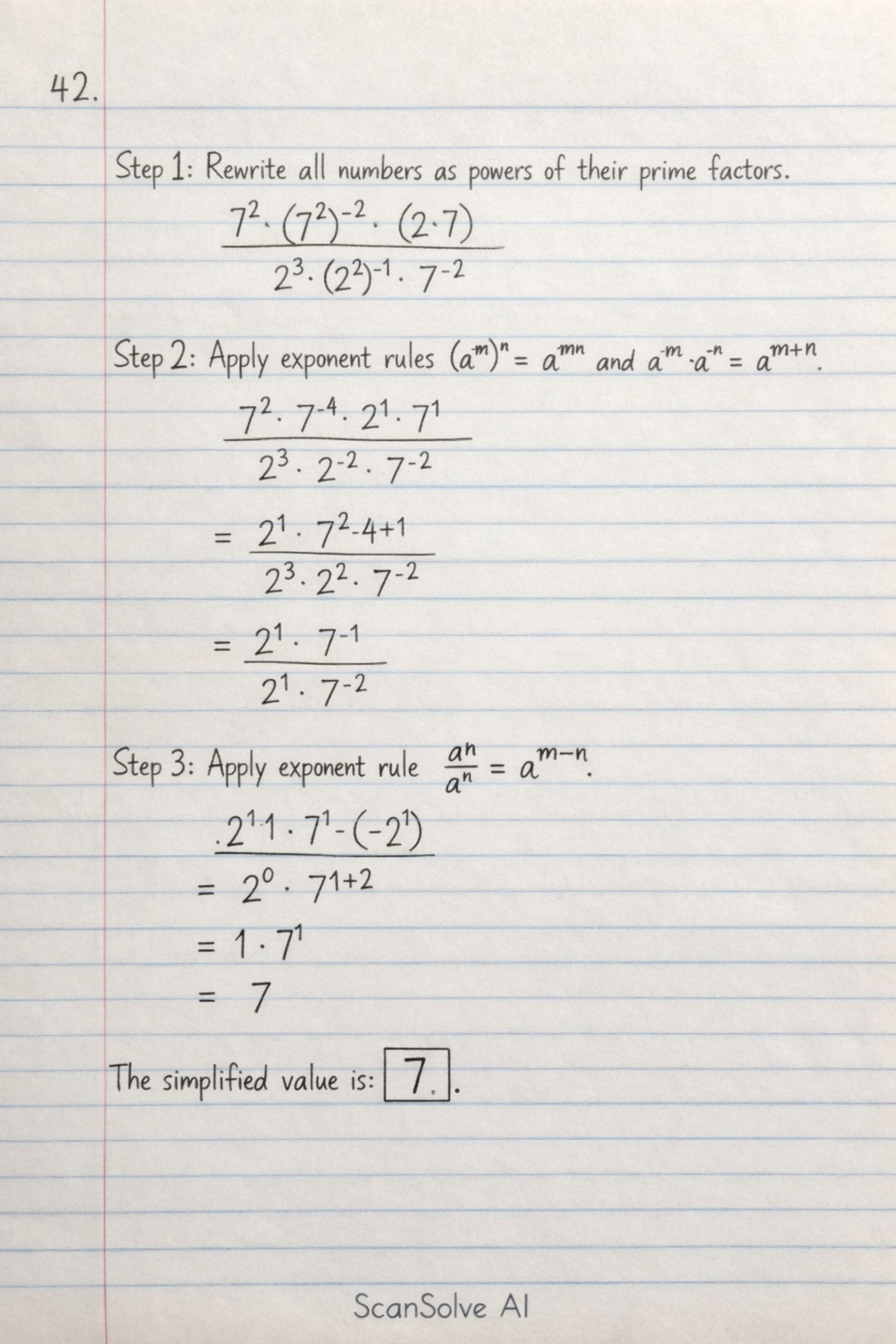
Simplify the following expressions using exponent rules: a) 72 x (72)-2 x (2 x 7)23 x (22)-1 x 7⁻² b) (0.024 x 0.00057)/(0.95 x 0.0018 x 16)
ScanSolve AI Answer
Answers
3 partsStep-by-step solution
7 steps42.
Step 1: Rewrite all numbers as powers of their prime factors.
Step 2: Apply exponent rules and .
Step 3: Apply exponent rule .
The simplified value is .
43.
Step 1: Convert decimals to fractions or powers of 10.
Step 2: Simplify the numerical part.
Divide 24 by 16: .
Divide 57 by 18: .
Divide 3 by 6: .
Divide 19 by 95: .
The value is .
44.
Step 1: A regular heptagon has 7 equal sides and 7 equal interior angles. It can be divided into 7 congruent isosceles triangles, with their vertices at the center O.
Step 2: Calculate the angle at the center for each triangle.
Step 3: The area of one such triangle (e.g., ) is given by the formula:
Given radius .
Step 4: Calculate the total area of the heptagon.
Step 5: Round to 2 decimal places.
The area of the heptagon is .
45.
Part a· 2 steps
Find the number of sides of the polygon;
Use the formula for the sum of interior angles of a polygon with sides
Set the formula equal to the given sum and solve for .
The number of sides of the polygon is .
Part b
the size of each exterior angle of the polygon.
The sum of the exterior angles of any convex polygon is .
For a regular polygon with sides, each exterior angle is equal.
Substitute .
The size of each exterior angle is .
Part c8
the number of triangles the polygon can be divided into
A polygon with sides can be divided into triangles by drawing diagonals from one vertex.
Substitute .
The number of triangles the polygon can be divided into is .
Try one yourself
A new problem that tests the same skill.
Still stuck on this one?
Ask a follow-up, and the answer starts from this question.
More Mathematics Questions
Handwritten Step-by-Step Solution
Get this as a handwritten image on WhatsApp — like a tutor wrote it for you.
Try on WhatsApp