
We read your photo as:
Simplify the general term of the sum: sqrt(1 + (1)/(n2) + (1)/((n+1)2))
Mathematics
ScanSolve AI Answer
Answer
Step 1: Simplify the general term of the sum.
Let the general term be .
The expression inside the square root is:
The numerator can be factored as .
Now, substitute this back into the expression for :
We can rewrite this expression:
Using partial fraction decomposition for :
So, the simplified general term is:
Was this helpful?
Try one yourself
A new problem that tests the same skill.
Still stuck on this one?
Ask a follow-up, and the answer starts from this question.
Got a different question?Ask your own question
More Mathematics Questions
QSimplify: sqrt((82 4^(n+1))/(2^(2n) 16))QSimplify the expression: (sqrt(3) + sqrt(2)) / (3*sqrt(2) + 2*sqrt(3))QIsolate the square root term by multiplying both sides by (n)/(2m).QSimplify the term (3)/(sqrt(3)).QEvaluate the limit: lim (n to infinity) sqrt(n) / (sqrt(n+1) - sqrt(n))
Browse by topic:Algebra
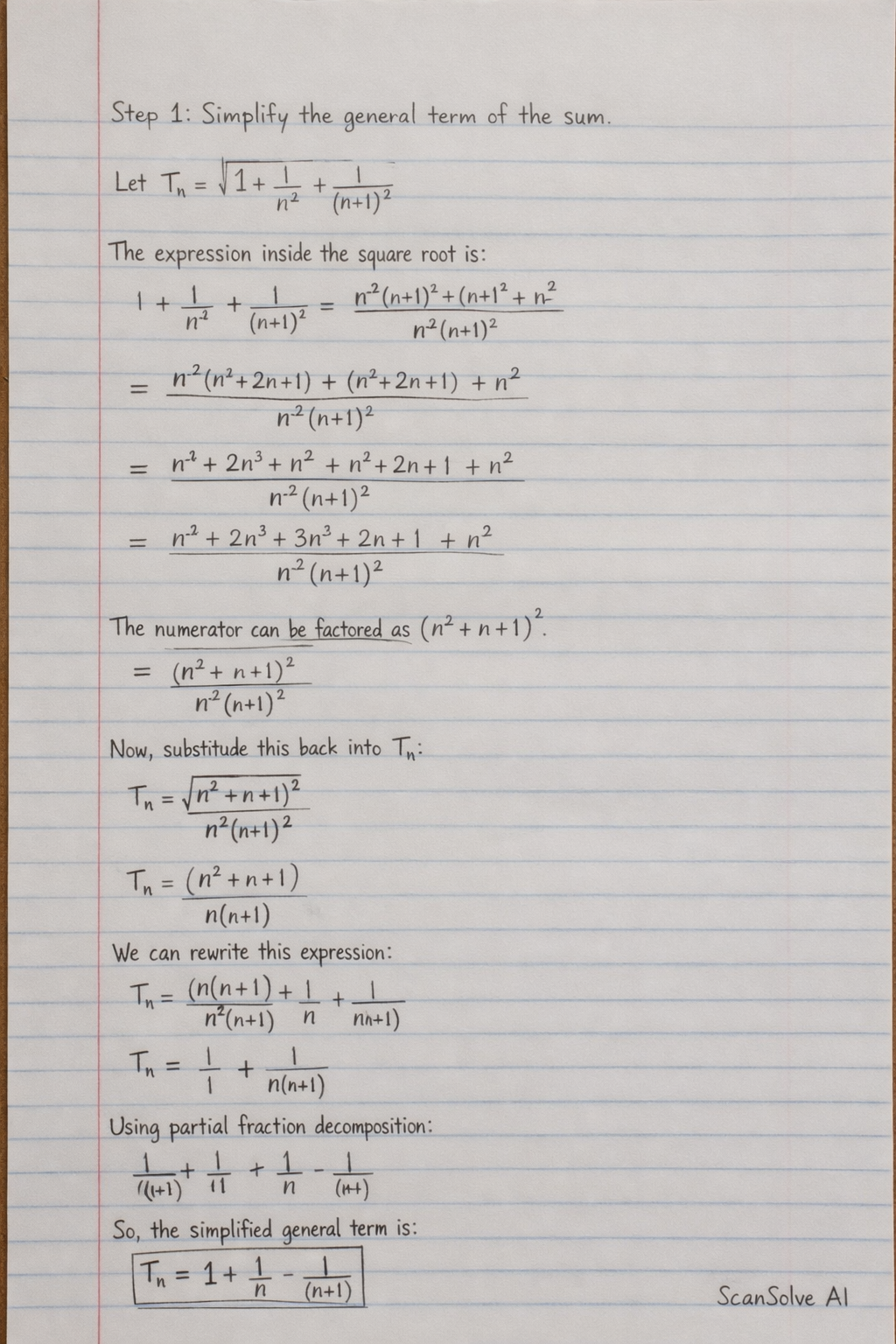
Handwritten Step-by-Step Solution
Get this as a handwritten image on WhatsApp — like a tutor wrote it for you.
Try on WhatsApp