a) Show that log(70/33) + log(22/135) - log(7/18) = 3log2 - 2log3. b) If log10 x = a, compute the value of 10^(a-1) in terms of x.

Mathematics
a) Show that log(70/33) + log(22/135) - log(7/18) = 3log2 - 2log3. b) If log10 x = a, compute the value of 10^(a-1) in terms of x.

ScanSolve AI Answer

Answer

x10\frac{x}{10}

*a) Show that log7033+log22135log718=3log22log3\log \frac{70}{33} + \log \frac{22}{135} - \log \frac{7}{18} = 3 \log 2 - 2 \log 3.

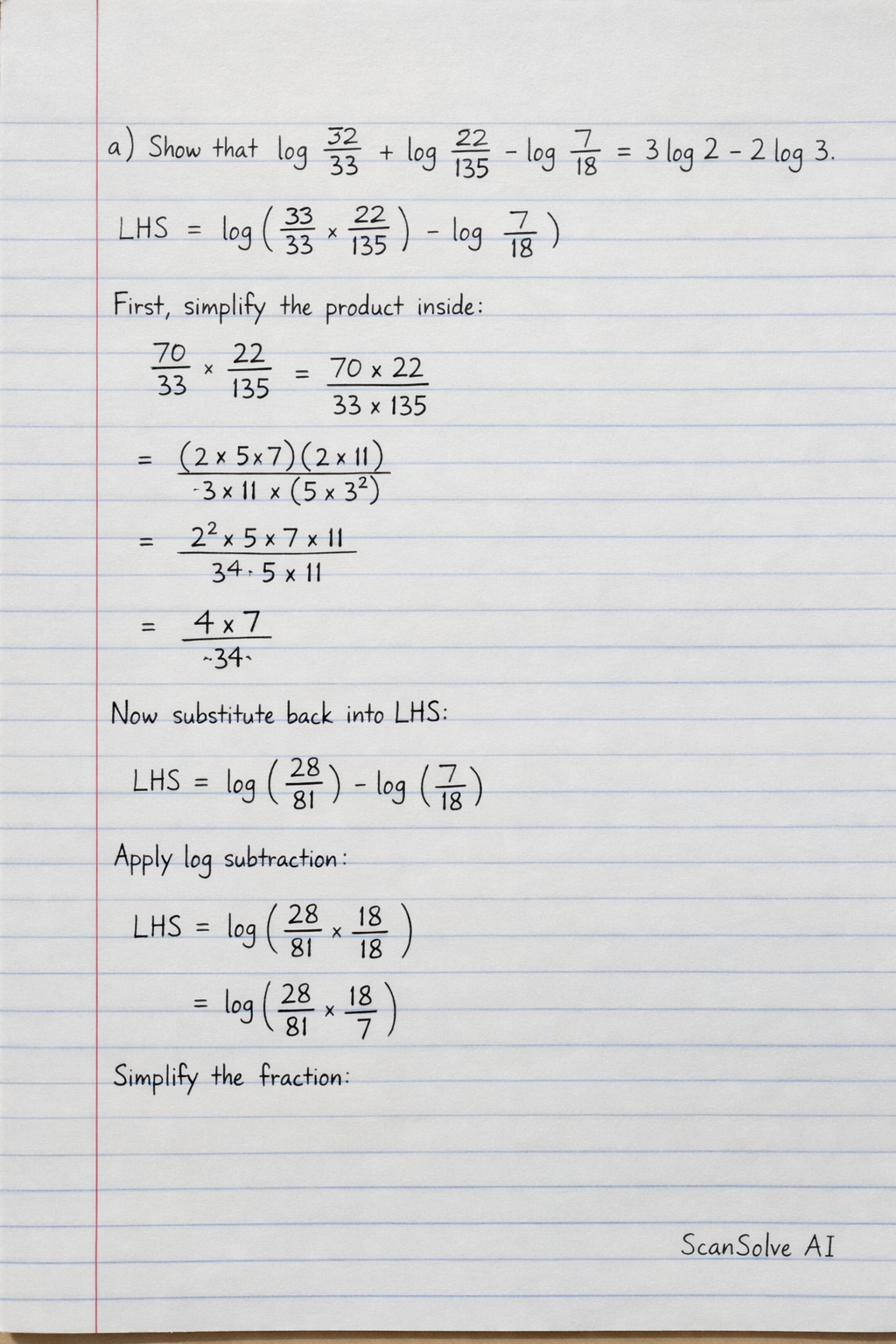
Step 1: Simplify the left-hand side (LHS) using logarithm properties logA+logB=log(AB)\log A + \log B = \log(AB) and logAlogB=log(AB)\log A - \log B = \log\left(\frac{A}{B}\right). LHS=log(7033×22135)log718LHS = \log \left( \frac{70}{33} \times \frac{22}{135} \right) - \log \frac{7}{18} First, simplify the product inside the logarithm: 7033×22135=70×2233×135\frac{70}{33} \times \frac{22}{135} = \frac{70 \times 22}{33 \times 135} Factorize the numbers to simplify: (2×5×7)×(2×11)(3×11)×(5×33)=22×5×7×1134×5×11\frac{(2 \times 5 \times 7) \times (2 \times 11)}{(3 \times 11) \times (5 \times 3^3)} = \frac{2^2 \times 5 \times 7 \times 11}{3^4 \times 5 \times 11} Cancel common factors (5 and 11): =22×734=4×781=2881= \frac{2^2 \times 7}{3^4} = \frac{4 \times 7}{81} = \frac{28}{81} Now substitute this back into the LHS: LHS=log(2881)log(718)LHS = \log \left( \frac{28}{81} \right) - \log \left( \frac{7}{18} \right) Apply the subtraction property of logarithms: LHS=log(28/817/18)=log(2881×187)LHS = \log \left( \frac{28/81}{7/18} \right) = \log \left( \frac{28}{81} \times \frac{18}{7} \right) Simplify the fraction: 2881×187=(4×7)×(2×9)(9×9)×7\frac{28}{81} \times \frac{18}{7} = \frac{(4 \times 7) \times (2 \times 9)}{(9 \times 9) \times 7} Cancel common factors (7 and 9): =4×29=89= \frac{4 \times 2}{9} = \frac{8}{9} So, the LHS simplifies to: LHS=log(89)LHS = \log \left( \frac{8}{9} \right)

Step 2: Express the result in terms of log2\log 2 and log3\log 3. Rewrite 89\frac{8}{9} using powers of 2 and 3: 89=2332\frac{8}{9} = \frac{2^3}{3^2} Substitute this into the LHS: LHS=log(2332)LHS = \log \left( \frac{2^3}{3^2} \right) Apply the logarithm properties log(AB)=logAlogB\log\left(\frac{A}{B}\right) = \log A - \log B and log(An)=nlogA\log(A^n) = n \log A: LHS=log(23)log(32)LHS = \log(2^3) - \log(3^2) LHS=3log22log3LHS = 3 \log 2 - 2 \log 3 This matches the right-hand side (RHS) of the given equation. Therefore, the statement is shown.

*b) If log10x=a\log_{10} x = a, compute the value of 10a110^{a-1} in terms of xx.

Step 1: Convert the logarithmic equation to an exponential equation. Given log10x=a\log_{10} x = a. By the definition of a logarithm, this means: 10a=x10^a = x

Step 2: Express 10a110^{a-1} using exponent rules. Recall the exponent rule ABC=ABACA^{B-C} = \frac{A^B}{A^C}. 10a1=10a10110^{a-1} = \frac{10^a}{10^1}

Step 3: Substitute the value of 10a10^a from Step 1. Substitute 10a=x10^a = x into the expression: 10a1=x1010^{a-1} = \frac{x}{10} The value of 10a110^{a-1} in terms of xx is x10\boxed{\frac{x}{10}}.

Was this helpful?

Need help with your own homework?

Get instant step-by-step solutions to any question. Free to start.

Ask Your Question
Handwritten step-by-step solution preview

Handwritten Step-by-Step Solution

Get this as a handwritten image on WhatsApp — like a tutor wrote it for you.

Try on WhatsApp

Still have questions?

Quick Answer

*a) Show that (70)/(33) + (22)/(135) - (7)/(18) = 3 2 - 2 3. Step 1: Simplify the left-hand side (LHS) using logarithm properties A + B = (AB) and A - B = ((A)/(B)).

a) Show that log(70/33) + log(22/135) - log(7/18) = 3log2 - 2log3. b) If log10 x = a, compute the value of 10^(a-1) in terms of x.
Mathematics

This mathematics problem involves applying core mathematical principles and formulas. Below you will find a complete step-by-step solution with detailed explanations for each step, helping you understand not just the answer but the method behind it.

ScanSolve AI Answer
*a) Show that (70)/(33) + (22)/(135) - (7)/(18) = 3 2 - 2 3. Step 1: Simplify the left-hand side (LHS) using logarithm properties A + B = (AB) and A - B = ((A)/(B)). LHS = ( (70)/(33) × (22)/(135) ) - (7)/(18) First, simplify the product inside the logarithm: (70)/(33) × (22)/(135) = (70 × 22)/(33 × 135) Factorize the numbers to simplify: ((2 × 5 × 7) × (2 × 11))/((3 × 11) × (5 × 3^3)) = (2^2 × 5 × 7 × 11)/(3^4 × 5 × 11) Cancel common factors (5 and 11): = (2^2 × 7)/(3^4) = (4 × 7)/(81) = (28)/(81) Now substitute this back into the LHS: LHS = ( (28)/(81) ) - ( (7)/(18) ) Apply the subtraction property of logarithms: LHS = ( (28/81)/(7/18) ) = ( (28)/(81) × (18)/(7) ) Simplify the fraction: (28)/(81) × (18)/(7) = ((4 × 7) × (2 × 9))/((9 × 9) × 7) Cancel common factors (7 and 9): = (4 × 2)/(9) = (8)/(9) So, the LHS simplifies to: LHS = ( (8)/(9) ) Step 2: Express the result in terms of 2 and 3. Rewrite (8)/(9) using powers of 2 and 3: (8)/(9) = (2^3)/(3^2) Substitute this into the LHS: LHS = ( (2^3)/(3^2) ) Apply the logarithm properties ((A)/(B)) = A - B and (A^n) = n A: LHS = (2^3) - (3^2) LHS = 3 2 - 2 3 This matches the right-hand side (RHS) of the given equation. Therefore, the statement is shown. *b) If _10 x = a, compute the value of 10^a-1 in terms of x. Step 1: Convert the logarithmic equation to an exponential equation. Given _10 x = a. By the definition of a logarithm, this means: 10^a = x Step 2: Express 10^a-1 using exponent rules. Recall the exponent rule A^B-C = (A^B)/(A^C). 10^a-1 = (10^a)/(10^1) Step 3: Substitute the value of 10^a from Step 1. Substitute 10^a = x into the expression: 10^a-1 = (x)/(10) The value of 10^a-1 in terms of x is (x)/(10).