
We read your photo as:
Simplify the left side of the inequality.
Mathematics
ScanSolve AI Answer
Answer
Step-by-step solution
5 stepsSimplify the left side of the inequality.
Multiply the fractions on the left side:
Gather all terms containing on one side and constant terms on the other side.
Add to both sides of the inequality:
Add to both sides of the inequality:
Combine the constant terms on the right side.
Find a common denominator for and , which is 8.
Now add the fractions:
Solve for .
Divide both sides by 4:
Express the solution as an interval.
The inequality means that can be any value strictly greater than . In interval notation, this is written as:
Was this helpful?
Try one yourself
A new problem that tests the same skill.
Still stuck on this one?
Ask a follow-up, and the answer starts from this question.
Got a different question?Ask your own question
More Mathematics Questions
QSimplify the absolute value on the right side of the inequality.QExpand the left side of the inequality.QSimplify the fraction on the right side.QSubtract 3 from both sides of the inequality.QSubtract 2 from both sides of the inequality.
Browse by topic:Algebra
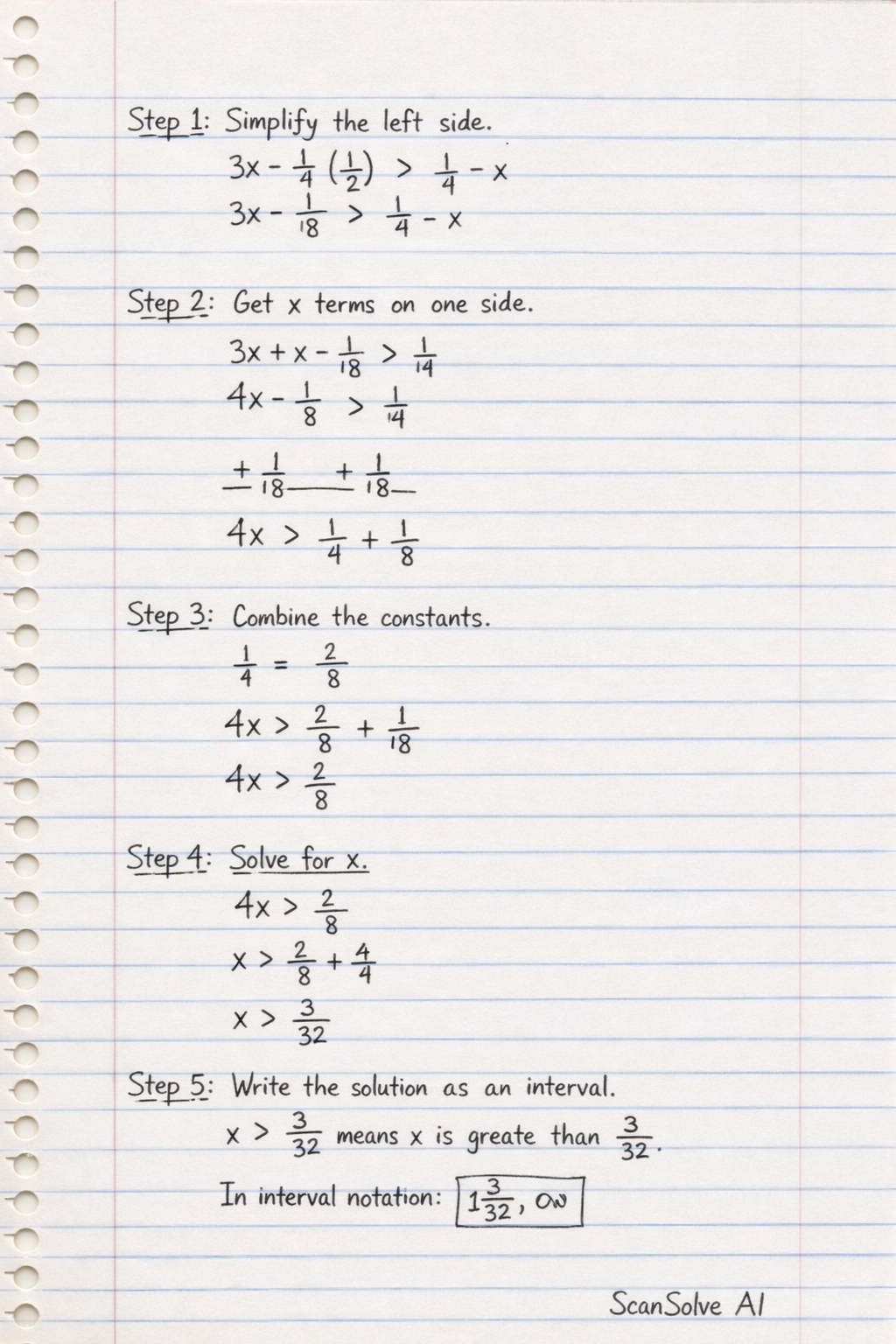
Handwritten Step-by-Step Solution
Get this as a handwritten image on WhatsApp — like a tutor wrote it for you.
Try on WhatsApp