∫ sin(√x) dx = ?

Mathematics
∫ sin(√x) dx = ?

ScanSolve AI Answer

Answer

2sin(x)2xcos(x)+C2\sin(\sqrt{x}) - 2\sqrt{x}\cos(\sqrt{x}) + C

To solve the integral sin(x)dx\int \sin(\sqrt{x})\,dx, we will use a substitution followed by integration by parts.

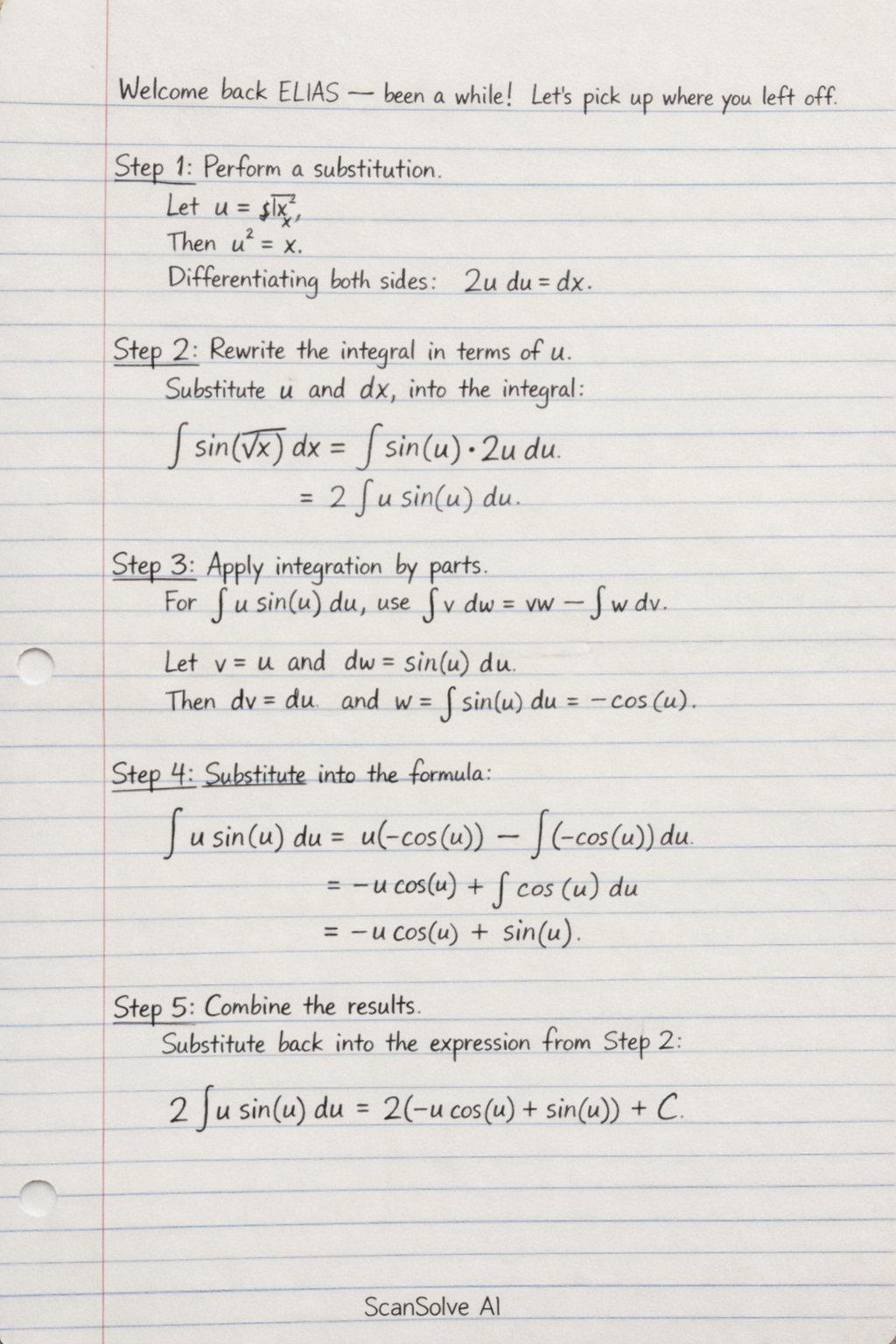
Step 1: Perform a substitution. Let u=xu = \sqrt{x}. Then u2=xu^2 = x. Differentiating both sides with respect to uu gives 2udu=dx2u\,du = dx.

Step 2: Rewrite the integral in terms of uu. Substitute uu and dxdx into the integral: sin(x)dx=sin(u)2udu=2usin(u)du\int \sin(\sqrt{x})\,dx = \int \sin(u) \cdot 2u\,du = 2 \int u \sin(u)\,du

Step 3: Apply integration by parts. For the integral usin(u)du\int u \sin(u)\,du, use the integration by parts formula vdw=vwwdv\int v\,dw = vw - \int w\,dv. Let v=uv = u and dw=sin(u)dudw = \sin(u)\,du. Then dv=dudv = du and w=sin(u)du=cos(u)w = \int \sin(u)\,du = -\cos(u).

Step 4: Substitute these into the integration by parts formula. usin(u)du=u(cos(u))(cos(u))du\int u \sin(u)\,du = u(-\cos(u)) - \int (-\cos(u))\,du =ucos(u)+cos(u)du= -u\cos(u) + \int \cos(u)\,du =ucos(u)+sin(u)= -u\cos(u) + \sin(u)

Step 5: Combine the results. Now, substitute this back into the expression from Step 2: 2usin(u)du=2(ucos(u)+sin(u))+C2 \int u \sin(u)\,du = 2(-u\cos(u) + \sin(u)) + C

Step 6: Substitute back u=xu = \sqrt{x}. Replace uu with x\sqrt{x} to express the answer in terms of xx: 2(xcos(x)+sin(x))+C2(-\sqrt{x}\cos(\sqrt{x}) + \sin(\sqrt{x})) + C =2sin(x)2xcos(x)+C= 2\sin(\sqrt{x}) - 2\sqrt{x}\cos(\sqrt{x}) + C

The final answer is 2sin(x)2xcos(x)+C\boxed{2\sin(\sqrt{x}) - 2\sqrt{x}\cos(\sqrt{x}) + C}.

Send me the next one 📸

Was this helpful?

Need help with your own homework?

Get instant step-by-step solutions to any question. Free to start.

Ask Your Question
Handwritten step-by-step solution preview

Handwritten Step-by-Step Solution

Get this as a handwritten image on WhatsApp — like a tutor wrote it for you.

Try on WhatsApp

Still have questions?

Quick Answer

To solve the integral (sqrt(x))\,dx, we will use a substitution followed by integration by parts.

∫ sin(√x) dx = ?
Mathematics

This mathematics problem involves applying core mathematical principles and formulas. Below you will find a complete step-by-step solution with detailed explanations for each step, helping you understand not just the answer but the method behind it.

ScanSolve AI Answer
To solve the integral (sqrt(x))\,dx, we will use a substitution followed by integration by parts. Step 1: Perform a substitution. Let u = sqrt(x). Then u^2 = x. Differentiating both sides with respect to u gives 2u\,du = dx. Step 2: Rewrite the integral in terms of u. Substitute u and dx into the integral: (sqrt(x))\,dx = (u) · 2u\,du = 2 u (u)\,du Step 3: Apply integration by parts. For the integral u (u)\,du, use the integration by parts formula v\,dw = vw - w\,dv. Let v = u and dw = (u)\,du. Then dv = du and w = (u)\,du = -(u). Step 4: Substitute these into the integration by parts formula. u (u)\,du = u(-(u)) - (-(u))\,du = -u(u) + (u)\,du = -u(u) + (u) Step 5: Combine the results. Now, substitute this back into the expression from Step 2: 2 u (u)\,du = 2(-u(u) + (u)) + C Step 6: Substitute back u = sqrt(x). Replace u with sqrt(x) to express the answer in terms of x: 2(-sqrt(x)(sqrt(x)) + (sqrt(x))) + C = 2(sqrt(x)) - 2sqrt(x)(sqrt(x)) + C The final answer is 2(sqrt(x)) - 2sqrt(x)(sqrt(x)) + C. Send me the next one 📸