
We read your photo as:
Write these word problems in mathematical language (without working out the answers): a) the difference between 69 and 43 b) the sum of 112 and 28 c) one third of 24 increased by 8 d) the square root of 16 is equal to the square of 2 e) 15 less than 99 f) 20 more than 16.
ScanSolve AI Answer
Step-by-step solution
10 steps1. Write these word problems in mathematical language (without working out the answers):
- a) The difference between 69 and 43:
- b) The sum of 112 and 28:
- c) One third of 24 increased by 8:
- d) The square root of 16 is equal to the square of 2:
- e) 15 less than 99:
- f) 20 more than 16:
2. Find the values of the letters in the following flow diagrams:
- a)
Calculate $a, b, c$ by multiplying the input by 3.
$$ a = 2 \times 3 = 6 $$ $$ b = 8 \times 3 = 24 $$ $$ c = 16 \times 3 = 48 $$Calculate $d, e, f$ by adding 6 to $a, b, c$.
$$ d = a + 6 = 6 + 6 = 12 $$ $$ e = b + 6 = 24 + 6 = 30 $$ $$ f = c + 6 = 48 + 6 = 54 $$ The values are: $\boxed{a=6, b=24, c=48, d=12, e=30, f=54}$- c)
Determine the value of using any input-output pair.
Using the first pair:
Verify with other pairs (optional, but good for checking).
$$ 16 + 21 = 37 $$ $$ 49 + 21 = 70 $$ The value is: $\boxed{g=21}$3. Write these phrases as expressions (write the unknown number as x):
- a) A number is decreased by the square of 4:
- b) The product of 6 and a number is increased by 10:
- c) A number divided by 3 is added to the square of that number:
- d) A number multiplied by 5 is subtracted from 25:
- e) Half of a number is added to one third of that number:
- f) 2 less than the product of a number and 8:
4. Think of a number. Add 5. Multiply the sum by 2. Subtract 1. Write an expression using for the unknown. Find the value of this expression if .
Write the expression.
Let the unknown number be .
Add 5:
Multiply the sum by 2:
Subtract 1:
The expression is:Find the value of the expression when .
The value of the expression is:
5. Copy and complete the following table:
Calculate the output for the given input values.
For :
For :
For :
For :Find the input when the output is 250.
The completed table is:
6. If , and , find the values of these expressions:
-
a)
The value is:
-
b)
The value is:
-
c)
The value is:
-
d)
The value is:
7. Write an expression to describe the relationship of the data in the tables:
-
a) Observe the relationship between and : The output is always 2 more than the input . The expression is:
-
b) Observe the relationship between and : For For For For The relationship holds for the first three pairs. Assuming there might be a typo in the last value of (it should be for to hold), the most consistent expression for the majority of the data is:
8. What number doubled and added to 12 gives 20?
-
Set up the equation.
Let the number be .
Solve for .
The number is:
Still stuck on this one?
Ask a follow-up, and the answer starts from this question.
More Mathematics Questions
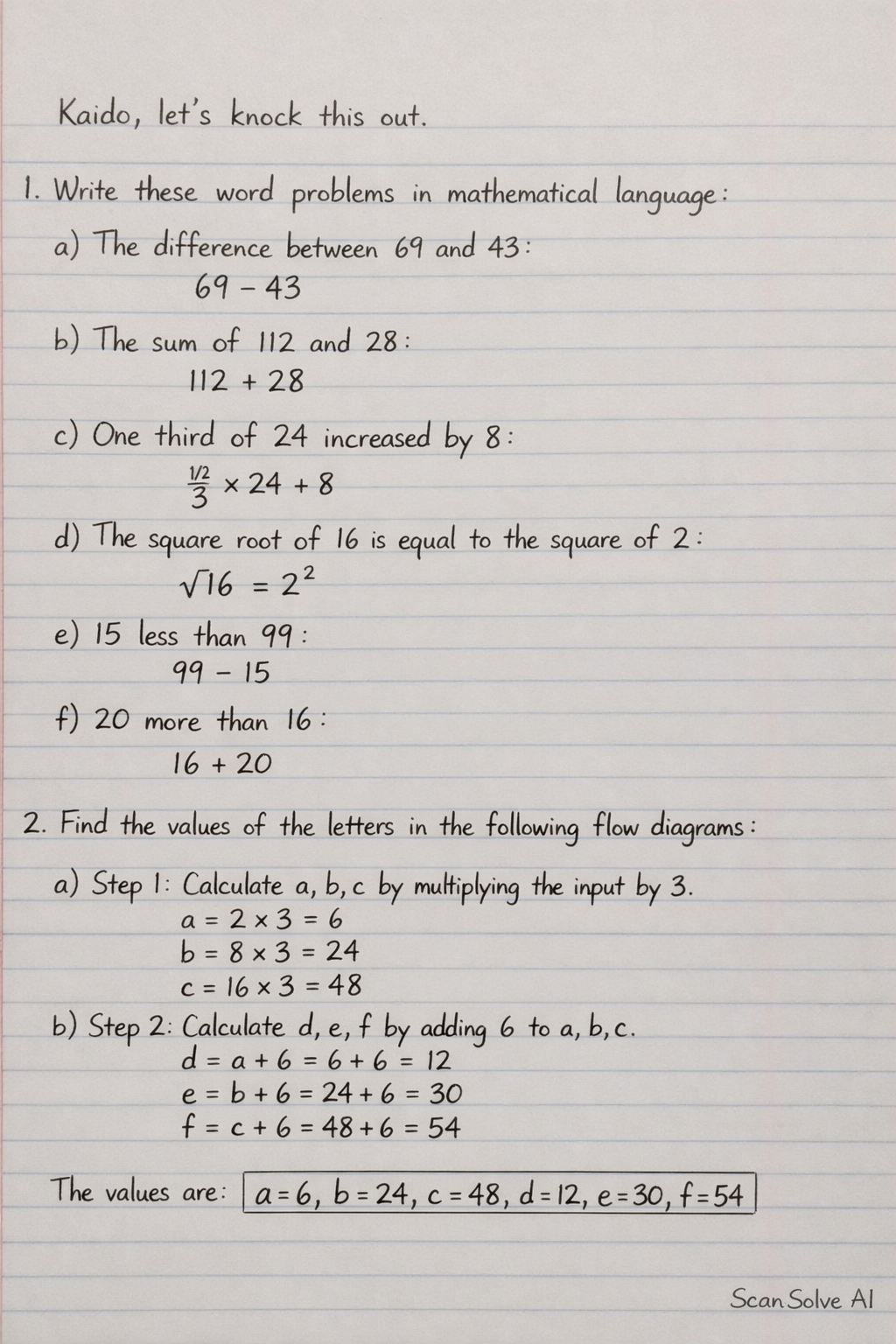
Handwritten Step-by-Step Solution
Get this as a handwritten image on WhatsApp — like a tutor wrote it for you.
Try on WhatsApp