
We read your photo as:
Solve the following math problems: 6. Work out the square of: a) 8, b) 15. 7. Complete the sequences: a) 2, 3, 5, 7, ? b) 1, 3, 6, 10, ? c) 2, 4, 8, 16, ? d) 12, 14, 16, 18, ?. 8. Circle all prime num
ScanSolve AI Answer
Step-by-step solution
12 stepshere are the solutions to the math problems:
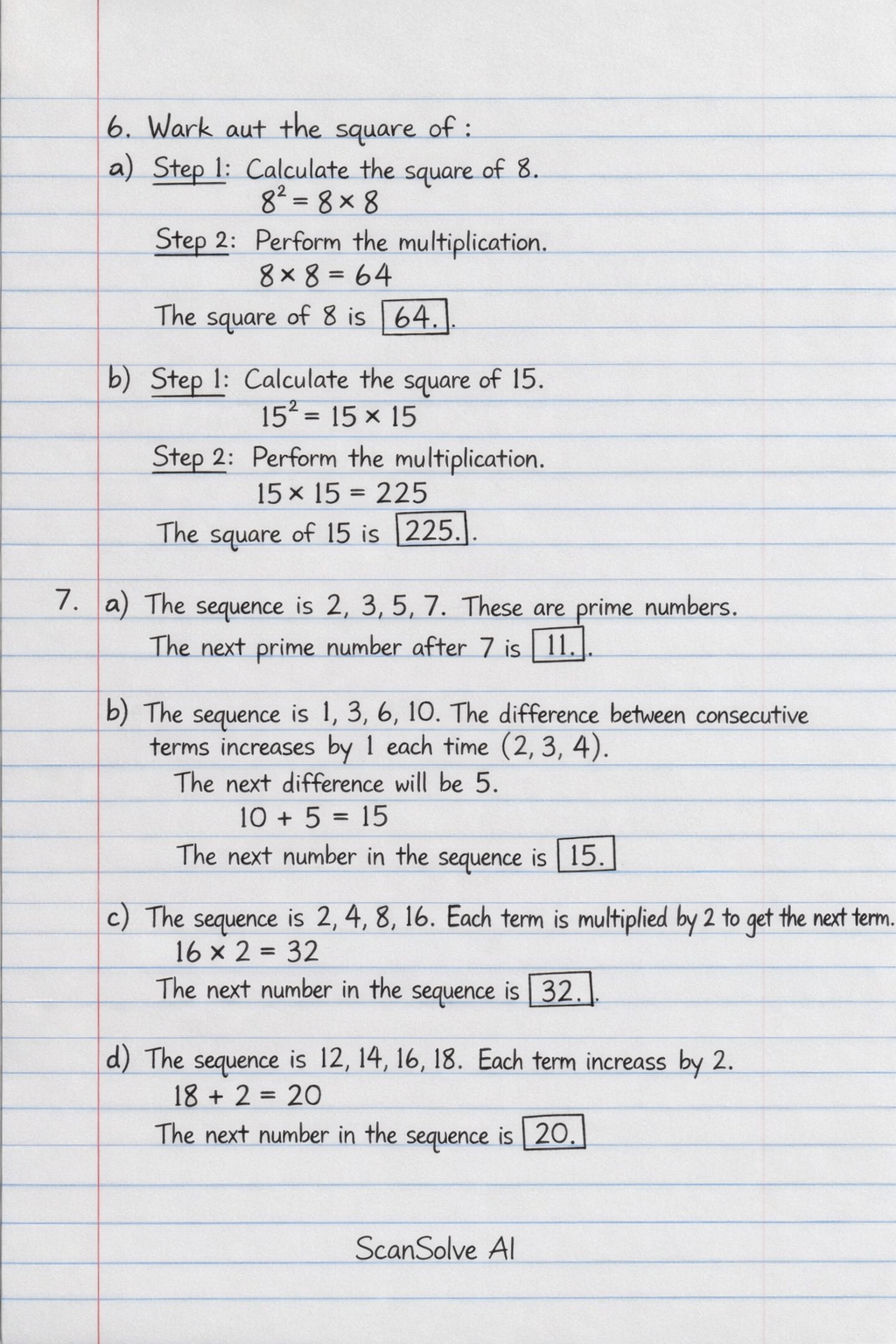
6. Work out the square of:
a)
Calculate the square of 8.
Perform the multiplication.
The square of 8 is .
b)
Calculate the square of 15.
Perform the multiplication.
The square of 15 is .
7. Complete the sequences below.
a) The sequence is 2, 3, 5, 7. These are prime numbers.
The next prime number after 7 is .b) The sequence is 1, 3, 6, 10. The difference between consecutive terms increases by 1 each time (2, 3, 4).
The next difference will be 5.The next number in the sequence is .
c) The sequence is 2, 4, 8, 16. Each term is multiplied by 2 to get the next term.
The next number in the sequence is .
d) The sequence is 12, 14, 16, 18. Each term increases by 2.
The next number in the sequence is .
8. Circle all prime numbers.
A prime number is a natural number greater than 1 that has no positive divisors other than 1 and itself.a) 2, 1, 6, 5, 9
The prime numbers are .b) 5, 6, 9, 2, 11
The prime numbers are .c) 9, 15, 11, 7, 5, 3
The prime numbers are .d) 9, 8, 11, 12, 10, 8
The prime number is .9. Work out the sum of the first 4 odd numbers.
Identify the first 4 odd numbers.
The first 4 odd numbers are 1, 3, 5, and 7.
Calculate their sum.
The sum of the first 4 odd numbers is .
10. List the multiples of 5 between 1 and 35.
List multiples of 5.
Multiples of 5 are numbers obtained by multiplying 5 by an integer.
Identify multiples of 5 that are greater than 1 and less than 35.
The multiples are , , , , , .
The multiples of 5 between 1 and 35 are .11. Complete the factor tree below.
a)
For the top box, multiply the two branches below it.
For the bottom right box, divide 14 by the given branch 2.
The completed factor tree has in the top box and in the bottom right box.
b)
For the right box below 70, multiply its two branches.
For the left box below 70, divide 70 by the value in the right box (35).
The completed factor tree has in the left box and in the right box.
Still stuck on this one?
Ask a follow-up, and the answer starts from this question.
More Mathematics Questions
Handwritten Step-by-Step Solution
Get this as a handwritten image on WhatsApp — like a tutor wrote it for you.
Try on WhatsApp