
We read your photo as:
Solve the following math problems: 1. 1.03 6 = ? 2. Convert 72 (base 10) to binary. 3. Simplify 0.25 100 + 10 * 2.5 = ? 4. 2/3 - 1/4 = ? 5. Find the next number in the sequence: 9, 3, 1, 1/3, ...
ScanSolve AI Answer
Step-by-step solution
5 stepsHere are the solutions to the problems:
1. Multiply
The answer is .
2. Change 72 ten to binary base
To convert a base-10 number to binary, we repeatedly divide by 2 and record the remainders.
remainder 0
remainder 0
remainder 0
remainder 1
remainder 0
remainder 0
remainder 1
Reading the remainders from bottom to top gives the binary number.
The answer is .
3. Simplify
Perform the multiplications.
Perform the addition.
The answer is .
4. Subtract
Find a common denominator for 3 and 4, which is 12.
Convert the fractions to have the common denominator.
Subtract the fractions.
The answer is .
5. Find the next number in the sequence below:
9, 3, 1, \frac{1}{3}, \text{___}
Observe the pattern: each term is obtained by dividing the previous term by 3.
Following this pattern, the next term is:The next number in the sequence is .
6. Write 20,015 in words
The number 20,015 written in words is Twenty thousand fifteen.7. A farmer has roll of string of long [length missing], he cuts it into equal pieces, each 50 metres long. How many pieces does he get altogether?
The total length of the roll of string is missing from the question.
If the total length of the string roll were known (let's say metres), the number of pieces would be calculated by dividing the total length by the length of each piece:Without the total length of the string, the exact number of pieces cannot be determined.
Still stuck on this one?
Ask a follow-up, and the answer starts from this question.
More Mathematics Questions
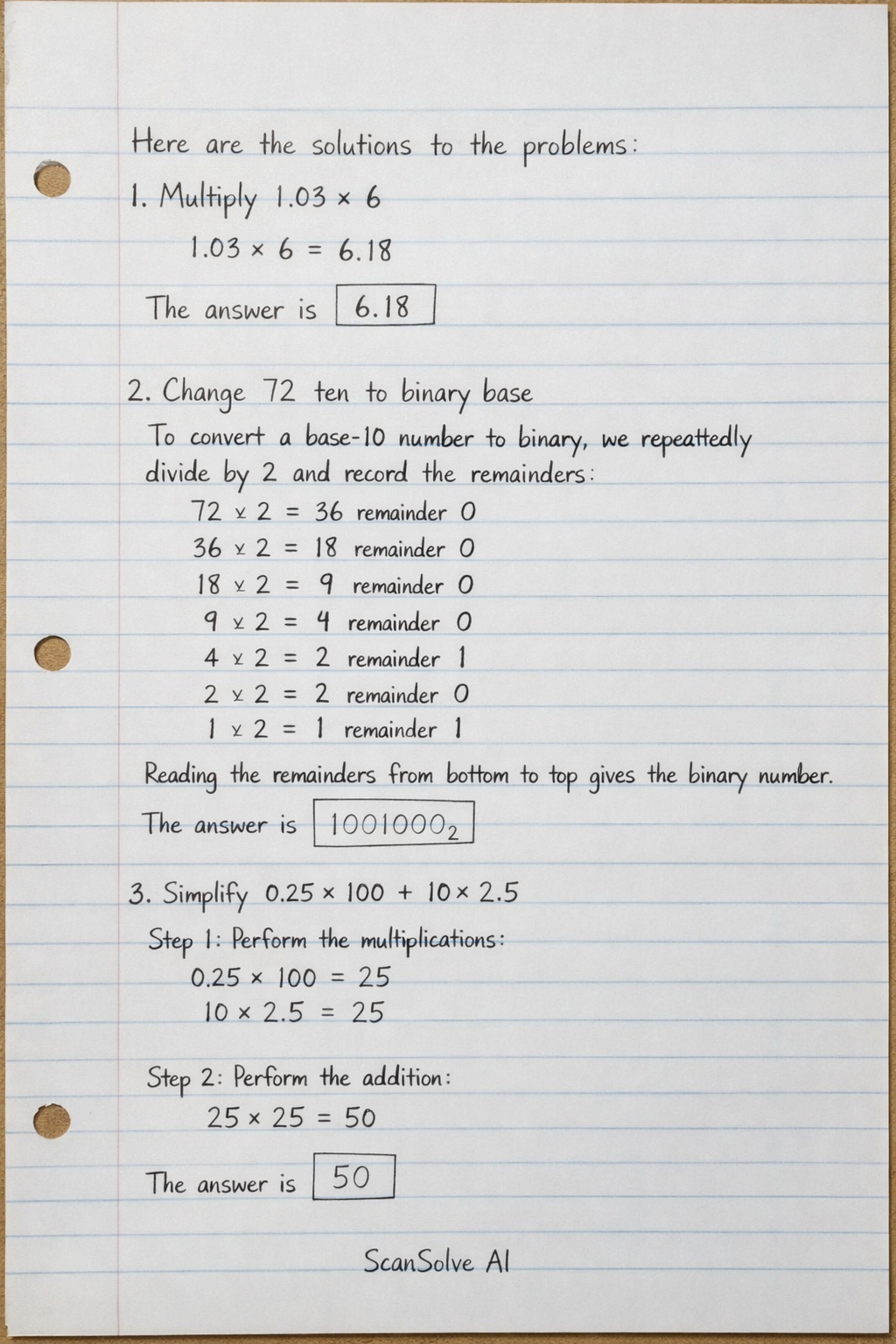
Handwritten Step-by-Step Solution
Get this as a handwritten image on WhatsApp — like a tutor wrote it for you.
Try on WhatsApp