
We read your photo as:
Solve the following mathematics problems: 1. Convert 21 (Base 10) to Base 2. 2. Calculate a 15% discount on N5,000. 3. List 3 cylindrical and 3 rectangular prism objects. 4. Simplify 5x + 10 - 2x + 4.
ScanSolve AI Answer
Step-by-step solution
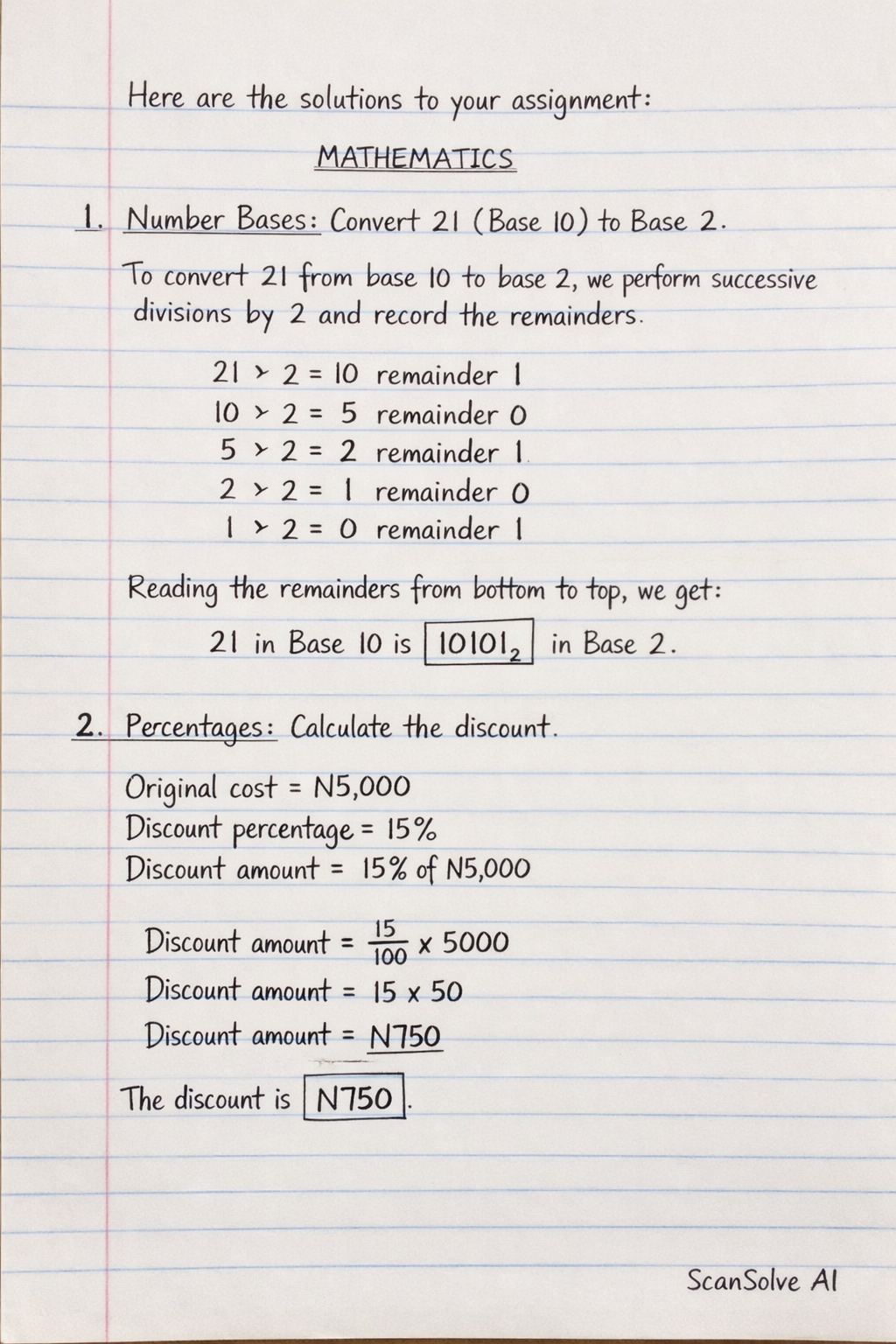
10 stepsHere are the solutions to your assignment:
MATHEMATICS
-
Number Bases: Convert 21 (Base 10) to Base 2. To convert 21 from base 10 to base 2, we perform successive divisions by 2 and record the remainders.
Reading the remainders from bottom to top, we get: The number 21 in Base 10 is in Base 2.
-
Percentages: Calculate the discount. Original cost = N5,000 Discount percentage = 15% Discount amount = of N5,000
The discount is .
-
Geometry: List 3 cylindrical and 3 rectangular prism objects.
- Cylindrical objects:
- Can of soda
- Battery
- Toilet paper roll
- Rectangular prism objects:
- Brick
- Book
- Cereal box
- Cylindrical objects:
-
Algebra: Simplify the expression: .
Group like terms.
$$ (5x - 2x) + (10 + 4) $$Combine like terms.
$$ 3x + 14 $$ The simplified expression is $\boxed{\text{3x + 14}}$.5. Fractions: Fraction of cake left. Fraction eaten on Friday = Fraction eaten on Saturday =
Find the total fraction of cake eaten.
$$ \text{Total eaten} = \frac{2}{5} + \frac{1}{4} $$ Find a common denominator, which is 20. $$ \text{Total eaten} = \frac{2 \times 4}{5 \times 4} + \frac{1 \times 5}{4 \times 5} $$ $$ \text{Total eaten} = \frac{8}{20} + \frac{5}{20} $$ $$ \text{Total eaten} = \frac{8+5}{20} = \frac{13}{20} $$Find the fraction of cake left.
$$ \text{Fraction left} = 1 - \text{Total eaten} $$ $$ \text{Fraction left} = \frac{20}{20} - \frac{13}{20} $$ $$ \text{Fraction left} = \frac{7}{20} $$ The fraction of the whole cake left is $\boxed{\text{}\frac{7}{20}\text{}}$.6. Decimals: Multiply without using a calculator.
Multiply the numbers as if they were whole numbers.
$$ 125 \times 4 = 500 $$Count the total number of decimal places in the original numbers.
12.5 has 1 decimal place. 0.4 has 1 decimal place. Total decimal places = $1 + 1 = 2$.Place the decimal point in the product.
Starting from the right of 500, move the decimal point 2 places to the left. $$ 5.00 $$ The product is $\boxed{\text{5}}$.7. LCM: Find the Lowest Common Multiple (LCM) of 12, 18, and 24.
Find the prime factorization of each number.
$$ 12 = 2^2 \times 3^1 $$ $$ 18 = 2^1 \times 3^2 $$ $$ 24 = 2^3 \times 3^1 $$For each prime factor, take the highest power that appears in any of the factorizations.
Highest power of 2 is $2^3$. Highest power of 3 is $3^2$.Multiply these highest powers together.
$$ \text{LCM} = 2^3 \times 3^2 = 8 \times 9 = 72 $$ The LCM of 12, 18, and 24 is $\boxed{\text{72}}$.8. Angles: Use a protractor to draw an angle of and label it correctly as "Obtuse". * To draw a angle: 1. Draw a straight line segment. This will be one arm of the angle. 2. Place the center of a protractor on one endpoint of the line segment (the vertex). Align the baseline of the protractor with the line segment. 3. Locate the mark on the protractor. 4. Make a small mark at . 5. Draw a second line segment from the vertex to the mark. 6. Label the angle as . * An angle of is an obtuse angle because it is greater than but less than .
-
Word Problem: Cloth needed for 6 outfits. Cloth for one outfit = 2.5 meters Number of outfits = 6
15 meters of cloth are needed for 6 outfits.
-
Symmetry: Draw a square and a rectangle. Draw all the lines of symmetry for each shape.
- Square: A square has 4 lines of symmetry.
- Two lines pass through the midpoints of opposite sides (one horizontal, one vertical).
- Two lines pass through opposite vertices (the diagonals).
- Rectangle: A rectangle has 2 lines of symmetry.
- One line passes through the midpoints of the longer opposite sides (horizontal).
- One line passes through the midpoints of the shorter opposite sides (vertical).
- Square: A square has 4 lines of symmetry.
DIGITAL TECHNOLOGIES
Task: Open Microsoft Word and type a "Happy Holiday" message to Mr. Victor.
a. Shortcut Challenge: Highlight your name and press Ctrl + B. What happened to the text?
When you highlight text and press Ctrl + B in Microsoft Word, the selected text becomes bold.b. Press Ctrl + E. Where did your text move to on the page?
When you press Ctrl + E in Microsoft Word, the selected text or the current paragraph is centered on the page.c. Press Ctrl
-
Still stuck on this one?
Ask a follow-up, and the answer starts from this question.
More Mathematics Questions
Handwritten Step-by-Step Solution
Get this as a handwritten image on WhatsApp — like a tutor wrote it for you.
Try on WhatsApp