
We read your photo as:
Solve the following mathematics problems: 1. Round 2,748,595 to the nearest 10,000. 2. Multiply 0.0409 by 0.0021 in standard form. 3. A student spent 1/4 of her money on books and 1/3 on transport. Wh
ScanSolve AI Answer
This answer stops before the end.
It was cut off when it was first written. Ask ScanSolve this question again for the full working.
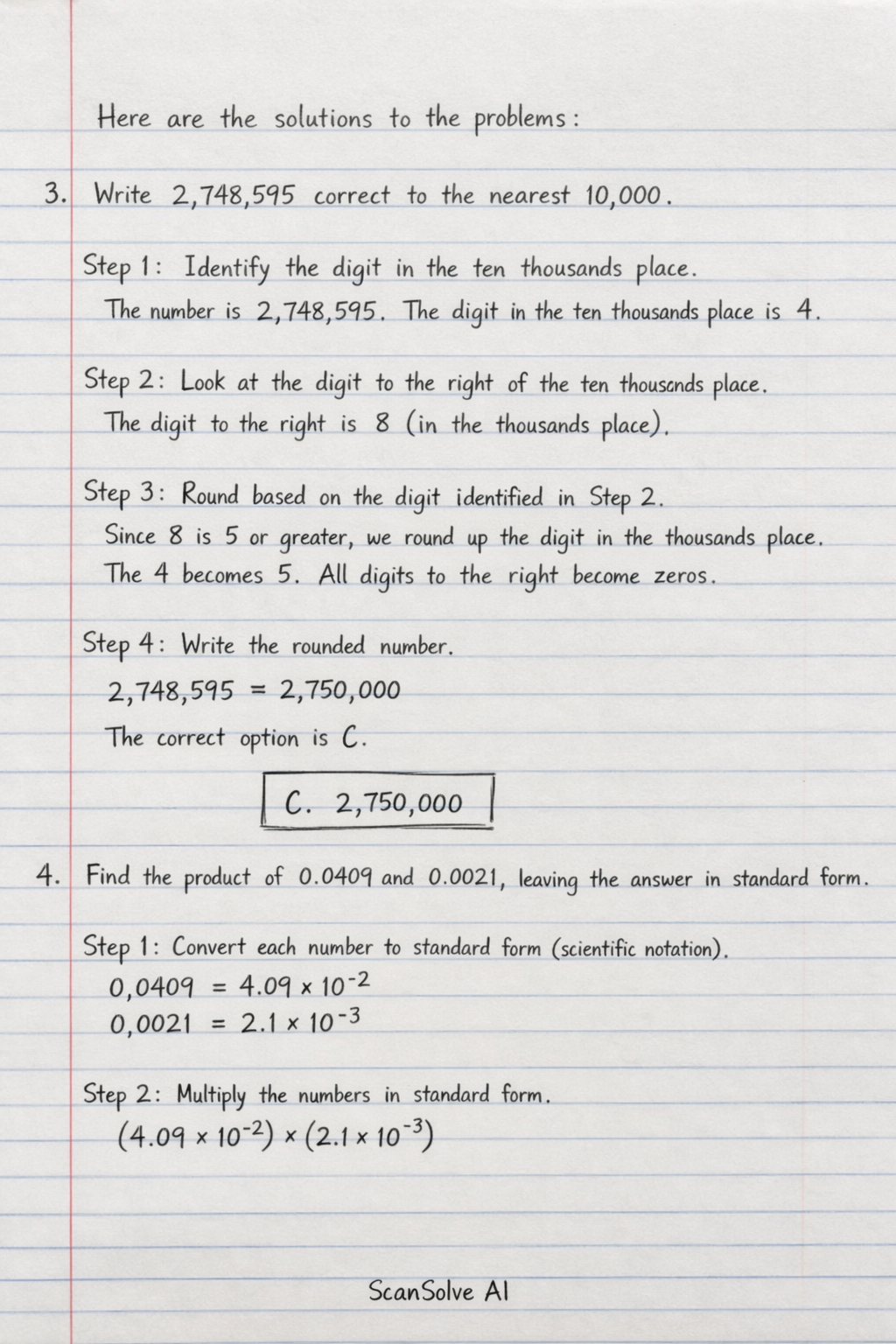
Here are the solutions to the problems:
3. Write 2,748,595 correct to the nearest 10,000.
Step 1: Identify the digit in the ten thousands place.
The number is 2,748,595. The digit in the ten thousands place is 4.
Step 2: Look at the digit to the right of the ten thousands place.
The digit to the right is 8 (in the thousands place).
Step 3: Round based on the digit identified in Step 2.
Since 8 is 5 or greater, we round up the digit in the ten thousands place. The 4 becomes 5. All digits to the right become zeros.
Step 4: Write the rounded number.
The correct option is C.
4. Find the product of 0.0409 and 0.0021, leaving the answer in standard form.
Step 1: Convert each number to standard form (scientific notation).
Step 2: Multiply the numbers in standard form.
Step 3: Multiply the numerical parts and the powers of 10 separately.
The correct option is B.
5. A student spent of her money on books and on transport. What fraction of the money was left?
Step 1: Calculate the total fraction of money spent.
Fraction spent on books
Fraction spent on transport
Total fraction spent
Step 2: Find a common denominator for the fractions and add them.
The least common multiple of 4 and 3 is 12.
Total fraction spent $= \frac{3}{12} + \frac{4}{12} = \frac{3+4}{12} = \frac{7}{12}$$
Step 3: Calculate the fraction of money left.
The total money is represented by 1 (or ).
Fraction left
Fraction left
The correct option is B.
Still stuck on this one?
Ask a follow-up, and the answer starts from this question.
More Mathematics Questions
Handwritten Step-by-Step Solution
Get this as a handwritten image on WhatsApp — like a tutor wrote it for you.
Try on WhatsApp