
We read your photo as:
Solve the following arithmetic problems: b) 3 (3)/(5) + 1 (2)/(5) c) 14 - (-26) d) 0.357 x 2.7 e) -17 - (60 - 84) f) 6 (2)/(3) - (1)/(8)
ScanSolve AI Answer
Step-by-step solution
38 stepsPart b· 3 steps
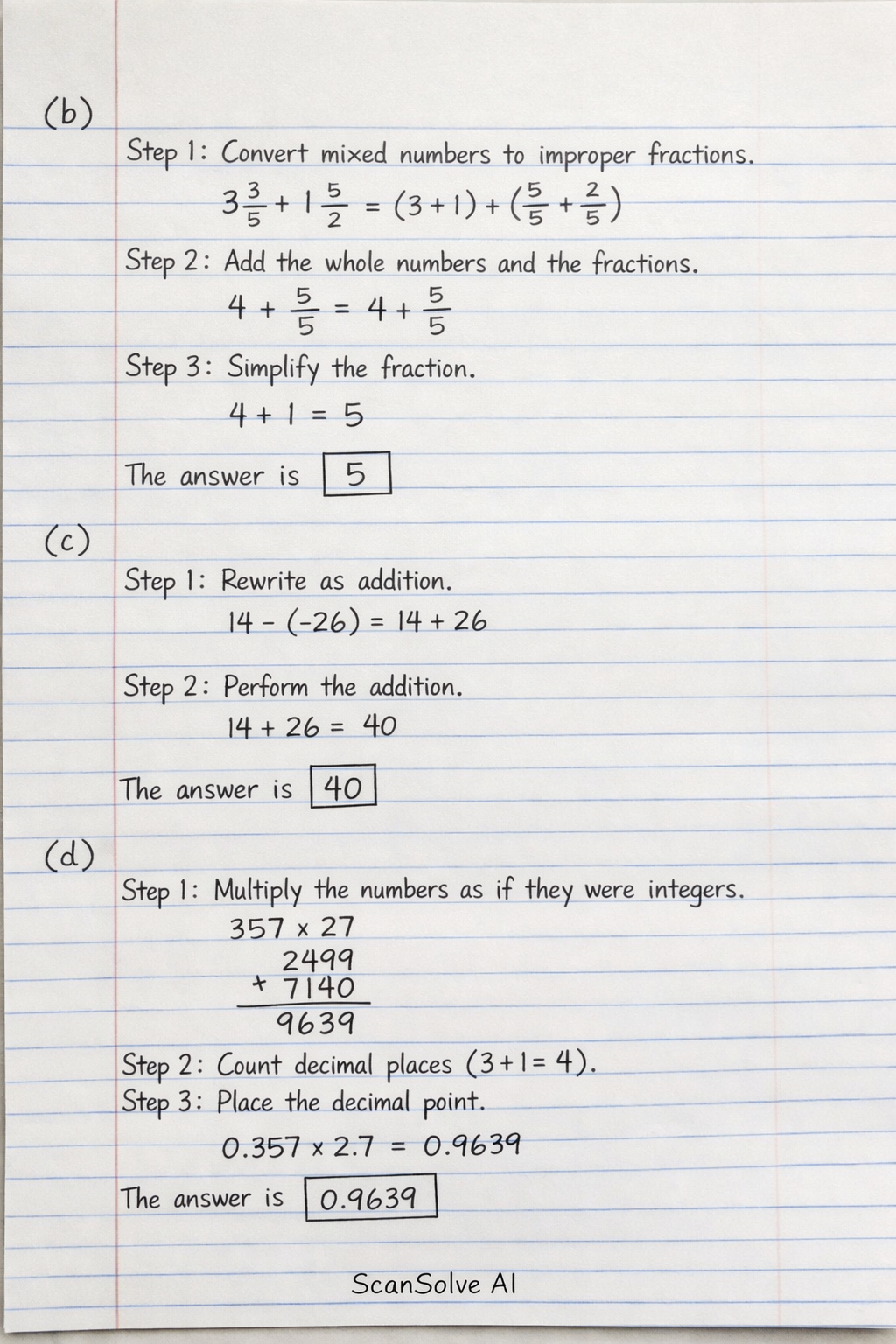
Convert mixed numbers to improper fractions or add whole numbers and fractions separately.
Add the whole numbers and the fractions.
Simplify the fraction.
The answer is .
Part c· 2 steps
Rewrite the subtraction of a negative number as addition.
Perform the addition.
The answer is .
Part d· 3 steps
Multiply the numbers as if they were integers.
Count the total number of decimal places in the original numbers (3 in 0.357 and 1 in 2.7, for a total of 4).
Place the decimal point in the product.
The answer is .
Part e· 4 steps
Perform the operation inside the parentheses first.
Substitute the result back into the expression.
Rewrite the subtraction of a negative number as addition.
Perform the addition.
The answer is .
Part f· 5 steps
Convert the mixed number to an improper fraction.
Find a common denominator for the fractions and .
The least common multiple of 3 and 8 is 24.
Convert both fractions to have the common denominator.
Perform the subtraction.
Convert the improper fraction back to a mixed number.
So, .
The answer is .
Part g· 4 steps
Perform the division.
Divide 130 by 62.
Bring down the 2 after the decimal point.
Place the decimal point in the quotient.
The answer is .
Part h· 3 steps
Multiply 403 by 2.
Multiply 403 by 40.
Add the results from Step 1 and Step 2.
The answer is .
Part h(i)· 14 steps
Add the whole numbers.
Add the fractions.
Since they have the same denominator, add the numerators.
Simplify the fraction.
Add the results from Step 1 and Step 3.
The answer is .
j)
Perform the division.
Divide 38 by 19.
Bring down 5.
with a remainder of 5.
Bring down 7.
.
The answer is .
2. a)
Identify the range for the number
greater than 160 and smaller than 180.
List multiples of 17 until one falls within the specified range.
Select the multiple that is between 160 and 180.
The number is .
2. b)
List all integers between 20 and 45.
Identify prime numbers (numbers greater than 1 that have no positive divisors other than 1 and themselves) from the list.
- 23 (prime)
- 29 (prime)
- 31 (prime)
- 37 (prime)
- 41 (prime)
- 43 (prime)
Count the identified prime numbers.
There are 6 prime numbers between 20 and 45.
The answer is .
Still stuck on this one?
Ask a follow-up, and the answer starts from this question.
More Mathematics Questions
Handwritten Step-by-Step Solution
Get this as a handwritten image on WhatsApp — like a tutor wrote it for you.
Try on WhatsApp