

This mathematics problem involves applying core mathematical principles and formulas. Below you will find a complete step-by-step solution with detailed explanations for each step, helping you understand not just the answer but the method behind it.
ScanSolve AI Answer
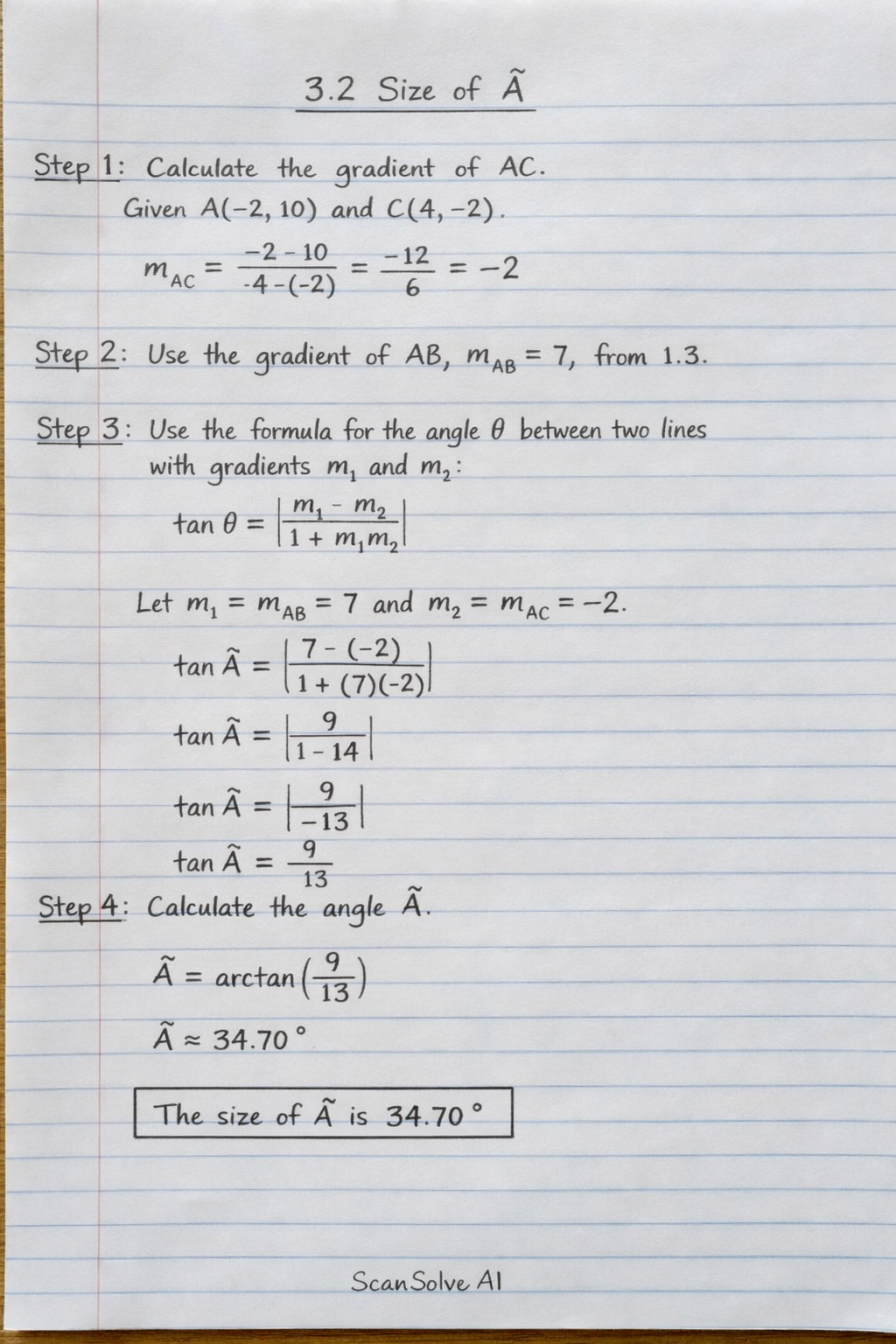
Here are the solutions for 3.2, 3.3, and 4: 3.2 Size of A Step 1: Calculate the gradient of AC. Given A(-2; 10) and C(4; -2). m_AC = (-2 - 10)/(4 - (-2)) = (-12)/(6) = -2 Step 2: Use the gradient of AB, m_AB = 7, from 1.3. Step 3: Use the formula for the angle between two lines with gradients m_1 and m_2: = | (m_1 - m_2)/(1 + m_1 m_2) |. Let m_1 = m_AB = 7 and m_2 = m_AC = -2. A = | (7 - (-2))/(1 + (7)(-2)) | A = | (9)/(1 - 14) | A = | (9)/(-13) | A = (9)/(13) Step 4: Calculate the angle A. A = ((9)/(13)) A ≈ 34.70^ The size of A is 34.70^. 3.3 Coordinates of the point of intersection of the diagonals of parallelogram ACES, where S is a point in the first quadrant. Step 1: The diagonals of a parallelogram bisect each other. The point of intersection is the midpoint of either diagonal. Step 2: Use the coordinates of A(-2; 10) and E(12; 0) to find the midpoint M of diagonal AE. M_x = (x_A + x_E)/(2) = (-2 + 12)/(2) = (10)/(2) = 5 M_y = (y_A + y_E)/(2) = (10 + 0)/(2) = (10)/(2) = 5 The coordinates of the point of intersection of the diagonals are (5; 5). 4 Calculate the coordinates of T. Step 1: Calculate the length of BE using B(-4; -4) and E(12; 0). BE = sqrt((12 - (-4))^2 + (0 - (-4))^2) BE = sqrt((16)^2 + (4)^2) BE = sqrt(256 + 16) BE = sqrt(272) BE = sqrt(16 × 17) = 4sqrt(17) units This confirms the given length. Step 2: Use the distance formula for ET with E(12; 0) and T(p; p), and set ET = 4sqrt(17). ET = sqrt((p - 12)^2 + (p - 0)^2) 4sqrt(17) = sqrt((p - 12)^2 + p^2) Step 3: Square both sides and solve for p. (4sqrt(17))^2 = (p - 12)^2 + p^2 16 × 17 = p^2 - 24p + 144 + p^2 272 = 2p^2 - 24p + 144 0 = 2p^2 - 24p + 144 - 272 0 = 2p^2 - 24p - 128 Divide by 2: 0 = p^2 - 12p - 64 Step 4: Factor the quadratic equation. (p - 16)(p + 4) = 0 This gives two possible values for p: p = 16 or p = -4. Step 5: Apply the condition p > 0. Since p > 0, we choose p = 16. The coordinates of T(p; p) are (16; 16). Last free one today — make it count tomorrow, or type /upgrade for unlimited.