
We read your photo as:
Find the size of h and g in the diagram below.
ScanSolve AI Answer
Step-by-step solution
7 stepsHere are the solutions to your math problems:
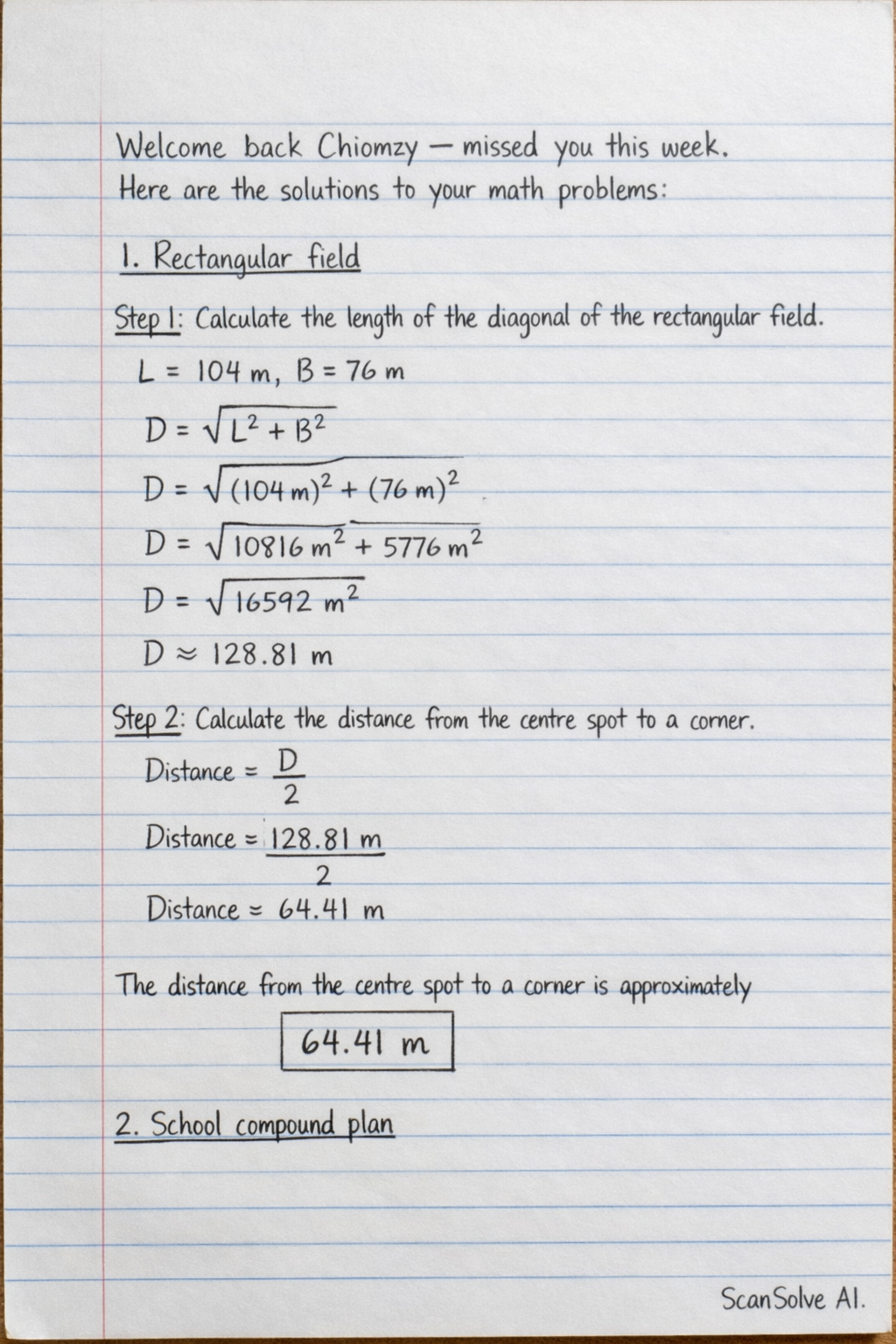
1. Rectangular field
Calculate the length of the diagonal of the rectangular field.
The length () is and the breadth () is . The diagonal () can be found using the Pythagorean theorem:
Calculate the distance from the centre spot to a corner.
The distance from the centre spot to a corner is half the length of the diagonal.
The distance from the centre spot to a corner is approximately .
2. School compound plan
Assumption: The scale "2cm:10cm" is likely a typo and should be "2cm:10m" for a school compound plan. We will proceed with the assumption that on the drawing represents in reality. This simplifies to a scale of .
Convert the actual dimensions to the drawing scale.
The actual length is and the actual breadth is .
The scale is on the drawing for every in reality.Calculate the length on the drawing.
Calculate the breadth on the drawing.
The length on the drawing is and the breadth on the drawing is .
3. Triangle
Determine the size of angle .
The diagram shows a triangle with two sides marked with single dashes, indicating that these sides are equal in length. This means it is an isosceles triangle. In an isosceles triangle, the angles opposite the equal sides are equal. One base angle is given as . Therefore, the other base angle, , must also be .
Determine the size of angle .
The sum of angles in any triangle is . So, we have:
Substitute the value of :
The size of is and the size of is .
Still stuck on this one?
Ask a follow-up, and the answer starts from this question.
More Mathematics Questions
Handwritten Step-by-Step Solution
Get this as a handwritten image on WhatsApp — like a tutor wrote it for you.
Try on WhatsApp