
We read your photo as:
Sketch the graph of the quadratic function y = -x2+4x+1, identifying its vertex, y-intercept, and x-intercepts.
ScanSolve AI Answer
Answer
Use the left and right arrow keys to trace the curve, up and down to jump between key points, and plus and minus to zoom.
| Point | x | y |
|---|---|---|
| x-intercept | −0.24 | 0 |
| y-intercept | 0 | 1 |
| Maximum | 2 | 5 |
| x-intercept | 4.24 | 0 |
Step-by-step solution
5 stepsHere's the solution for question 2a:
To sketch the graph of , we need to find its key features: the vertex, y-intercept, and x-intercepts.
Determine the direction of the parabola.
The coefficient of is , which is negative. Therefore, the parabola opens downwards.
Find the vertex of the parabola.
For a quadratic function , the x-coordinate of the vertex is given by .
Here, , , .Substitute into the equation to find the y-coordinate:
The vertex is at . This is the maximum point of the parabola.
Find the y-intercept.
The y-intercept occurs when .
The y-intercept is at .
Find the x-intercepts.
The x-intercepts occur when .
Multiply by :
Use the quadratic formula :
The x-intercepts are approximately and .
Sketch the graph.
- Plot the vertex .
- Plot the y-intercept .
- Plot the x-intercepts and .
- Draw a smooth parabola opening downwards, passing through these points. The axis of symmetry is the vertical line .
The key points for the sketch are:
- Vertex:
- Y-intercept:
- X-intercepts:
Try one yourself
A new problem that tests the same skill.
Still stuck on this one?
Ask a follow-up, and the answer starts from this question.
More Mathematics Questions
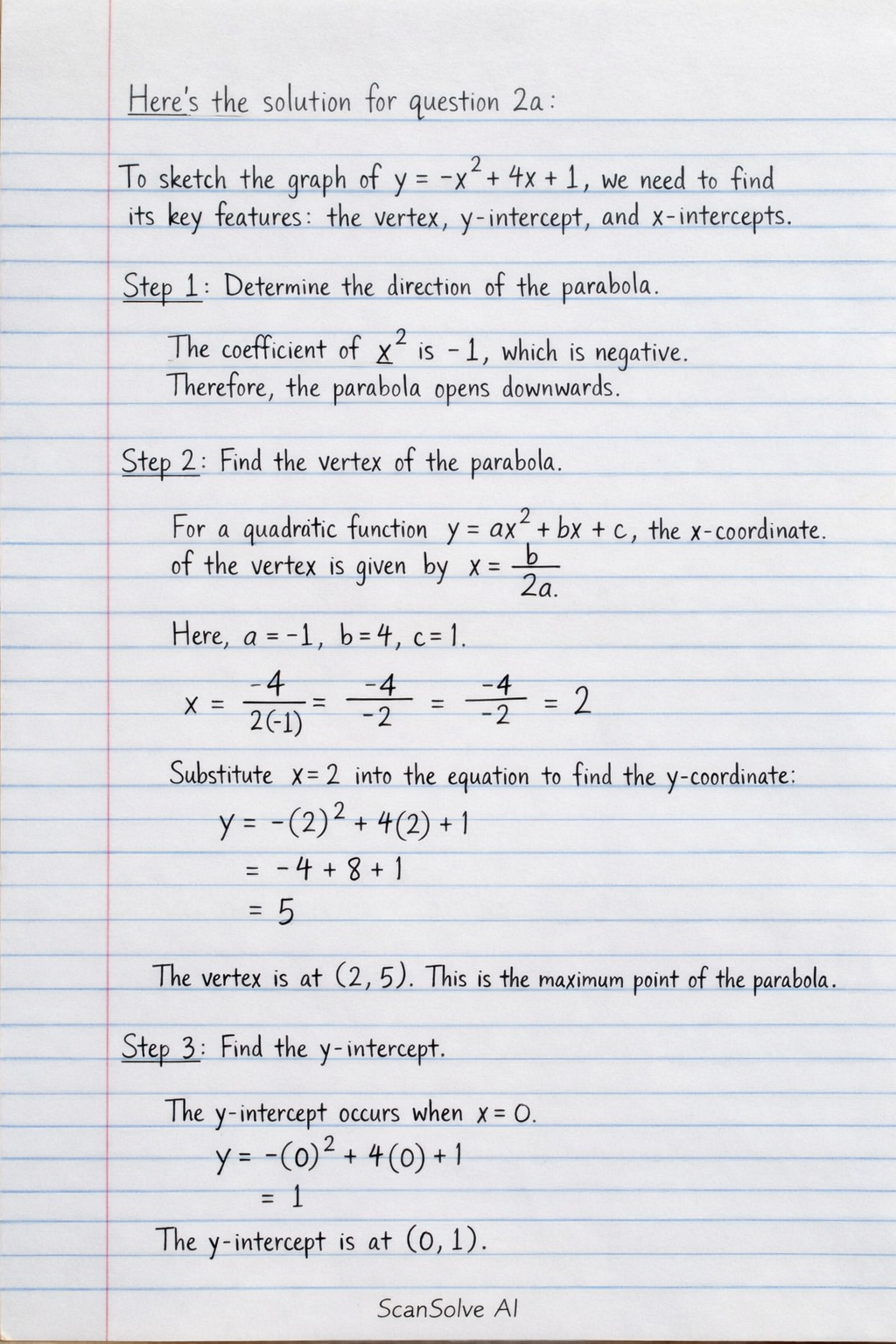
Handwritten Step-by-Step Solution
Get this as a handwritten image on WhatsApp — like a tutor wrote it for you.
Try on WhatsApp