
We read your photo as:
Sketch the nets of the following pyramids and hence work out the surface area of each. Pyramid (c) has a square base with side length 12 cm and slant edges of 10 cm.
Mathematics
ScanSolve AI Answer
Answer
Step-by-step solution
5 stepshere is the solution for part (c).
1. Sketch the nets of the following pyramids and hence work out the surface area of each.
- Pyramid (c):
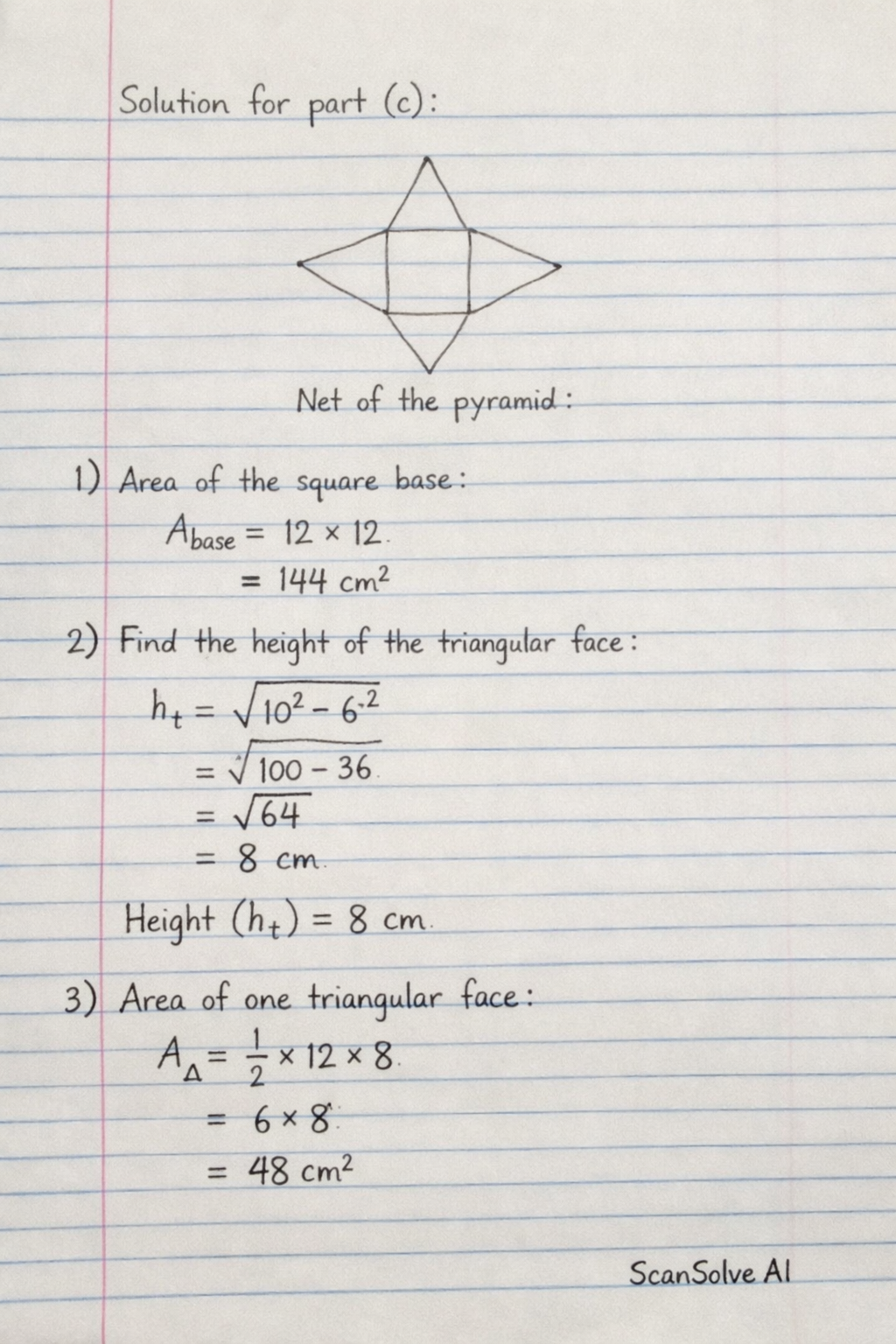
- Net: The net consists of a square base with side length 12 cm. Attached to each side of this square are four isosceles triangles. Each isosceles triangle has a base of 12 cm and two equal sides (slant edges) of 10 cm.
- Surface Area Calculation:
Calculate the area of the square base.
$$ A_{base} = (12 \text{ cm})^2 = 144 \text{ cm}^2 $$Calculate the height of one isosceles triangular face (this is the slant height of the pyramid).
For an isosceles triangle with base cm and equal sides cm, the height can be found using the Pythagorean theorem:
Calculate the area of one isosceles triangular face.
$$ A_{triangle} = \frac{1}{2} \times \text{base} \times \text{height}_t = \frac{1}{2} \times 12 \text{ cm} \times 8 \text{ cm} = 48 \text{ cm}^2 $$Calculate the total area of the four triangular faces (lateral surface area).
$$ A_{lateral} = 4 \times 48 \text{ cm}^2 = 192 \text{ cm}^2 $$Calculate the total surface area by adding the base area and the lateral surface area.
        $$
        A_{total} = A_{base} + A_{lateral} = 144 \text{ cm}^2 + 192 \text{ cm}^2 = 336 \text{ cm}^2
        $$
        The surface area is $\text{}336 \text{ cm}^2\text{}$
Was this helpful?
Try one yourself
A new problem that tests the same skill.
Still stuck on this one?
Ask a follow-up, and the answer starts from this question.
Got a different question?Ask your own question
More Mathematics Questions
QSketch the nets of the following pyramids and hence work out the surface area of each.QA square-based pyramid has a base side length of 20 cm and a slant edge of 26 cm. Calculate the…QCalculate the surface area of a square based pyramid with base side length 9 cm and slant height 14…QA square-based pyramid has a base side of 20 cm and a slant edge of 26 cm. How many total surfaces…QFind the surface area of the square-based pyramid.
Browse by topic:Geometry
Handwritten Step-by-Step Solution
Get this as a handwritten image on WhatsApp — like a tutor wrote it for you.
Try on WhatsApp